
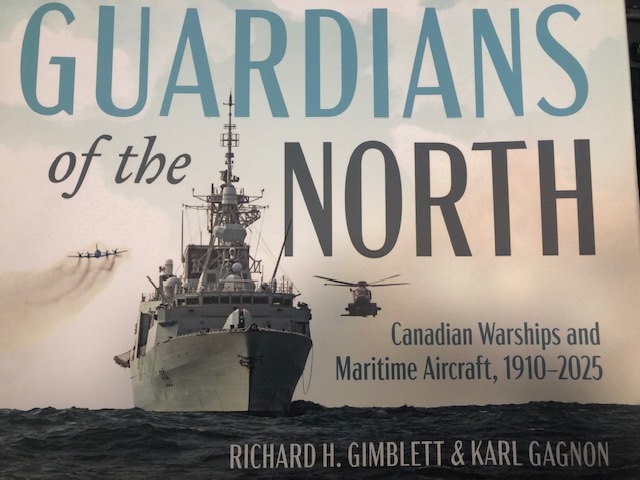
Guardians of the North. Canadian Warships and Maritime Aircraft, 1910-2025. By Richard H. Gimblett & Karl Gagnon. Dundurn Press, Toronto. (dundun.com; @dundurnpress.com). 2025. 383 pp. (275 X 215mm. ISBN: 9781459755550; epub: 9781459766667. $CDN60.
Reviewed by CDR Fraser M. McKee, Toronto
This comprehensive reference volume should be on the shelves of every Canadian who has an interest in its naval vessels and aircraft from the origins of the Royal Canadian Navy (and even slightly before) until today’s proposed new destroyers and maritime patrol aircraft.
For every one of the nearly 50 classes of ship that has borne the category of ‘H.M.C.S.’, there are descriptions and tables accounting for every single ship. The inclusion of similar descriptions and tables for the dozen aircraft that the Navy has employed, along with shore-based maritime patrol aircraft operated by the RCAF, makes this an absolutely unique and very valuable addition – fully one-third of the volume is given over to naval/maritime aircraft. A reference, certainly, but more than that – a class-by-class description and illustration of every one, complete for the first time.
However, the real prize for readers is two-fold: Firstly, the hundreds of accompanying ship drawings by naval artist Karl Gagnon are in themselves well worth the large volume’s acquisition – for personal pleasure and information or as a gift (some readers might be tempted to obtain a second volume to cut-out-and-frame many of them). A few of the profile drawings are rare, such as the pre-1910 Fisheries Protection Vessels and HMCS CANADA; elsewhere, for HAIDA (illustrating the famous Tribals) there are three page-wide views, showing her as in each of 1944, 1953 and 1960. Tthere also are three corvette drawings – as first built, an extended fo’c’s’le increased endurance version, and a Castle class. Photographic imagery is at a minimum, typically one or two per class, given that other histories have covered them adequately.
The second, and most valuable and fascinating read, is the two to six page text sections by Dr. Richard Gimblett, lately RCN Command Historian, for each class, discussing their origins, in-service changes and modifications, and eventual disposals. These make for briefly told but immensely useful additions to one’s knowledge of the development of each class of ship. The internal naval and Governmental acquisition problems, the ‘why’ of design decision resolution, of financing within budget restraints, of building with maximum Canadian participation – all these aspects are covered, often for the first time, and certainly the first time all in one reference volume. For those wishing even more detail, for each of the classes there is a “Suggested Further Reading” of other volumes more specific to the class, from carrier to corvette to Armed Yachts, and even the two RCN sail training vessels.
In all there are 48 ‘chapters’ of class of ships, and a dozen types of aircraft operated by RCN, RCNR and RCAF air crews. There are four appendices covering: ship classes operated; aircraft specifications; Air Squadrons by number; and weapon fits. Finally, there sections for acronyms and abbreviations, a list of ‘official histories,’ and comprehensive online references.
Just to select a few items that caught this reviewer’s eye on perusal: Bringing it fully up to the present, there is a review of the newly semi-approved modified RN Type 26 destroyer with reference to the Australian’s same selection, and of the RCAF’s Boeing ‘Poseidon’ patrol aircraft. In the summary of the fleet auxiliary oilers such as ASTERIX, there is a brief review of Vice Admiral Mark Norman’s court case when he was charged with and absolved for giving private information to the public when his Navy had no fleet support ships operational, making her acquisition essential. There is a brief review of the post-2nd World War wished-for plans for a modest East and West coast balanced fleet, very much in accord with Admiral of the Fleet Sir John Jellico’s 1919 Report on the same lines. We’re slow learners.
This spectacular volume is a ‘must have’ for anyone with an interest in the RCN, past, present or future. A review could extend for pages, but suffice to say, while there have been a hundred fine volumes offered of the RCN’s ships in total, by classes such as its cruisers, aircraft carriers, destroyers, frigates, corvettes, even the wartime armed yachts and two sail training ships and so forth, down to the most minor types, this reference is unequalled in scope. With the numerous and meticulous colored drawings of every class of ship as well as many individual ones as well, it is both an essential reference and a marvelous coffee table volume.