
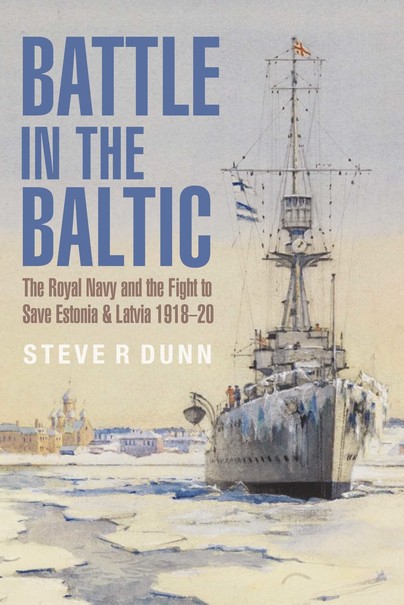
Battle in the Baltic. The Royal Navy and the Fight to Save Estonia and Latvia 1918-20. By Steve R Dunn. First published in hardback by Seaforth Publishing, Barnsley, in 2020. Reprinted in paperback by Seaforth Publishing, Barnsley, in 2026. ISBN 978 1 3990 9655 3 (Paperback) ISBN 978 1 5267 4274 4 (E publication)
Reviewed by David Hobbs
Steve Dunn has written a number of books for Seaforth Publishing about naval operations before and during the First World War and his name will, therefore, be familiar to many ANI members. I reviewed the original hardback edition of this book for the ANI in early 2020 and my comment that it was a very readable account of an important but little known campaign that still has relevance today appears as the leading quotation on the back cover of this paperback reprint. Since the first edition’s publication, Battle in the Baltic has assumed even greater relevance as an important source of historical background after Russia attacked Ukraine in 2022 and has shown open hostility towards the continued independence of the Baltic Republics, Poland and Finland, all of which are now members of NATO.
Steve Dunn’s book describes the measures taken by the Royal Navy in 1919 to defend the nascent Baltic Republics, explaining how power deployed from the sea countered operations against them by German troops that were unaffected by the armistice in the west and by both White Russian and Red Bolshevik armies that sought to absorb the new republics into their own polities. Between 1939 and the collapse of the Soviet Union the Baltic Republics were absorbed into the USSR but having subsequently regained their freedom they once again fear attack. As recently as 9 July 2026 the UK signed an agreement with NATO allies that border the Baltic to create a standing naval force charged with deterring Russian aggression in the region so the need to defend the Baltic Republic’s independence is far from over. UK ground and air force detachments have already been rotated with other NATO forces in the region and their readiness has been tested on an almost daily basis by Russian probes. The continuing influence of naval power in the Baltic since 2022 has, therefore, elevated the importance of Steve Dunn’s book. This reprint is, therefore, timely and makes affordable copies of an excellent book available to a wider potential readership.
Significant naval forces were deployed to the Baltic by the RN from November 1918 to the beginning of 1920 with an overall total of 238 ships involved and a daily average of 88 in the second half of 1919. There were significant losses; twenty officers and 108 men were killed and a light cruiser, two destroyers, two sloops, one submarine, an Admiralty drifter, ten light craft and a stores carrier were sunk. Every ship had to operate in waters that were inadequately charted and which contained mines laid by German, Russian and British forces, many of which had broken loose from their original anchors. For most of 1919 the force was commanded by Admiral Sir Walter ‘Titch’ Cowan but the British Government never adequately described the mission it expected his force to perform or stipulated any specific rules of engagement. The use of force whenever he sought permission for it was dealt with on a case by case basis. The British Government was close to bankruptcy after the First World War but felt that it had to do something in the Baltic. A limited intervention by the Royal Navy seemed to be the ideal solution since putting troops on the ground would have taken events to a significantly higher dimension that would certainly be expensive and probably lead on to wider conflict. The British ships used their guns against Germans, White and Red Russians at various times and carried out strikes against the Red Fleet at Kronstadt with motor torpedo boats which sank several capital ships and prevented it taking a more active part in the conflict. Throughout 1919 the austere and war weary British Government vacillated, limiting involvement with its concomitant expenditure on the one hand and a half-hearted desire to prevent the advance of Bolshevik forces into the Baltic states on the other. Parliamentary indifference led to political constraints that forced Admiral Cowan’s to fight a limited war within which he tried to take the most appropriate action in circumstances that could change rapidly, arguably foreshadowing mistakes of strategy that would be made in later limited conflicts including Korea, Vietnam, Iraq, Libya and Afghanistan. As the author observes on page 259, limited war makes little sense when subsequently analysed as Admiral ‘Jacky’ Fisher pointed out at the First Hague Peace Conference in 1899. ‘Moderation in war is imbecility’ he proclaimed. ‘Hit first, hit hard and keep on hitting’ was his credo. Instead, as in the Baltic in 1919 and many limited wars since, servicemen have been sent into harm’s way with inadequate resources and their arms metaphorically tied behind their backs by political and societal constraints.
Despite the indifferent attitude to operations within Prime Minister Lloyd George’s cabinet and his government’s failure to accurately describe what it expected the navy to achieve, the RN tackled operations with its usual determination and achieved some remarkable results including the award of three Victoria Crosses to officers who attacked the Red Fleet in motor torpedo boats. One of the recipients of the VC, Commander Claud Congreve Dobson VC DSO RN went on after his time in the Baltic to serve with the RAN as the executive officer at the Flinders Naval Depot in Victoria between 1922 and 1925.
Despite every hurdle placed in its way by hostile forces and the British Government’s determination to avoid greater involvement the RN was able to dominate the Baltic and its gunfire supported Estonian and Latvian volunteers against their various enemies. Its success can be measured by the fact that the Baltic states retained their independence until being forcibly absorbed into the USSR after the Second World War. Memorials to the gallant sailors who died helping them to achieve their original independence have survived, however, and annual ceremonies commemorate them. On reading this book through for the second time I was engrossed by the author’s very well structured description of this little known campaign and struck by the similarity between the situation in 1919 and contemporary events in the Baltic as they unfold in news bulletins. This is an important book that deserves a place on the shelves of anyone interested in limited war operations, the development of power projection from the sea and the many and various tasks undertaken by the Royal Navy in its recent past. I give it my highest recommendation.