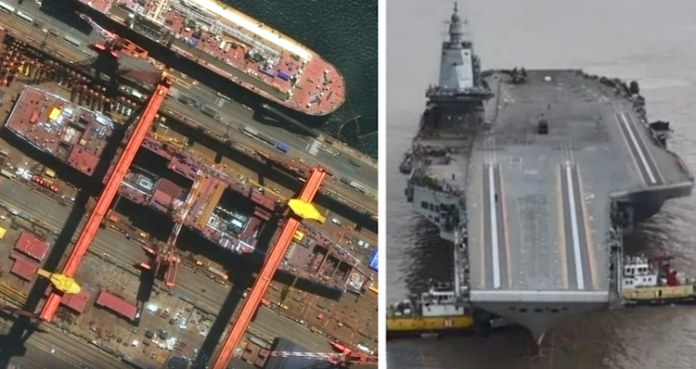
Satellite footage of the Dalian Shipyard in northern China has confirmed that construction of the country’s first nuclear-powered aircraft carrier is progressing rapidly, positioning the warship for completion in the early 2030s and service entry before the middle of the decade, Military Watch reports.
In less than a year, prefabricated hull components have been assembled into a clearly recognisable hull, which analysts have noted highlights the unique speed and scale at which China’s maritime industrial base has been able to operate. Signs of rapid progress in construction follow a U.S. Department of War report assessing that the Chinese People’s Liberation Army (PLA) Navy aims to field six additional aircraft carriers capable of accommodating fixed wing manned aircraft by 2035, bringing the total to nine ships.
The Jiangnan Shipyard where the Fujian was constructed is expected to continue the construction of supercarriers alongside the Dalian Shipyard, and may exclusively produce conventionally powered vessels. A combination of carriers with both types of power systems could provide the Navy with an optimal mixed fleet for operations in the Western Pacific, and operations further afield such as in the mid-Pacific, Middle East, and Indian Ocean, where the greater range provided nuclear power would be invaluable. Conventionally powered aircraft carriers have the advantage of much lower procurement and sustainment costs, lower maintenance needs, and significantly lower servicing times, which is expected to make them highly preferable for regional operations where the additional range of nuclear powered ships is not required.
New images of China’s first nuclear supercarrier in November showed the installation of a nuclear reactor containment structure, confirming assessments that the ship would be nuclear powered. This followed reports as early as November 2024 indicating that a nuclear reactor prototype for surface warships was being constructed near the city of Leshan. Images have also confirmed that infrastructure expansion is underway at a naval facility in Qingdao, Shandong Province, including the expansion of piers and the building of demagnetisation facilities. The facility currently serves as the home port for the aircraft carrier Liaoning, and is expected to eventually accommodate a supercarrier in the early 2030s. Rapid progress on the Chinese carrier program has been made as the U.S. Gerald Ford class carrier program has been cased with continuously worsening delays and serious performance issues.