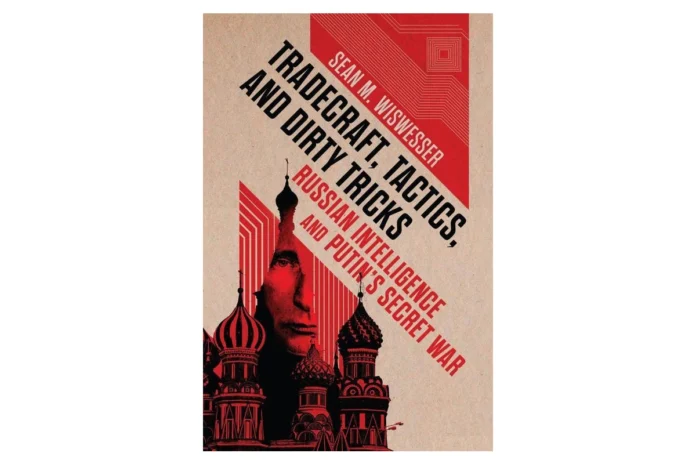
Tradecraft, Tactics, and Dirty Tricks; Russian Intelligence and Putin’s Secret War. By Sean M Wiswesser. Naval Institute Press, Annapolis, 2026
Reviewed by Tim Coyle
There are many subsets of Intelligence (‘-ints’) and how it is collected. These include – but are not limited to – acint, comint, fisint, osint and ‘rumint’. But the most well-known and ancient of these ‘-ints’ is Human Intelligence (Humint) with its dark recesses which has exposed the starkness of the Secret War as the stuff of endless intrigue over generations.
It transfixes adherents worldwide with fiction, film and nonfiction exposés of ruthless skullduggery, pitiless exploitation and traitorous actions through ideological motivation, or more likely, financial gain. The ‘trade’ smugly regards it as ‘The Second Oldest Profession’ .
Perhaps the greatest spy story authors are Ian Fleming and John le Carre. Fleming served in naval intelligence in World War 2 and le Carre worked with the British secret service and their writings led to a postwar boom in spy stories and films.
The fictional stories are paralleled by equally fascinating true tales of intelligence agents and agencies exposing historical disasters and successes.
The author, Sean M Wiswesser, is an operational humint insider. A 30-year Central Intelligence Agency (CIA) veteran, he brings his lifetime of experience as a national security professional to this ‘nuts and bolts’ assessment of Russian intelligences services’ practices, procedures and professionalism (known as ‘tradecraft’).
A fluent Russian speaker, Wiswesser served as a senior CIA operations officer who worked closely with associated US and Allied agencies in battling the main Soviet and later the Russian Intelligence Services (RIS), comprising the Foreign Intelligence Service (SVR), the Federal Security Service (FSB – formerly KGB), and the Main Intelligence Directorate (GRU).
Even for the hardened spy craft enthusiast, Wiswesser’s narrative is of such depth and analysis that few readers would rate the book anything less than a truly superb study. The author gives due credit to related narratives of intelligence agents’ contributions and uses these to enhance his analyses.
Wiswesser worked for years with RIS double agents and formed close and, in some cases, personal relationships. From these associations, and close observations and interactions with the Russian agencies, he formed a professional opinion of their effectiveness. They are shown to be wholly corrupt with agents and managers completely absorbed in self-enrichment; ideology and patriotism are very much secondary. Those few ideologists who enlist for love of country are soon disabused as they are trampled on by bottom feeders and self-servers. Despite this, the RIS continues to present a formidable opponent to Western national security. Russian corruption and ruthlessness have a capability all is own. The authoritarian and ruthlessness inherent in the ‘siloviki’ (the Russian ruling elite) has its foundations in centuries of oppression of its people from Ivan the Terrible and his dreaded antecedents and successors up to the present.
Wiswesser’s poor assessment of the Russian tradecraft cannot be sheeted home to American triumphalism; his interactions with these services over decades equips him to form objective views of their shortfalls.
Wiswesser’s credibility is strengthened by his Russian language skills. Majoring in Russian at university he forged a love of the language and its people and culture but hated how the Soviet, and now the totalitarian Putin regime and its security forces, treats them. He was able to instil trust in RIS contacts largely because he had no Russian familial ethnicity which normally raised suspicions in Russian interlocuters. He enhanced his language skills by engaging with all manner of people including long-term associations with two émigré Russians who worked in compartmented seclusion in the CIA headquarters in the best le Carre tradition.
So, what will the reader glean from Wiswesser’s Tradecraft, Tactics and Dirty Tricks? They will learn about:
- the main Russian intelligence agencies, the ‘Rezidentsiyas’ in the embassies and follow a RIS agent in his daily work ;
- RIS training and preparation;
- Surveillance techniques and street tradecraft;
- Double agents, and
- Operational technology and special operations.
Specific Russian tradecraft examined in detail includes Dead Drops, ‘Ghost Stories’, Agent Signals, ‘Sticks and Bricks’, Double Agents, Useful Idiots, ‘Swallows’, Sabotage and Active Measures.
Of particular interest is the last chapter: ‘The RIS in the Ukraine War’. This is a most valuable revelation of the incompetence of Russian intelligence in failing to assess the likelihood of Ukraine fighting back and reporting to Putin what he wanted to hear – a classic case of lack of courage in telling truth to power. This is a time-worn failure in authoritarian regimes and Russia is not the only culprit in history – examples exist in some Western administrations.
Even though Wiswesser highlights the RIS deficiencies, he recognises US intelligence agency failures exemplified by traitors such as Hanssen and Ames. He is also critical of the current US Administration’s funding cutbacks to national security agencies, the State Department and foreign aid funding which is diminishing US influence internationally.
In the Epilogue, Wiswesser reviews his working with Russians over his career. Here he reveals some of the personal relationships formed over time and shows that human feelings can extend through the shadowy Secret World.
In summary, Sean Wiswesser has largely demystified the arcane RIS and forensically delved into its modus operandi. Spy story enthusiasts will be enthralled with the level of analysis and the tradecraft terminology. There may well be some covert professional agents who could learn from this CIA master agent. In any event Tradecraft, Tactics, and Dirty Tricks is a fascinating true-life dive into the West’s favourite ‘bête noire’.