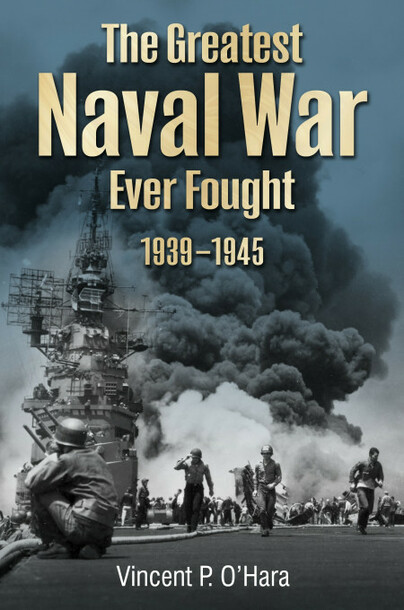
The Greatest Naval War Ever Fought 1939-1945. By Vincent P O’Hara. Seaforth Publishing, Barnsley, 2026. ISBN 978-1-03615-310-6 (Hardback). ISBN 978-1-03615-311-3 (Epub)
Reviewed by David Hobbs
A naval historian and author who graduated from the University of California, Berkeley, Vincent P O’Hara lives in Chula Vista, California. Prior to this book, his most recent title was Fighting in the Dark, also published by Seaforth, in 2023. He explains in his introduction that The Greatest Naval War Ever Fought is the result of a lifelong interest in naval and maritime affairs, warships, sailors and the sea.
He has authored, co-authored or edited seventeen books on the First and Second World Wars at sea and regards the research carried out for his earlier works as providing the basis for this work. He explains that the text follows a number of themes which include questions of command and national leadership, the integration of new technologies such as radar, the influence of logistics, particularly underway refuelling, the development of carrier aviation and both intelligence and systems for self-appraisal. This is not, therefore, a short history of the Second World War at sea per se but and analytical look at aspects of the way in which the conflict was fought.
To give examples, the loss of HMAS Sydney in 1941 is covered in just seven lines on page 106 within a paragraph on German commerce raiders. (In Volume I of G Hermon Gill’s History of the RAN it fills nine pages with a map). Sydney’s action against the Italian cruiser Bartolomeo Colleoni is not mentioned. The British Pacific Fleet, BPF, is only mentioned in brief sentences on six pages.
Despite some early doubts, I found that the text is indeed thought-provoking and encourages the reader to understand the conflict in different ways. His observation that the German Navy was better prepared for open ocean warfare during the hunt for Bismarck and Prinz Eugen than the RN in 1941 was well made. The Germans had logistic re-supply ships positioned throughout the Atlantic but contemporary RN doctrine lacked a similar capability, choosing instead to rely on short sorties from established bases. Then I turned to page 118 on which O’Hara describes the damage inflicted on the aircraft carrier Illustrious by German dive-bombers on 10 January 1941. He writes that ‘…most accounts credit deck armour as the flattop’s salvation’ and gives this line the source note ‘3’. On turning this up I was surprised to find my own book British Aircraft Carriers given as the primary reference and Donald Macintyre’s The Battle for the Mediterranean as the second. What I actually wrote in the former was in a section headed ‘Was the armoured deck a good idea’ (on page 89, not 155 as printed in the source note) was that a carrier with effective hangar deck armour and an open-sided hangar topped by a light-structured flight deck might have survived as well or better and had the potential to operate considerably more aircraft. Most bombs fell outside the armoured part of the flight deck and the one bomb that did hit penetrated it and exploded inside the enclosed hangar causing considerable damage. The source reference gives the impression that my account credited the armoured deck with Illustrious’ salvation. It did not. Macintyre’s account ( which does have the correct page number) is said in the same source note to ‘contain the same narrative’ although written half a century earlier. In fact, the two differ since Macintyre wrote ‘but for her armoured flight deck which absorbed the shock of some of the hits, the Illustrious must have been sunk’. My book stressed that the most positive feature of the design was the protection given to bulk avgas stowage without which the ship, like several damaged US and Japanese carriers, would in all likelihood not have survived. At least O’Hara goes on to mention this later in his paragraph.
Page 119 contains an opinion stated by the author which is based on a major error. He states that the appearance of German aircraft had ‘caught the Mediterranean Fleet flat-footed ‘because Illustrious was not equipped with radar’. Had O’Hara studied the section on Illustrious in British Aircraft Carriers more closely he would have seen that she was actually the first aircraft carrier in the world to be completed with radar. The Admiralty decided in 1939 to delay her completion by two months in order to fit a Type 79Z air search radar. O’Hara appears not to have included Derek Howse’s important book Radar at Sea in his research. Had he done so, he would have learnt about the carrier’s important work in radar-controlled fighter direction and even the names of the people in Illustrious who made it work so well. O’Hara’s view seems oddly at variance with Howse’s statement on page 64 of Radar at Sea that Illustrious‘established something near to air supremacy over the Eastern Mediterranean’. His apparent lack of research into this particular question led to him to make the implied criticism that the Admiralty distributed responsibility for the formulation of doctrine to fleets rather than doing it centrally. This would be an unfair view because fighter direction was evolving dynamically in action at sea; that was where the experts were in 1941. As soon as the Admiralty absorbed details of the latest aircraft direction techniques using radar they were promulgated, like other warfare disciplines such as gunnery, submarines and mine warfare, in the confidential ‘Progress in …’ series pamphlets and distributed to the fleet. Aircraft Direction was included as a complete section within the Naval Aircraft Progress series, CB 3053. These do not appear in O’Hara’s bibliography.
On a more positive note, O’Hara includes small campaigns that are not written about widely. These include the fighting between Thailand and France mentioned on page 95. The bulk of the book reads and although I did not see any other errors, I will make some observations. Despite the author identifying command arrangements as one of his themes, he makes no mention of the interesting command arrangements within which the BPF operated alongside the USN command structure during 1945. At the time these were, as far as I know, unique. O’Hara frequently makes comparisons between the way in which naval aviation was deployed and used by the USN and RN and I expected him to draw conclusions from the loan of HMS Victorious to form part of the US Pacific Fleet during 1943. Her RN naval air squadrons operated USN aircraft using USN techniques and tactics and she operated as part of CARDIV 1 under Rear Admiral D W C Ramsay USN who flew his flag in the USS Saratoga. Victorious’ superior fighter direction capability but smaller deck led to a mix of RN/USN fighter squadrons operating from her while Saratoga’s larger deck and more comprehensive air weapons stowage led to an RN Avenger squadron joining similarly-equipped USN units in her. O’Hara does mention Saratoga being lent temporarily to the British Eastern Fleet in 1944 but his failure to mention the loan of Victorious to CinCPAC command is surely a significant opportunity missed.
The Greatest Naval War is a complex book in which the author capitalised on his long term studies to create an analytical work that covers an enormous subject within a reasonably-sized book. The titles included within the 14-page bibliography were clearly insufficient for the task, however, and the author would, undoubtedly, have benefitted from reading more widely. Because of the comments I made above, I would advise potential ANI readers to look carefully at the content before deciding whether or not to buy this book. Having said that, however, O’Hara does achieve his aim of stimulating readers to think more widely about the conflict and he does make clear the lasting importance of sea power. Thus it does have merit and that is good.