You probably know what a Freedom of Navigation Operation (FONOP) is. But do you really?
Maritime disputes have thrust international law into conversations about defence and strategy in recent years.
But international lawyers and strategic analysts still talk past each other. The former speak a language that doesn’t easily translate without a lot of explanation.
The latter often over-estimate their understanding. They can be dismissive of international law, or simplistic in their advocacy of it.
You might support the ‘rules-based order,’ or you might criticise it (hopefully you do both). Regardless, you’ll be more persuasive if you understand the rules in question.
If you think FONOPs are only about strategic signalling, or supporting one country and deterring another, then you don’t understand them as well as you assume.
What are FONOPs?
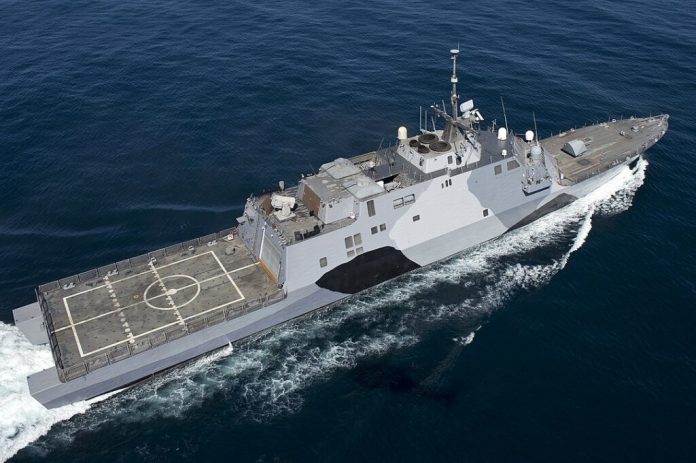
The US Navy operates in waters around the world to underscore its right to do so. It generally does this where it thinks other governments are unreasonably trying to limit where foreign vessels (and aircraft) can go, and what they’re allowed to do when they’re there. In other words, their freedom of navigation.
It calls these activities Freedom of Navigation Operations (and sometimes other things like ‘operational assertions’).
Contrary to popular assumption, these operations challenge the claims of friends as well as adversaries. Though unsurprisingly, FONOPs against a country like China are bound to generate headlines.
The US is the only country that maintains a comprehensive FONOPs program. But other countries will sometimes conduct similar activities.
There’s legal logic behind FONOPs.
What’s the legal logic?
International law is shaped by behaviour. If enough countries start acting a certain way, and do so with a sense of legal right or obligation, that behaviour can solidify into a rule of law binding all countries.
Courts apply defined criteria to determine if something has evolved from a trend into binding international law. See the below section on customary international law for more context.
For the time being, two points are important.
First, international law emphasises consistency and reciprocity. If you expect vessels to act a certain way in your waters, it’s important that your own vessels act that way in other countries’ waters, or your legal position looks shaky. (As do your political and policy stances).
Your position also looks weak if you inconsistently defend it. Selectively asserting your claims, or making exceptions for some countries and not others, is a good way to undermine your position.
Second, international acceptance is key to a claim or habit evolving into law. This acceptance doesn’t always have to be explicit. Silence might count. So might behaviour.
An example. Say a country tries banning foreign navy vessels from entering a stretch of water. You don’t recognise this excessive new claim, but you tell your navy to avoid the area just in case, so as not to inflame tensions.
This might be a prudent decision. But it could also be construed as complying with the new claim. So you’ll want to consistently clarify to the country concerned (and the international community) that your avoidance of the area doesn’t reflect recognition or acceptance of the claim.
When the US conducts a FONOP, it’s not leaving any room for misinterpretation. It’s demonstrating through words and actions that it opposes what it sees as an unreasonable limit on freedom of navigation.
What does this have to do with the US Navy?
In practice, FONOPs usually involve navy vessels sailing through a body of water and making a record of it. It might also involve conducting some activities that the coastal state improperly seeks to ban while they’re at it.
Why the Navy? A few reasons occur to me:
- It has the resources. It has one of the biggest fleets with the widest presence in the world (and it responds to US government tasking, which civilian ships don’t – and shouldn’t).
- Many of the claims that FONOPs challenge seek to limit what foreign military vessels are allowed to do. It makes little legal or political sense to challenge those limitations with civilian vessels.
- US Navy ships (and aircraft) are state vessels with certain legal protections. They’re also a more formidable target than civilian vessels if anyone seeks to harass or damage them.
FONOPs are only one part of a broader suite of tools the US uses to uphold freedom of navigation norms, which includes diplomacy and education initiatives.
The US is just one country, so its behaviour alone doesn’t make or break international law. But having been so powerful over the last few decades, its rejection or acceptance of certain norms has historically carried disproportionate weight.
These operations do also largely reflect international consensus – so it is usually defending rules that have been largely settled.
Not every international lawyer believes FONOPs are necessary. Some question why the US can’t just state its objections without also doing so physically.
That’s a legitimate debate to have.
What is freedom of navigation?
The ability to move unimpeded through waters where international law says you can – and to do what you’re entitled to in, on and above the water when you’re there.
To understand the contemporary discussion, consider two historic ways to conceive of the oceans:

Taken to their extreme, neither stance is practical. That’s why much of today’s law of the sea seeks to balance the legitimate rights of coastal states with those of the broader international community.
A country’s rights in a particular part of its surrounding waters – and vessels’ rights to navigate in those waters – are usually determined by how close that water is to a country’s coastline.
Territorial waters usually extend as far as 12 nautical miles from land. Within them, countries can basically enforce laws as they would domestically. Unlike on land, foreign vessels can still pass through (subject to conditions). They don’t need things like visas and passport stamps unless they’re planning to stick around.
Exclusive Economic Zones usually extend up to 200 nautical miles from land. A country has exclusive rights to determine who can fish there, or exploit other resources. But vessels are otherwise free to come, stay and and go as they would on the high seas.
These are just two examples. You can see a more comprehensive guide here.
Where do disagreements on freedom of navigation lie?
All countries agree that freedom of navigation matters. But some disagree on the fine print: what exactly can vessels do, and where?
I’ll provide a list of indicative disagreements later. But one shortcut is to look at the US’s yearly summaries of which countries were subjected to FONOPs and why.
A glance at those summaries makes two things obvious.
First, many of the countries whose position on freedom of navigation differs from the US are in Asia – and many are former colonies. Asia is at the heart of growing global competition, including over maritime norms. And former colonies can be particularly sensitive to the idea of foreign navies conducting gunboat diplomacy off their coastlines.
Second, although the range of contested claims is quite broad, a recurring theme relates specifically to the activities of military (or other official) vessels and aircraft.
We hear a lot about China failing to respect freedom of navigation (for example, it prevents Philippine fishers from operating where they’re legally permitted.)
But a key area of disagreement between the US and China relates specifically to what foreign military vessels and aircraft are permitted to do in waters off islands that it claims as its territory.
When the US conducts a FONOP in the South China Sea, it’s often addressing those stances rather than taking a ‘side’ in territorial disputes, even though the media sometimes casts it that way (with the US government sometimes blurring the lines too).
But isn’t this stuff settled in UNCLOS?
Largely.
But when some countries ratified the United Nations Convention on the Law of the Sea (UNCLOS), they filed clarifications and caveats about how they defined freedom of navigation.
Filing these clarifications doesn’t exempt those countries from adhering to the treaty, or allow them to opt out of provisions that relate to freedom of navigation. But it does demonstrate that not all countries share the same preferences and may like to see norms evolve over time.
Additionally, it’s important to note that UNCLOS isn’t the only source of maritime law. In some cases UNCLOS reiterates and strengthens principles that already existed, and continue to exist in parallel. This means there are some laws of the sea to which all countries are bound even if they didn’t sign on to UNCLOS.
That’s why the US considers itself bound by, and incentivised to protect, provisions in UNCLOS that reflect pre-existing customary international law.
Something becomes customary international law when:
- lots of countries comply with it and
- they comply because they see it as a legal obligation (or right) rather than, say, a courtesy.
These two criteria are known as ‘state practice’ and ‘opinio juris.’ They’re quite subjective criteria, so international courts spend a lot of time considering whether something meets the threshold.
You might notice that FONOPs are structured to reflect the two criteria for something to become customary international law. They demonstrate a consistent state practice (by operating their ships in the way they do). And they demonstrate opinio juris through statements (and vessels’ responses to challenges by other militaries, which is usually some version of ‘I am a state vessel operating in line with international law’).