
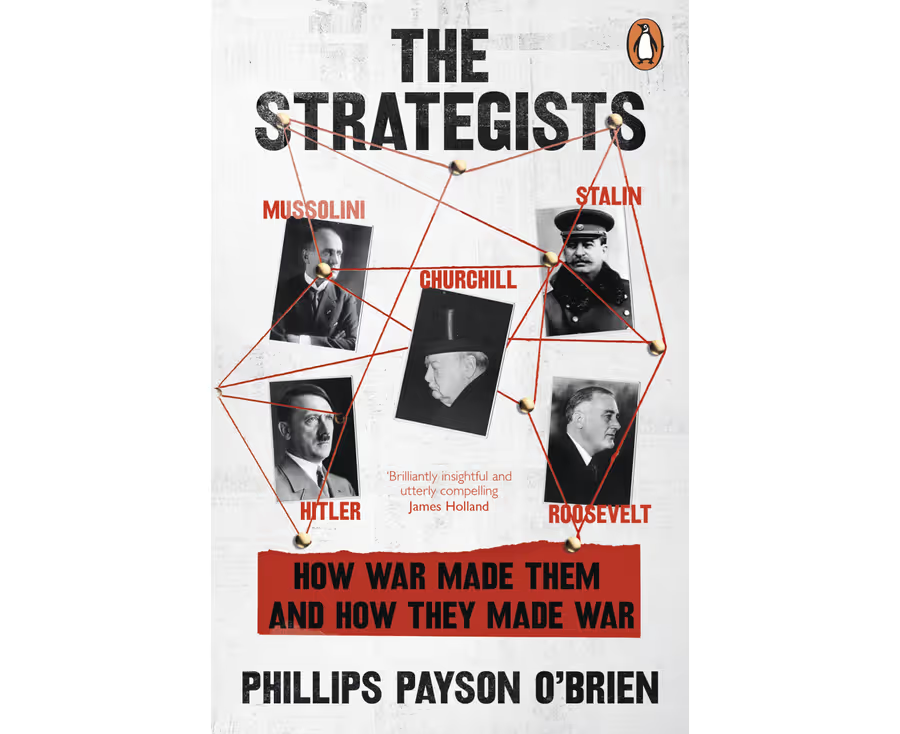
The Strategists. Churchill, Stalin, Roosevelt, Mussolini and Hitler – How War Made Them, And How They Made War. ISBN: 9781405966597. Penguin.
Reviewed by Andrew Davies*
The Great Man theory of history, which posits that history is shaped mainly by hugely influential and singular individuals, was once the primary form of historical writing. It has largely fallen out of favour in academia in these post-postmodern days, being regarded as overly simplistic and representative of a dated hierarchical and patriarchal worldview. In his 2024 book on Churchill, Stalin, Roosevelt, Mussolini and Hitler, however, Phillips O’Brien is having none of that. (From The Strategist. The Australian Strategic Policy Institute.)
He concluded: “Though these five men were supposedly parts within large, well-staffed states with layers of bureaucracy, they individually made the crucial choices over strategy and most of the time were able to see those choices enacted. As such, the idea of there being a clear and logical national strategy remains a positivist dream but an actual myth.”
In the book, The Strategists, O’Brien builds his case over 436 pages, and ultimately makes a reasonable, but not entirely convincing, argument. In support of his notion, it’s hard to see how World War II in Europe would have taken the course that it did without the nationalist and racialist pathologies of Hitler driving German ambitions. But, conversely, the conflict between Japan and the United States had been brewing for decades. American studies of possible strategies for countering Japanese power projection began less than a year after Japan’s victory over Russia in 1905, and the first US Strategy of the Pacific was penned in 1919, followed by the first War Plan Orange in 1923. At least some of the events of 1939 to 1945 were largely independent of the individuals in high offices.
However, it’s fair to say that the prosecution of the war depended on those personalities in important ways. The invasion of Italy in 1943 was almost entirely down to Churchill’s ambition to successfully find a soft underbelly to Europe this time around (undaunted by the Dardenelles fiasco in the previous war). Roosevelt firmly backed a cross channel invasion of France, but the US found itself dragged along for a strategically doubtful campaign in Sicily and Italy. It washed its hands entirely of yet another Churchillian tilt at windmills in the disastrous 1943 Aegean campaign following the surrender of Italy, however.
Similarly, the Soviet Union’s woeful unpreparedness for a German invasion in 1941 owes much to Stalin’s overconfidence in the strength of his relationship with Hitler. The lack of prepared defensive lines and the paucity of talent in officer ranks—largely due to purges instigated by Stalin—gave Germany early successes, before Hitler’s overconfidence and micromanagement of battlefield affairs gave them back from 1942 onwards.
O’Brien offers a well-executed and informative biographical section on each of the five leaders, with emphasis on the experiences that most strongly influenced their outlook on military and foreign affairs—often during World War I. Because of the importance of the five principals, there are many previous biographies, but the focus here works well. If nothing else, a careful read of this book would help those making comparisons between contemporary figures and Hitler, Stalin or Mussolini to better match the psychopath. In an interesting analysis, O’Brien argues strongly that, of all the national leaders scrutinised here, Stalin was the one who demonstrated the greatest adaptability, growing into the role of a successful wartime leader after having started with a poor grasp of military affairs and strategy.
Through the book we see Stalin grow in stature and power, while the others are progressively diminished. On the allied side Roosevelt’s terminal decline sapped his energy, while Churchill was increasingly sidelined as the US, with its military-industrial might, came to dominate both the planning and execution of major operations. By the end, Churchill was left trying to cling onto the British Empire against Roosevelt’s wishes, and he failed to have any notable influence on Stalin where Poland was concerned. Hitler and Mussolini did not survive to see the end of the war their psychopathies had led their nations into.
There are some glaring omissions. The five subjects are all from the Euro-Atlantic part of the world, so the very important Asian players get short shrift. Chiang-Kai Shek and Mao Zedong get two and one index references, respectively, though that beats Japan’s Prime Minister Tojo and Emperor Hirohito, each with none at all. The psychology of leadership in Japan in the 1930s and ’40s that launched an essentially suicidal war is a fascinating story—but you won’t find it here. (Try Eri Hotta’s Japan 1941 instead.) Given that Italy’s role in the war—swiftly losing its overseas empire before being relegated by its senior axis partner to bit-player status—was relatively minor, surely the Japanese angle is more important? Similarly, don’t expect to find anything on the leadership within Commonwealth nations.
Nonetheless, readers of The Strategist are likely to enjoy The Strategists. Despite covering much well-trodden ground and leaving out significant aspects of the story, there’s always room for a new angle, and this is a well-written and cogent work.