
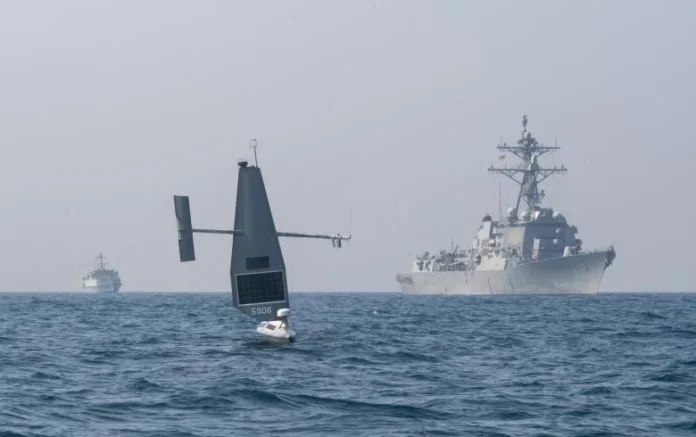
Buoyed by billions in investments into robotic systems, the Navy is considering how it will manage the swarms of unmanned surface, subsurface and aerial drones throughout the fleet, US Naval Institute News reports.
Robotic autonomous systems (RAS) are being positioned as a key part of the Navy’s future as a hedge force – a mix of forward-deployed manned and unmanned tailored to specific geographical areas. Integrating the RAS into the fleet is now a major effort for the Navy, Chief of Naval Operations Adm. Darl Caudle said (Feb 2026) while speaking with reporters at WEST 2026.
“It’s a challenge making an ensemble of these types of capabilities in a meaningful way that combatant commanders and Navy component commanders can ask for in a way that solves one of their key operational problems,” he said. “We don’t want this just to be a gadget.”
Currently, the Navy has organized RAS by the domain they operate – surface, subsurface and air – but the nature of how the systems could work together may require a new task force commander, Caudle said.
“This RAS commander, if you will, knows how to command and control these packages of unmanned capabilities to achieve the mission outcomes that the strike group commander may want,” he said. “Where my head is – and we’re not there yet – a RAS warfighting commander, it’s almost a joint task force commander just for these systems alone.”
The concept for how to use drones isn’t fully formed but leaders have pointed to the “hellscape” defense against a Taiwan invasion by the People’s Liberation Army Navy as a possible template. Hellscape would coordinate swarms of lethal aerial, surface and subsurface drones to stymie amphibious ships and landing craft from reaching across the 90-mile-wide Taiwan Strait. In the air, that could include loitering munitions, and on the surface, that could include explosive unmanned surface vehicles and similarly lethal subsurface RAS.
While Caudle said the early testing has been promising, codifying that coordination will be key to how RAS can be applied to the Navy’s future fleet.
“We have got to figure out how to build out these units of force so that they can be asked for in a logical way, and then command and control them,” Caudle said.
The general structure of how the RAS would be employed was laid out in Caudle’s new fighting instructions, which was released this week.
“The Navy must address the associated doctrinal shortfalls, organizational seams and process gaps, including determining how we will allocate RAS in service decisions like strategic laydown, dispersal and global force management,” reads the instructions. “For us to integrate RAS into our standard force delivery model, RAS capabilities must be describable in standard terms, interfaces and outcomes.”
In that vein, newly confirmed Vice Adm. Dougals Verissimo, commander of Naval Air Force Command, said naval aviators are now working through their own concepts to incorporate larger collaborative combat aircraft (CCAs) into the fleet.
Rather than a mass of swarming drones, the CCAs initial promise is to act as wingmen to the Navy’s manned fighters and act at the direction of humans in the cockpit, underway or ashore.
The Navy has contracted with General Atomics, Boeing, Anduril and Northrop Grumman for concept studies of CCAs while Lockheed Martin is contracted to build a ground control station for the aircraft, USNI News previously reported.
While the hunt for new aircraft is underway, Verissimo said he is studying incorporating CCAs into the air wing.
“It may be a [surveillance] system. It may be a weapons delivery system. It may be some type of specific sensing system that [gives] those manned platforms with mission orders the ability to understand the battle space and execute based on their authorities… That’s where we’re heading in how we think and ask for capabilities,” Verissimo said.