
By Tom Sharpe*
The Royal Navy has nine nuclear-powered submarines. Four of them are the Vanguard class, tasked with providing the nation’s strategic deterrent and armed with Trident nuclear ballistic missiles for this purpose. They are entirely taken up by that task.
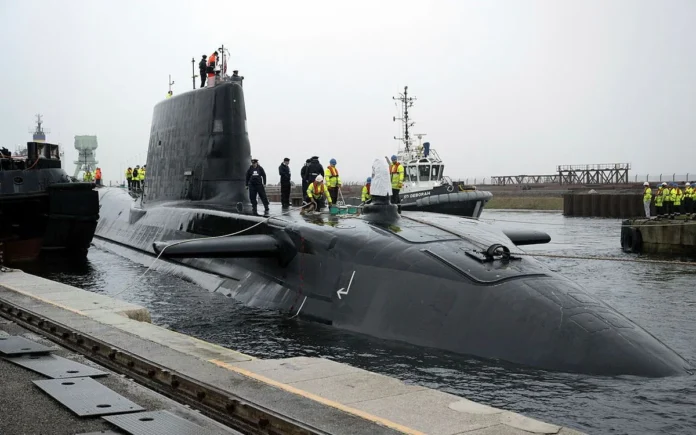
The other five subs are the Astute class, conventionally armed, nuclear-powered attack boats: the only other submarines that the UK has.
Attack submarines like this are an absolutely vital part of our continuous, silent struggle alongside the US in the waters of the North Atlantic. In this struggle we seek to monitor Russian ships and subs, keeping our own deterrent boats undetected and perhaps theirs under surveillance – and also monitor their efforts against critical British, European and trans-Atlantic undersea cables and pipelines.
Of the seven planned Astutes, five are currently in service, one is in a (years long) trials process and one is in build. Even when all seven are operational, that won’t be enough. In the meantime, these boats have had a tricky start to their operational lives, plagued from build by reliability issues (particularly the first ones) and an unforgivable maintenance backlog that has seen some boats stuck alongside for over a thousand days.
Often enough in the past couple of years there has not been a single British attack boat at sea for quite long periods. They are brilliant submarines when working, no doubt, but that has been hard to sustain. Last year we didn’t have enough availability to send a sub with the Carrier Strike global deployment – and a Carrier Strike Group without a submarine isn’t really a Carrier Strike Group.
There is a grim irony here. Now that the Strike Group is back after its long deployment to the other side of the world, the first thing we do with our sole newly working SSN is send her to where they just came from.
The optics of this are terrible. The First Sea Lord recently warned that Britain’s post-war advantage in the Atlantic “is at risk” and that “we are holding on, but not by much”. The now maligned Strategic Defence Review of last year, historic analysis and, frankly, common sense all dictate that the North Atlantic and High North are where we as a maritime nation should be most focused. Our regional seas are essential for our island’s survival: there are underwater threats manifesting here every day and it’s where we can add most value to our allies. Even more pressingly, as Nato wobbles, is now the time to take away one of our key pieces?
If Anson had stayed here, there is plenty of work for her. “Atlantic Bastion” is the name given to the Royal Navy’s plan to cohere underwater operations across all domains in the Greenland, Iceland, UK gap and beyond. Russian submarines are increasingly deploying through this gap and getting up to no good around our Critical Underwater Infrastructure. They must be constantly tracked and our own SSNs are a key part of this large, multinational web.
There are more general contingencies – tracking spy ships, gathering intelligence, special forces work or preparing for rapid escalation – and all these feature on the “things to do” list. Attack boat support for the Continuous At-Sea Deterrent (CASD) of Vanguard class submarines is less critical than many make out: the deterrent boats operate effectively with minimal escort, in fact they prefer it. However, it’s still part of the job – more a matter of helping with the bigger Atlantic picture than actually operating with the missile subs. And let’s not get into the state of the deterrent submarines themselves for now.
On the other side of the argument, this deployment has been long planned as a core part of our Aukus commitment, and bailing out of it would imperil the whole deal. With so few hulls, this crisis is indicative of the Royal Navy’s continuous need to balance exquisite, long-term programmes against reacting to events. Certainly last year’s Carrier Strike deployment gathered plenty of criticism as the Prince of Wales and her group sailed past various potential points of action (most notably the Red Sea) to maintain her beautifully crafted programme. This is a painful but inevitable consequence of simply not having enough ships, and here we are again.
Aukus is much more complex than just providing Australia with nuclear-powered submarines, no matter how important that capability is to them – and it is very important. The technology-sharing part of it is critical too as is the access this gives the US to the same problem facing Australia. In other words, maintaining it benefits everyone. Letting it fail, no matter how difficult that might become, is not acceptable.
And here’s why. No Aukus subs for Australia means no replacement attack submarines for us. The SSN(R) programme is directly and inextricably linked to the Australian version in terms of technology development and follow-on yard capacity. Cancel Aukus and we will have to say goodbye to this absolutely critical capability for a very long time, if not forever. Sending this boat out there now, no matter how painful, or how odd it looks, is a recognition of this.
*Tom Sharpe OBE served for 27 years as a Royal Navy officer, commanding four different warships
This article first appeared in The Telegraph and is republished with the permission of the author.




The Virginia/AUKUS submarine deal is the biggest scam/con job ever perpetuated on Australia by its so called allies UK & USA. All for the same of bolstering their ailing submarine building programs, as well as getting access to Australian naval based for a song!