China’s fast-growing fleet of advanced attack submarines has overtaken Russia’s undersea force in numbers and is rapidly closing in on the size of the U.S. fleet. Compounding the threat is the possibility that the People’s Liberation Army Navy (PLAN) could arm its new attack submarines with an expanding arsenal of hypersonic weapons such as the YJ-20. (From: 1945.)
The Chinese submarine threat to the West is about more than fleet size and the ability to mass. undersea power. It is also important to understand the growth of China’s undersea technological capabilities.
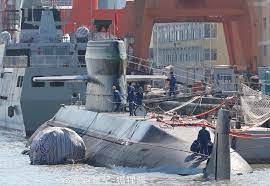
Armed with wake-homing torpedoes, anti-ship missiles, and naval mines, China’s ultra-quiet Type 093A attack submarine is the first air independent propulsion (AIP) undersea attack boat operated by the PLAN.
The boat is coated with anti-sonar anechoic tiles to reduce risk of acoustic detection, has six torpedo tubes, and can launch YJ-18 anti-ship missiles.
While non-nuclear AIP submarines such as the Type 093A are slower, less capable, and less maneuverable than nuclear-powered submarines, they can operate for weeks without surfacing. Oxygen is generated using fuel cells onboard the submarine, allowing it to remain submerged for weeks at a time.
This increases survivability, as it makes the submarine less detectable and increases the likelihood of a successful surprise attack or clandestine undersea reconnaissance mission.
An assessment of the Type 093A submarine in Seaforces Online cites a U.S. Naval Institute analysis explaining that the Yuan-class AIP submarines are primarily intended to operate as anti-ship cruise-missile platforms.
As AIP submarines, they are capable of loitering for long periods of time undetected, placing themselves in position to launch surprise attacks on surface ships from littoral waterways.
Nuclear-powered submarines such as the U.S. Navy’s Virginia-class are faster and much more capable, but their reactors and cooling systems generate an acoustic signature that is more detectable than anything emitted by AIP submarines.
At the same time, advanced Virginia-class submarines have been upgraded in recent years with enhanced quieting technologies, such as coating materials and noise-reducing engine systems.
The PLAN operates an estimated 20 to 25 Yuan-class submarines, a fleet size large enough to hold an area under threat or provide an undersea envelope of protection and surveillance. While the Type 093A might be quiet, however, once detected it is likely to be far more vulnerable to being destroyed—these submarines lack the power, speed, and maneuverability of Virginia boats.
The PLAN is already building its next generation of attack submarines. These seek to integrate nuclear propulsion with AIP. The Type 041 Zhou-class submarine is China’s first submarine with a nuclear reactor.
The hybrid propulsion system integrates a conventional diesel-electric engine with a small, low-power nuclear reactor for AIP. The two systems are intended to augment one another and, ideally, combine the stealth and quieting technology of AIP with the speed, power, and performance of nuclear propulsion.
Type 041 submarines are also built with an “X”-shaped stern, an innovation that adds quieting technology while increasing maneuverability and supporting a smoother, quieter glide path through the water. The U.S. Navy Columbia-class nuclear armed ballistic missile submarine also has an X-shaped stern.
Type O93A submarines could especially threaten Taiwan. The quiet, AIP-enabled submarine might be able to loiter and hide in strategically vital areas key to the undersea defense of the Taiwanese coastline.
Given that Taiwan is roughly 100 miles from mainland China, it seems Type 093A attack submarines might be in position to support a Chinese amphibious attack on the island.