
By Tom Sharpe*
As the lunar new year arrives in 2026, the Chinese People’s Liberation Army Navy (PLAN) continues to grow at an eye-watering rate. With approximate warship numbers nearing 400 and tonnage passing 3.2 million, China has for some while had the world’s largest fleet by vessel count: though the US Navy still leads in overall tonnage at 4.5 million tons, perhaps a more relevant metric. The USN also maintains a technological advantage and while that gap is closing also, the Americans have a huge amount more operational experience.
Nevertheless, projections indicate that by 2040, the PLAN could include 10 ballistic missile submarines (SSBNs), 16 nuclear attack submarines (SSNs), and over 400 surface combatants. This is not a force designed for local defence: it is intended for global power projection. You can argue all you like about China’s lack of expansionist ideology, but the PLAN order of battle tells its own story.
Submarines illustrate the point particularly well. China now operates the second-largest nuclear submarine fleet, with about 32 boats compared to the US at roughly 70. Recent imagery from Bohai Shipyard shows the new Type 09V attack sub, a design measuring 110-115 meters with X-form rudders, vertical launch systems for missiles, and pump-jet propulsion for enhanced stealthiness. At 9,000-10,000 tons, this very powerful vessel underlines Beijing’s focus on advanced undersea platforms, with potential SSBN variants in development.
Carriers truly show the scope of Beijing’s ambition. The third carrier, Fujian (Type 003), was commissioned in November 2025 with electromagnetic aircraft launch systems (EMALS, electric catapults) for more efficient aircraft operations. By my calculation they got this incredibly complex technology working in about half the time it took the US on the Gerald R Ford class. When our carriers were being built, we didn’t even try – and thanks to a dubious bureaucratic conspiracy, we refused to use the US kit.
The fourth PLAN carrier is under construction at Dalian, has nuclear propulsion and will likely surpass the Ford in tonnage, making it the largest and most powerful warship in the world. The Chinese super-supercarrier will have more than 100 aircraft including the J-35 fifth generation stealth jet. Estimates suggest that the PLAN will have six carriers by 2035, three of them monsters at least equal to their US equivalents. A Chinese supercarrier and its strike group could go anywhere in the world. If it decided to visit British waters, it would outgun the entire UK armed forces.
This is not an “over there” threat, as Russia arguably is. It is global reach. The US may be reluctant to be the world police nowadays: China seems keen to take on the role. As the USS Ford departs Venezuela for the Middle East to add to US options for dealing with Iran, it’s clear that neither of these enormously powerful navies have got the “aircraft carriers are obsolete” memo yet: that’s because that memo is – pardon me for speaking plainly – a load of rubbish.
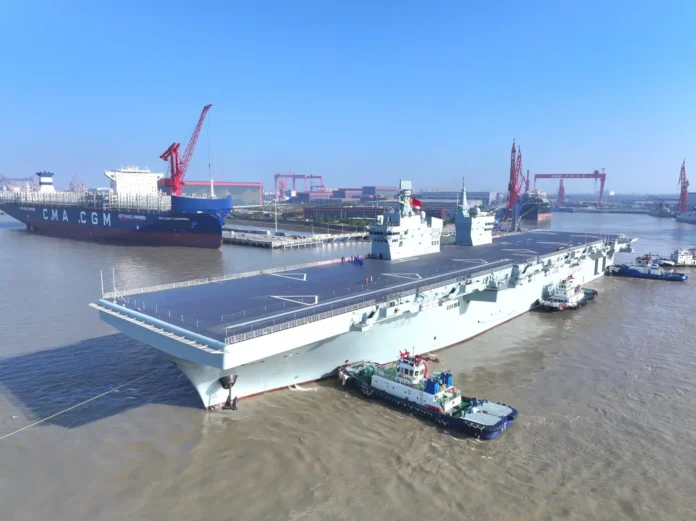
EMALS technology extends beyond big fleet carriers: the new Chinese Type 076 amphibious assault ship Sichuan has an EMALS catapult for drone launches and perhaps even fighter jets. Another EMALS cat has been allowed to be seen in modular form on the merchant vessel Zhongda 79, also equipped with containerised vertical launch missile cells. These amphibious and dual-use platforms blur civilian and military boundaries. What they don’t blur is offensive vs defensive use – that is clear. Likewise their Shuiqia barges with telescopic bridges. You can say they’re for disaster relief if it makes you feel better, but their actual use is obvious.
There are internal challenges. President Xi Jinping’s purges have recently targeted around 11 senior military figures, including Central Military Commission vice-chair Zhang Youxia. These purges are normally said to be the results of corruption but are probably aimed at securing loyalty and punishing readiness failures. Since 2023, dozens of generals, particularly from nuclear and eastern commands, have been removed, raising concerns about operational effectiveness – similar to corruption’s impact on Russia’s performance in Ukraine. Not to keep making US comparisons, but President Trump’s administration has removed roughly two dozen senior officers in his second term. It’s important to remember, however, that the US military has a long-standing history of removing senior commanders all the time – seldom for corruption, much more often for professional failure, affairs with subordinates and the like.
Meanwhile, in the UK, we barely have enough resources to tackle threats in our home waters, with the FCDO and various legal teams seemingly incapable of letting the Royal Navy get on with their job. We can’t even decide to do something about the stream of Russian shadow fleet tankers passing through our waters every day. We’ll be even more puzzled when a 120,000 ton Chinese nuclear-powered aircraft carrier starts doing race tracks in the Moray Firth, probably carrying more jets than our combined navy and air force, its accompanying warships and submarines packing more missiles than our entire stock.
Anyone who thinks this is an “over there” problem needs to pull their head out of where it currently is and have a look around.
*Tom Sharpe OBE served for 27 years as a Royal Navy officer, commanding four different warships
This article first appeared in The Telegraph and is republished with the author’s permission.