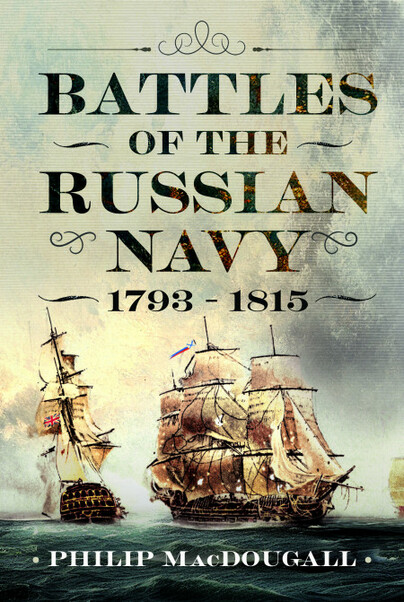
Battles of the Russian Navy 1793 – 1815. By Phillip MacDougall. Pen and Sword Maritime, Yorkshire, 2026.
Reviewed by Tim Coyle
During the wars against France in the period 1793 to 1815, Russia allied with Britain. The Russian navy was third largest after the other two protagonists. However, Russian navy participation in these campaigns hass been largely overlooked in English language narratives.
Russian warships were active in the Baltic, North Sea, Black Sea, the Mediterranean and the Adriatic Seas – areas of operation largely in common with today’s Russian Federation Navy.
In rectifying this lacuna in the English naval history lexicon, Philip MacDougall accessed Russian Imperial archives in the Belarus National Library in Minsk and the Central Naval Museum in St Petersburg, as well as the National Archives, Kew, and the National Maritime Museum, Greenwich.
The book’s main theme is the Russian navy’s capabilities and operations during the Napoleonic wars with particular emphasis on British advice across training, technical support and advice.
Philip MacDougall specialises in naval campaigns fought during the latter stages of sail; he has a special interest in conditions of service of officers and seamen, their recruitment, relationships between officers and the ‘people’ and how they performed in action. He also analyses naval industries: shipbuilding, dockyards, and related supporting infrastructure.
Battles of the Russian Navy consists of seven parts:
Part One: Organisations, Structures, and Readiness for War.
Part Two: Russian operations in the North Sea, and an Anglo-Russian expedition in 1799.
Part Three: New Friends and New Enemies: Tensions with Nelson and difficulties in Anglo-Russian naval relations.
Part Four: Bringing the Fleet into Better Condition: Adopting revised doctrine and dealing with the changes of emperors.
Part Five: At War with Napoleon.
Part Six: How Naval Wars should not be fought; Setbacks in the Adriatic, the Black Sea and the Baltic
Part Seven: The War with France 1812 -1814:
An Epilogue – Thoughts on a future war precedes an extensive Notes, References and Bibliography.
Empress Catherine the Great (reigned 1770 to 1796) took a special interest in the navy. She saw its potential to secure new territories for Russia and to advance trade. Catherine attracted notable British naval individuals to her service; one of which was Scottish-born Admiral Samuel Greig who was appointed Baltic Fleet commander. Talented British naval expatriates served the empress well. Russia itself had skilled native-born naval leaders; Fydor Fyodorovich Ushakov and Dmitry Nikolayevitch Senyavin being outstanding examples. However, there was a limited talent pool on which to draw once the ex-pats’ terms expired (usually on their deaths).
As an autocracy the will of the ruler was paramount and, towards the end of her reign, Catherine’s interest in the navy declined. Her successor, Tsar Paul 1, continued to support the navy; however, his assassination after five years in office saw his son, Alexander 1, favour the army to the navy’s detriment.
Prior to Catherine’s naval rejuvenation, the service’s organisations, structures and readiness for war were poor, exacerbated by rampant corruption, ineffective management and low standards of technical skills. MacDougall presents a comprehensive analysis profiling the naval support industry.
It was the ready acceptance of British naval expertise that forged the new Russian navy. British flag officers accepted appointments to command fleets and Russian officers were British-trained trained and seconded to Royal Navy ships.
A major drawback of Russian navy command and control was the dichotomy of two practically independent fleets: the Black Sea and the Baltic fleets. The Baltic fleet, based at Kronstadt near St Petersburg, was ice-bound for half the year rendering the fleet inactive with idle crews living in barracks. The Black Sea fleet was more innovatively led, even developing tactics in advance of other navies. Ships’ companies greatly differed; those of the Baltic Fleet were mainly serfs – from rural, poverty-stricken and subjugated regions – whereas the Black Sea Fleet attracted a higher standard of recruit, many with maritime backgrounds.
MacDougall follows this theme of geographical, materiel and personnel differences between the two fleets to demonstrate the Russian navy’s mixed record in the 1793 to 1815 period of the wars with France.
After backgrounding the Russian navy’s organisations, personnel, materiel and operational capabilities, MacDougall launches into the naval campaigns against the French, in company with the Royal Navy. He profiles the tensions which arose between the two allies and the successes and setbacks that ensued.
The book’s strengths are built on Russian language archives which allows English-speaking readers to appreciate the cultural differences which applied at the time.
But beyond that, it allows us to compare those Russian cultural and societal mores of 1793 – 1815 to those of Russia through subsequent history until the present.
It is this aspect that the book is valuable to not only maritime historians but for a wider readership which seeks to understand a civilisation of which Winston Churchill opined: ‘Russia is a riddle inside an enigma’.