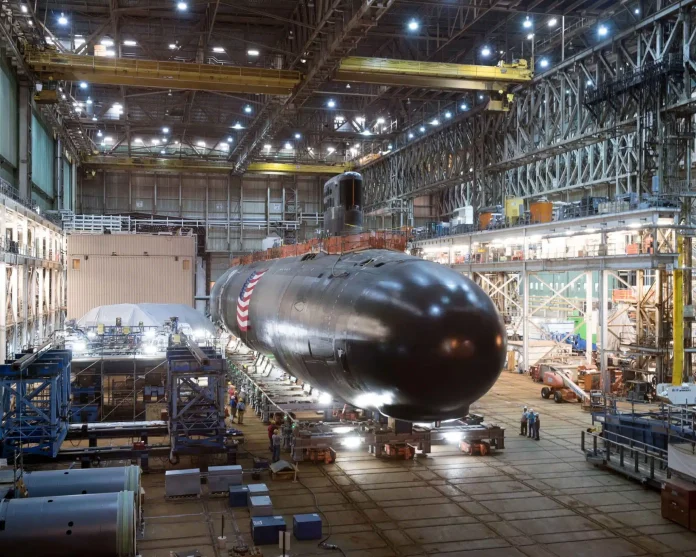
The U.S. Navy has cut submarine maintenance delays by 40% and returned or delivered 10 submarines over the past 12 months, senior service leaders reported at the Naval Submarine League’s 2026 Annual Symposium as U.S. submarine industrial base reforms gain traction, Naval News reports.
Throughout his opening remarks, Vice Adm. Rick Seif, Commander, Submarine Forces, outlined joint Navy and industry efforts to shorten maintenance availabilities for active submarines while scaling new-construction deliveries. That push follows landmark procurement commitments, including July’s $76.6 billion contract package for five Columbia-class Build II and nine Virginia-class Block VI submarines, alongside $5 billion in industrial base investments.
Seif noted that 10 submarines either entered or returned to service over the past 12 months. That total comprises two new-build Block IV Virginia-class fast-attack submarines commissioned in early 2026—USS Massachusetts (SSN-798) and USS Idaho (SSN-799)—alongside two boats completing Post-Shakedown Availabilities (PSAs) and six completing scheduled Chief of Naval Operations (CNO) depot maintenance availabilities.
Vice Adm. Rob Gaucher, Director, Submarine Programs and the Pentagon’s Submarine Direct Reporting Portfolio Manager, highlighted progress on the next two Block IV boats: the future USS Arkansas (SSN-800), which is on the precipice of sea trials, and the future USS Utah (SSN-801), which is nearing its fast cruise. Both boats are scheduled for delivery within two months and commissioning in Spring 2027. On-time delivery of Arkansas and Utah would mark four new-build Virginia-class deliveries within a 14-month span.
Gaucher detailed parallel progress in public and private shipyards, announcing that every fast-attack submarine currently in maintenance at Pearl Harbor Naval Shipyard and Portsmouth Naval Shipyard is either on or ahead of schedule. Boats such as USS John Warner (SSN-785) and USS Illinois (SSN-786) represent key recovery cases; although delayed relative to their original baselines, both are now projected to return to the fleet ahead of their adjusted schedules.
Post-deployment maintenance windows have also compressed. USS Iowa (SSN-797) completed its PSA in roughly six months compared to the typical eight-to-12-month window, making the boat available for surge tasking ahead of schedule. Gaucher also pointed to USS Massachusetts (SSN-798), whose formal PSA was waived in favor of pierside work facilitated by Huntington Ingalls Industries’ (HII) Newport News Shipbuilding, avoiding a drydocking period and accelerating fleet readiness.
Across the enterprise, cumulative days of maintenance delay fell from 1,400 days in FY24 to 800 days in FY25, before dropping another ~40% to 500 cumulative days in FY26 to date, with further reductions expected. At the same time, total submarine construction hours rose to nearly 29 million in 2026, up from 22 million the previous year—tracking toward a targeted ~30% year-over-year increase.
The effect of drastically reducing delay backlogs and the amount of time taken to produce or retrofit submarines come from a dedicated effort and sweeping reform, especially as it relates to how the Navy, funding bodies, and industry interact and work together to solve issues. In particular, Gaucher noted that reforms such as prior investments into Virginia-class parts and ensuring a stock of spare material over the past 3 years yielded dramatically positive effects on ensuring maintenance continued even through potential issues.
Part of ensuring availability of materials also stems from Gaucher’s efforts to remove administrative bottlenecks for a supplier base totaling ~27,000 separate suppliers through responding efficiently to industry feedback. Eliminating administrative barriers remains a high priority, with reduction in vendor certification times by up to %60 in some areas, nearing the %75 reduction originally ordered by Gaucher.
Rapid funding mechanisms also helped to improve prospects, as 11 Other Transaction Authority agreements were implemented in the past year, with Gaucher noting the increased speed of getting necessary funds to suppliers and contractors over legacy contract systems. Consolidation of contract has also have had a measurable effect, as contractors that may have received 100s of separate contracts now get a handful of contracts covering the same items , allowing for easier access, a tally of needed parts, and easier management across program offices, with the goal of consolidation of work into master contracts most suppliers.
Other reforms include the establishment of 41 priority suppliers, the establishment of facilities to construct sub-components outside of prime shipyards enabling greater focus on work only larger contractors can do, working personally with major yards to shore up behind schedule programs, pay increases for workers, and increasingly digitized infrastructure at suppliers/yards/contractors.
Gaucher also underscored the impact of a new internal “scorecard” tracking individual submarine programs across production milestones. Early warning indicators prompt direct engagement with prime contractor executives before schedule slippage compounds. Under the current assessment, two submarine shipbuilding programs are ahead of schedule, six are on schedule, and only one is behind.
Beyond hull construction and maintenance, Seif announced that the U.S. Navy’s torpedo inventory grew by up to 200 Mk 48 ADCAP heavyweight warshots, supporting full loadout availability across the submarine force.
Additionally, construction of support facilities and weapons programs designed to outfit submarines notably increased within the past 12 months, with Naval News reporting on the construction of new hypersonic weapons facility near Naval Station Norfolk, the progress of the Mk-58 Compact Rapid Attack Weapon, and the Navy’s need for the new lower-cost RAPTOR heavyweight torpedo.