During my annual sojourn in England for the northern summer I visited the Britannia Royal Naval College at Dartmouth where two of my uncles had been sent aged 13, back in the 1940s. They had subsequently become RN officers.
In the mid-1970s, my much-respected boss at the Joint Intelligence Organisation was Commander Haddon Spurgeon RAN (1930-2020) who had undertaken several training and exchange postings with the RN. That was apparently the norm during the early part of his career. In fact Haddon’s first officer posting was to the RN’s Caribbean squadron whose main activities according to Haddon were showing the flag, hosting onboard cocktail parties, and seducing the Caribbean gentry’s daughters.
Anyway I digress, my point being that I have a long family association with the RN, and a long work association with the RAN beginning with my enjoyable three years working for Commander Spurgeon at JIO.
This year, while in England, I read Captain Harold Hopkins RN’s 1964 book Nice to have you aboard about his time as a liaison officer with the US Pacific fleet during the Second World War. His posting was intended to prepare the way for the deployment of a British fleet to the Pacific in 1945, something I had not been aware of.
In fact, the part played by the RN in the final defeat of Japan is largely overlooked in Australian accounts of the Second World War. Yet in 1945, British naval forces operated alongside the United States Navy in some of the most important final campaigns of the Pacific War.
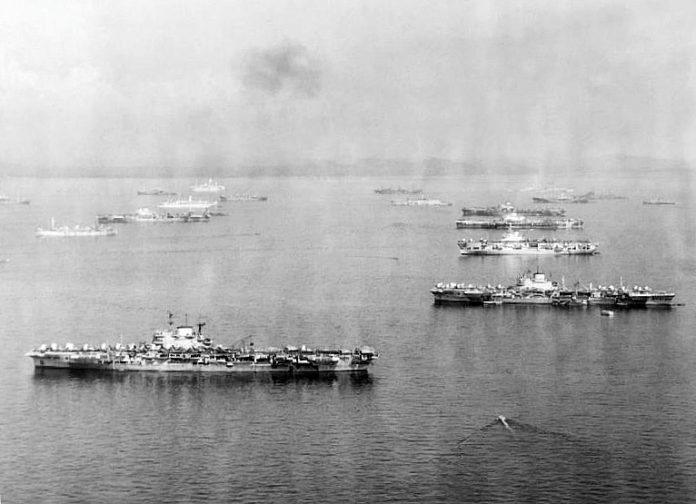
By late 1944, after years of fighting in European and Mediterranean waters, the RN had assembled a powerful striking force for deployment against Japan. The British Pacific Fleet (BPF), formally established in November 1944 under Admiral Sir Bruce Fraser, was a substantial Commonwealth undertaking, involving British, Australian and New Zealand ships and personnel.
The fleet operated under American strategic command. Initially designated Task Force 57, it served under Admiral Chester Nimitz’s Fifth Fleet, commanded by Admiral Raymond Spruance. In July 1945 it became Task Force 37 under Admiral William Halsey’s Third Fleet. British carriers, battleships and escorts were committed to sustained operations against Japanese forces.
At various stages, the BPF included six fleet aircraft carriers: HMS Illustrious, Formidable, Victorious, Indomitable, Indefatigable and Implacable. They were supported by light fleet and escort carriers, battleships, cruisers, destroyers, submarines and a substantial supply and maintenance organisation. Not all six fleet carriers operated together; normally four formed the main striking force. This was nevertheless an extraordinary deployment for an RN already stretched by six years of global war.
The British carriers had one particularly important advantage. Their flight decks were protected by armoured steel, unlike the largely wooden flight decks of American Essex-class carriers. This design was to prove its value against the kamikaze attacks that increasingly threatened Allied ships during the Okinawa campaign.
British carriers were struck repeatedly. Formidable suffered particularly serious damage, while Indefatigable and Victorious also sustained kamikaze hits. Aircraft were destroyed, men killed and flight decks damaged. However, the armoured construction helped contain the damage, fires were brought under control and operations resumed, sometimes within hours. The carriers were not invulnerable, but they demonstrated considerable resilience under repeated attack.
US Navy observers recognised the advantages of the British design. An oft-quoted remark attributed to an American liaison officer serving with the BPF captured the contrast: “When a kamikaze hit a US carrier it meant six months at Pearl Harbor; when it hit a ‘Limey’ carrier it was a case of ‘Sweepers, man your brooms!’” Although an exaggeration, the remark reflected the impression made by the British carriers’ ability to resume operations after sustaining damage.
The BPF’s principal task during the Okinawa campaign was to neutralise Japanese airfields in the Sakishima Islands, south-west of Okinawa. These provided potential staging points for Japanese aircraft attacking American invasion forces.
From March 1945, British carrier aircraft repeatedly bombed runways and installations, attacked aircraft and maintained patrols to prevent the Japanese from using the airfields effectively. On 12 and 13 April, Task Force 57 also struck Japanese airfields in northern Formosa (now Taiwan), helping prevent their use as staging bases for attacks against the Okinawa invasion forces.
The scale of the effort was considerable. During Operation Iceberg, which ran from March to May 1945, BPF aircraft flew 5,335 sorties and dropped approximately 958 tons of bombs. British battleships and other vessels also conducted bombardments. The fleet endured repeated kamikaze attacks while maintaining pressure on Japanese airfields. This was sustained combat service, not a token contribution to an American operation.
In July 1945, the British fleet moved on to attack the Japanese home islands as part of the US Third Fleet. British aircraft struck airfields, shipping and other military targets, while British battleships participated in naval bombardments. The BPF was now operating directly against Japan itself. For Britain, this was also a demonstration that, despite the enormous demands of the European war, the RN remained capable of deploying a powerful fleet thousands of miles from home.
The Royal Australian Navy (RAN) made a significant contribution, providing seven destroyers. HMAS Quiberon, Quickmatch and Queenborough were Q-class destroyers assigned to the BPF’s 24th Destroyer Flotilla and its main striking force. HMAS Napier, Nepal, Norman and Nizam were N-class destroyers serving with the 7th Destroyer Flotilla. Initially employed largely on escort and Fleet Train duties, they subsequently undertook additional screening and general escort tasks. Their contribution should not be overlooked simply because their duties were different from those of the main striking force.
Sydney was an important base for repairs, replenishment and maintenance. The British Fleet Train, designated Task Force 112, was assembled largely from merchant vessels and lacked the experience and efficiency of its American counterpart in underway replenishment. Logistics were the BPF’s greatest weakness. The British fleet depended heavily on replenishment facilities and American assistance to sustain prolonged operations in the Pacific.
Following the Okinawa operations, the fleet returned to Australia for maintenance and preparation for its next campaign. The BPF could not have maintained its operations in the Pacific without the support provided by Australian ports and facilities.
The scale of the American contribution to the Pacific War was, of course, vastly greater. The BPF arrived relatively late and never approached the size of the USN’s carrier forces. But judging the RN’s contribution by numbers alone misses the point. It undertook demanding operations, helped suppress Japanese air power during the Okinawa campaign and demonstrated that British armoured fleet carriers could withstand kamikaze attacks and remain effective in battle.
Its presence also mattered politically. Britain had a direct military role in the final campaign against Japan. On 2 September 1945, British Admiral Fraser signed the Japanese Instrument of Surrender aboard USS Missouri on behalf of the United Kingdom.
Australia’s wartime history understandably gives prominence to Kokoda, Singapore, the Coral Sea and campaigns fought closer to home. But the final defeat of Japan was not exclusively an American achievement. The British Pacific Fleet, with substantial Australian and other Commonwealth support, made an important contribution. That contribution deserves greater recognition in Australia’s history of the Pacific War.
Professor Clive Williams MG is a former Australian Defence intelligence analyst (clive.williams@terrint.org)