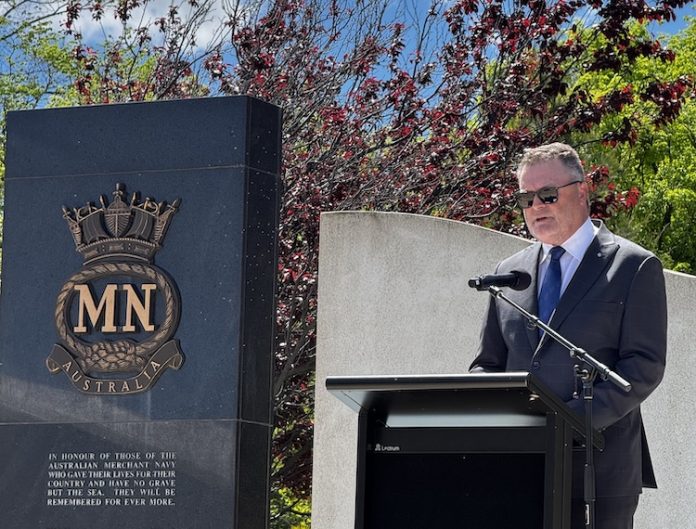
The following is the address by CDRE Ash Papp CSC RAN (Rtd) at the Merchant Navy memorial in Canberra.
Thank you for coming out today, and to those who organised this memorial ceremony.
Thanks to those who funded this memorial, and those who invest their time and effort maintain the corporate memory of our merchant navy.
Australia is a three ocean continent, an island, and an archipelago of population centres.
Literally and figuratively girt by sea, not just beaches.
Beyond those beaches, beyond the surf line, a quiet, unassuming, determined type of hero plies their trade.
Our merchant sailors.
Our nation is supplied and financed from the sea.
Australia’s livelihood, our prosperity, our security, is dependant on the sea.
It was on the ships deck that Australia was founded and connected to the world.
And so it remains.
Over 90% of Australia’s imports and exports move on merchant shipping.
Australia is the 5th largest user of shipping services in the world.
Australia’s exports by sea are worth about $314 billion annually.
Australia’s security, and our vulnerability, is the sea and merchant ships that move that cargo.
Merchant ships crewed by heroes, merchant sailors.
World War 1 reminded the modern world of the dependence and interconnectedness of the sea.
The lifeblood of Europe, and empires, was the sea.
So it remains.
The World War 2 sea battles, convoys and the military threats and protections of those convoys are well narrated, and the impacts well documented.
The bombing of British cities was devastating, cruel and criminal, but not strategically decisive.
It was seaborne logistics that was the strategic threat to survival, and merchant shipping was the strategic saviour of Great Britain and hence the saviour of Europe.
In 1940 alone, more than 500 ships were lost on the Atlantic supply routes to England, more than 3 million tonnes.
Winston Churchill did not sleep much apparently, but stated the only thing that kept him up nights was the absence of shipping arriving from North America to keep his nation alive. Churchill recalls his request to Roosevelt for more shipping and logistics in 1941 the most important letter he wrote.
In our own part of the world, Australia, and sea routes to and from Australia, were the lynchpin of survival or victory in the Pacific in 1941.
The famous sea battles in the Pacific in World War 2 were all about controlling the sea, so that merchant ships could keep the logistics flowing to and from Australia, underpinning victory, security and indeed prosperity through Asia.
In Australia today we reap the benefits, comfortable in our lifestyle, our living standards, and our security, because of that seaborne logistics, and those quiet, unassuming heroes.
Merchant sailors.
We see in the Middle East the uncertainty and financial cost of blocking sea routes and inhibiting seaborne cargo.
We saw one ship going sideways in the Suez Canal causing mayhem to supply routes to the Indo-Pacific.
We saw during COVID global supply chains interrupted.
Even rivers, with low water levels, are inhibiting logistic supplies and trade across Europe.
Of the plight, the dedication, the sacrifice of the sailors, we hear little.
Such is the tenor of a career at sea.
The sea, and what the sea means for Australia and the world, is but a passing interest for most Australians and most of the 8 billion residents of the world, even when the majority of them live by the sea.
Nations that win or lose wars triumph or suffer from two things: determination and courage, and logistics and supplies.
Logistics come by sea, always, not during war: it always has and always will.
We do not gather here today to pay homage to merchant ships or cargo.
Ships are only as good as the men and women that command and operate those ships.
Our mariners.
Our merchant sailors.
For the modern Australia, merchant sailors from all over the world who crew the ships upon which Australia depends.
Our merchant sailors in port, in coastal trading, in maritime security.
An understated role, a courageous role, for the benefit of our nation.
We gather to remember the sailors.
From all walks of life, from all parts of the country.
We remember the families, with an empty seat at their dinner table every night, with little or no knowledge of even where their loved ones is, has been, or is going.
In wartime families waited on impersonal and incomplete reports — headlines simply read “another ship lost” or “more cargo gone,” offering grieving relatives no names, no details, and no closure.
Records do not fully capture their loss.
This totem, the design and architecture or this memorial, is poignant. That the memorial was funded by private donations is also poignant.
Many hundreds of Australian merchant mariners who died in WW1 and WW2.
Many hundreds of families who lost loved ones, plying the sea lanes to keep logistics, national lifelines, open.
Countless men were lost at sea, a rusting hulk their watery grave.
These were civilians, not enlisted combatants — they were tradesmen, cooks, engineers and deckhands who signed on for commercial voyages and found themselves sometimes conscripted by circumstance into a life-and-death struggle.
Survivors often returned to little recognition — contemporary accounts note their contribution went largely unrecognised, with many carried the trauma of shipwreck, exposure to the harsh oceans, or lost shipmates.
I started my naval career escorting merchant ships through minefields to reopen a country’s lifelines.
I spent decades working and learning alongside merchant mariners.
I concluded my naval career as the largest employer of civil merchant mariners in the country, serving your nation in the Maritime Auxiliary Group.
The quiet, unassuming heroes of the seas.
They have my deep respect, and they deserve to have their stories told.
As necessary as memorials are, stone and iron do not qualify our memories.
Our thanks, our respect, the emotional impact, the courage, human effort and determination can only be captured in our hearts, in our minds, in our souls.
Our merchant sailors connect Australia to the world, and the world to Australia.
To the tens of thousands who served, to those who never returned, and to their families, we pay our enduring respect.
Tell their stories.
We owe them.
We will remember them.
Lest we forget..