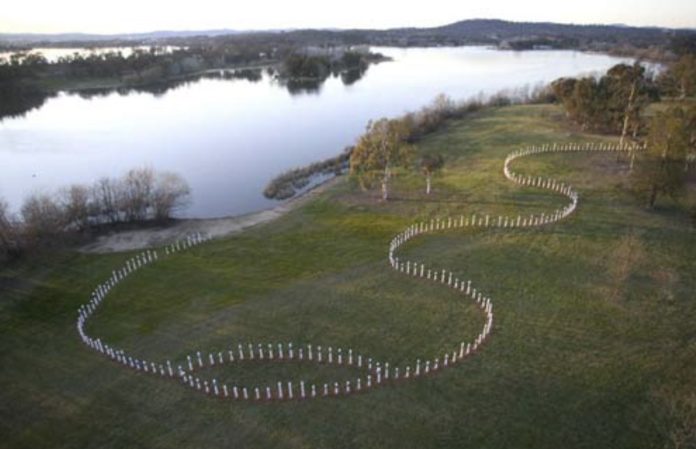
The recent marking of the 25th anniversary of the tragic loss of SIEV X and the criticisms earlier this year of crews of the UK’s Royal National Life Boat Institute in rescuing refugees at sea, draw attention to mariner’s responsibilities in regard to search and rescue. Professor Stuart Kaye outlines the complexities of these responsibilities in an article in Headmark 142 published in December 2011.
Maritime Search and Rescue as Everyone’s Responsibility
In the debate over asylum seeker boat arrivals, some attention has been directed at the circumstances under which people journey to Australia – specifically the small boats in which they cross the expanse of ocean before ever reaching our shores. This journey is necessarily a dangerous one, and large numbers of individuals have lost their lives. This necessarily raises the question, who has responsibility to rescue and protect these individuals, and what the extent of the Australian Government’s responsibility to rescue actually encompasses?
The boats used in people smuggling are typically small Indonesian fishing vessels, with limited range and even more limited ability to handle adverse weather conditions. To maximise the smugglers’ returns, these vessels are often severely overloaded. The most infamous case involved asylum seekers lost in the SIEV X disaster in 2001, when some 421 passengers were aboard a 19.5 metre boat which was lost en-route to Australia resulting in the deaths of over 350 people. In more recent times, the explosion and loss of SIEV 36 near the Ashmore Islands, and the wreck of SIEV 221 off Christmas Island have highlighted the dangers inherent in people sailing to Australia in small and often unseaworthy craft.
These dangers raise the issue of what obligations does Australia have in respect of vessels around our coasts. The answer is a complex web of international and domestic law, which inform the manner in which search and rescue is conducted, and our responsibilities in respect of ship safety. To begin, search and rescue is potentially every mariner’s responsibility. The Law of the Sea Convention provides that all vessels at sea must render assistance to those in distress, as far as they are able, without putting themselves or their vessel in undue danger. This requirement is reflected in a range of other international agreements including the International Convention on Maritime Search and Rescue and the Salvage Convention. It is also part of Australian law, being incorporated into the Navigation Act.
This duty to render assistance is deeply ingrained in the culture of all those who spend time out on the ocean, whether at work or play. It makes it clear that everyone at sea has not merely a moral obligation, but a duty to assist all those in distress, regardless of where they have come from and how they came to be in those circumstances. It also makes it clear it is not the responsibility of the Government alone, through the Navy or Customs Service, but of everyone. For most seafarers this is a fundamental element of life at sea, and how deeply it is ingrained is evident in a variety of ways, most notably the many volunteer organisations scattered around the Australian coastline who provide assistance to anyone at sea who is in need. Seafarers recognise the necessity of this mutual obligation as reflected in international law, as the vast expanses of the world’s oceans, and the extensive coastlines of so many countries, are simply far too great for any national body to undertake search and rescue alone.
The government’s role is reflected in Australia’s domestic law and international obligations. In terms of rescue, Australia has undertaken to coordinate rescues at sea in a truly vast area of ocean around our coasts – stretching from more than halfway across the Tasman in the Pacific, north to Indonesia, almost to India in the Indian Ocean and south to Antarctica. It represents 10% of the surface of the globe, and bears no relation to the maritime jurisdiction countries have over fishing or offshore petroleum. It is one of the largest search and rescue regions in the world.
As vessels in distress are often in remote areas, away from shipping lanes, when a distress call comes, the Australian Maritime Safety Authority (AMSA), as the agency for coordination of search and rescue over this vast area, often contacts the Navy to effect a rescue as no other shipping will be present, but in many more cases ordinary commercial or even recreational vessels might be dispatched to render what assistance they can. It was in this way the MV Tampa came to collect over 400 asylum seekers aboard in 2001. This emphasises that search and rescue is a shared responsibility, not merely a Government one, and one which mariners are generally happy to discharge when the occasion arises.
Whether Australia can and should do more to prevent disasters like those that befell SIEVs X and 221 is a difficult question. It has been suggested in some quarters that a single agency should absorb Australia’s search and rescue under one umbrella, and this would improve and enhance our capabilities to cope with disasters like SIEV 221. While attractive on some levels, it is worth noting whether centralised or not, already international and Australian law obliges every vessel at sea – foreign or Australian – to do what it can to render assistance to vessels in distress, and this of itself means we are maximising the reach of efforts to assist those in distress. While this will not always be the best vessel or crew for the job, with 10% of the planet to coordinate search and rescue over, we would need more vessels than exist in all the world’s navies and coast guards combined to take on the task of ensuring the best vessel is always on hand.
We have in AMSA a remarkably efficient organisation to coordinate getting the nearest practical assistance to a vessel in distress as quickly as possible. Unfortunately search and rescue by its very nature must be reactive, and the size of our maritime responsibilities so large, it is difficult almost to the point of impossibility to pre-position our finite resources to prevent tragedies like those that have already occurred from occurring again. It is impossible for the Government to maintain a safety surveillance vigil around all our coasts and across our oceans, and international law does not impose such an obligation upon us.
This problem however is not unique to Australia, and it is why international law has long recognised that everyone has a responsibility to render assistance at sea.
About the Author
Distinguished Professor Stuart Kaye OAM is Director and Professor of Law within the Australian National Centre for Ocean Resources and Security at the University of Wollongong. He was formerly the Dean of Law at the University of Western Australia having been appointed Winthrop Professor of Law in July 2010. He held a Chair in Law at the University of Melbourne 2006-2010 and was Dean and Professor of Law at the University of Wollongong 2002-2006. He holds degrees in arts and law from the University of Sydney, winning the Law Graduates Association Medal, and a doctorate in law from Dalhousie University. He is admitted as a Barrister of the Supreme Courts of New South Wales, Tasmania and Queensland.
Professor Kaye was appointed to the International Hydrographic Organization’s Panel of Experts on Maritime Boundary Delimitation in 1995 and in 2000 was appointed to the List of Arbitrators under the Environmental Protocol to the Antarctic Treaty. He was chair of the Australian International Humanitarian Law Committee from 2003-2009, for which he was awarded the Australian Red Cross Society Distinguished Service Medal. He was elected a Fellow of the Royal Geographical Society in 2007 and a Fellow of the Australian Academy of Law in 2011. He is a member of the Australian Research Council College of Experts. He holds the rank of Captain in the RAN, serving as a legal officer, principally providing advice in operations and international law for the ADF and Maritime Border Command.