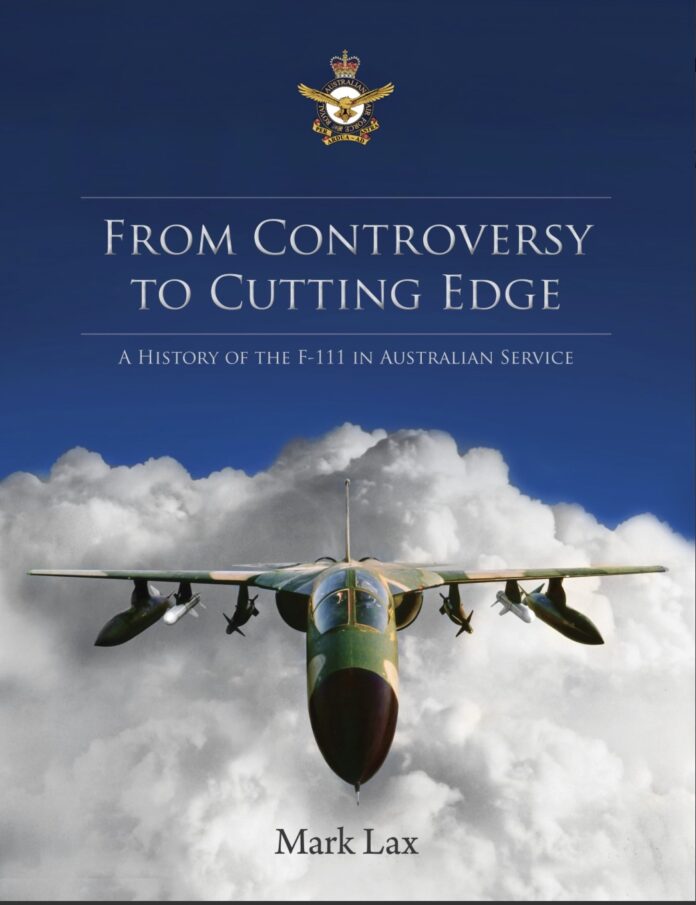
From Controversy to Cutting Edge, A History of the F-111 in Australian Service. By Mark Lax. Big Sky; Hardback; ISBN: 9781922615176. $39.99.
Reviewed by Tom Lewis
I must admit an entirely selfish desire to review this book, which comes from a long-held love of the F-111. Perhaps this came from an incident around 1974. As a member of the Air Cadets, we were on camp down at Fort Direction, in Tasmania. The RAAF had arranged for an F-111 to overfly us as part of its pass over the Hobart Regatta. We were duly assembled at the appointed hour. The aircraft approached us at speed out of the east to fly up the Derwent River. At what must have been 500 knots the pilot flick-rolled it and went over us, upside-down, at what was probably 300 feet. The noise, stupendous speed, and sheer awesomeness of the aircraft left an indelible impression.
Later I learnt to fly myself, in a minor way, and as an understanding of aircraft grew so too did an appreciation of the magnificent features General Dynamics had put into the package. The swing-wing was the most obvious; but the machine’s speed, its heavy bomb-load capacity, the terrain-following radar, and even clever minor characteristics. Who had thought up an automated ejection pod module, which would leave both aircrew side-by-side suspended under a parachute? What a terrific 20th century advance on the almost by-then antiquated scramble over the side into space and a fully manual pulling of the ripcord.
And so to this most comprehensive book by military aviation author Mark Lax. He takes us methodically through the acquisition process post-WWII:
Faced with the prospect of defending a huge landmass and conscious of the changing strategic
circumstances in South-East Asia, the Government needed a relatively cheap, reliable option that could
be pressed into service quickly to satisfy the heavy bomber requirement. The requirement was for an
aircraft able to travel long distances with a medium bombload.
We are taken through consideration of the Liberator, the Lincoln, and the Canberra – this last acquired and deployed to Vietnam. But it was a stop-gap. The Canberra, although sturdy and capable, was a generation behind the current thinking: that a bomber should be supersonic and be highly capable in the onboard electronic systems.
Various aircraft such as the British Vulcan were considered, but in the end it was the Gary Powers incident that changed the equation. Piloting a U-2 spy aircraft, Powers was shot down on 1 May 1960 by the Soviet Air Defence Forces in Sverdlovsk, Russia. Hit by a Surface to Air Missile at over 60,000 feet, the Powers incident meant that supersonic bombers flying at low heights – under enemy radar – were now a very necessary alternative.
Lax takes us through many pages of the political arguments and controversies surrounding the choice. This will be of interest to some but not others, but it’s necessary detail. In the end, in the chaotic international politics of SE Asia at the time, as he says: “Australia would finally get an aircraft that, if necessary, could fly unrefuelled to Jakarta, drop bombs and return. Australia could also now boast an independent deterrent…”
One of the most significant aspects of the purchase – an angle your reviewer has pursued recently in a paper on Robert Menzies – was the steady move away from British weapons systems to US materiel. The F-111 was not the only such item: there were three Charles F Adams destroyers for the Navy. It was the beginning of what we see today when the bulk of such purchases comes from America – witness the recent acquisition of Tomahawk missiles for Australia.
Lax pursues the so-called technical problems of the F-111 in depth. Given its radical design, and its many enemies in the acquisition process, the media got hold of the aircraft and refused to let go. Older readers will recall the many insults to the General Dynamics producers; the RAAF and the federal government of the time. There were problems with the swing wing, and losses of the aircraft in USAF combat in Vietnam had to be investigated. But they were all solved.
It seems though from the pages of From Controversy to Cutting Edge that this is a most suitable title. The purchase of the F-111 was likely the most controversial and politics-burdened acquisition of any defence item in this country’s armed forces’ history.
There are an enormous range of chapters in what is a most-handsome, highly-illustrated 286 page A4 work. Some of the more interesting to the average enthusiastic reader may be those on the Introduction of the Laser-Guided Bomb; The Pave Tack Project, and the machine’s development into Maritime Strike armed with the AGM-84 Harpoon missile. On the political side there was the use of the aircraft – and a Mirage as well – to acquire overhead imagery of the Franklin Dam during the intense political storm over that controversial Tasmanian project.
Overall the F-111 was a deterrent. In the words of Defence Minister Kim Beazley:
The F-111 was a deterrent and I can prove it. I was speaking with [Indonesian] General Benny Murdani and he said to me, ‘You know we have discussions about Australia in Cabinet from time to time and whenever my colleagues get a bit angry with Australia and are inclined to make trouble, I always say to them: “Do you realise the Australians have a bomber that can put a bomb through that window on to the table here in front of us”’.
We are taken through the four decades this fine machine served Australia. Eventually though it became an orphan, as other countries and air forces operating the F-111 retired it. Lax labels Australia’s decision, after the USAF stopped operating the aircraft, to keep going as “bold at best and unachievable at worst.” In the end many of the aircraft were pulled apart and buried, although twelve are preserved in museums around Australia.
This is an excellent book, and will fascinate not only aircraft enthusiasts and those interested in RAAF history but those readers who need to reference a vital part of Australia’s military thinking and strategy over the years. Highly recommended.
-o-o-O-o-o-
Dr Tom Lewis OAM is a military historian. His own recent works on military aviation include Bombers North, and Eagles over Darwin, covering operations out of northern Australian in WWII, and The Battle of the Coral Sea Explained, all from Avonmore Books; Australia’s Coastal War – the stories of the submarine, surface and air attacks around Australia in World War II and The Secret Submarine – the RAAF in action against a Japanese fleet submarine off NSW in 1943, from Big Sky.
Picture captions:
Book cover
The prototype F-111A lines up for its first flight – 21 December 1964. (RAAF)
The beloved “dump ‘n’ burn with the F-111’s afterburners on. (RAAF)
The variable wing configurations on display (Mark Lax)
Two AGM-142 missiles and the data-link pod under A8-140. (RAAF)
| F-111 Aircraft Models | ||
| Type | Number | Remarks |
| F-111A | 159 | · For USAF Tactical Air Command
· 42 of which were later converted to EF-111As and another 4 sold to the RAAF |
| EF-111A | 42 | · Converted F-111As used for electronic warfare missions. |
| FB-111A | 76 | · For USAF SAC
· 38 later converted to F-111G status |
| RF-111A | 1 | · Modified F-111A to RF-111A prototype. |
| YF-111A | 2 | · Renamed TF-111Ks which were converted for test flying. |
| F-111B | 7 | · For the USN
· Five prototypes and two production models were built before cancellation. |
| F-111C | 24 | · For the RAAF |
| RF-111C | 4 | · Converted F-111Cs to reconnaissance versions. |
| F-111D | 96 | · For TAC
· These were F-111As with digital avionics. |
| F-111E | 94 | · For TAC
· These were also F-111As with improved engine inlets and weapons capability. |
| F-111F | 106 | · For TAC
· Much improved avionics, engines and weapons capability. |
| F-111G | 34 | · Converted FB-111As
· Nuclear weapon equipment removed; digital avionics included · The RAAF acquired 15 of these in 1992 |
| FB-111H | 0 | · An advanced design intended to compete for the B-1 program
· None were ever built. |
| F-111K | 46 | · For the RAF. Fifty were ordered but later cancelled
· None were built. |
| TF-111K | 4 | · For the RAF as proficiency trainers but later cancelled after two built. |
| Total | 562 | Numbers in bold are original builds which make up the total. |