By RADN Sudarshan Shrikhande IN (Ret)
Editor’s note: Pakistan’s Hangor-class submarines could alter the underwater balance in the Indian Ocean, particularly if deployed into the Bay of Bengal. Their potential nuclear role adds another layer of concern for India. The author argues for urgent investment in underwater surveillance, manned and unmanned systems, and integrated space-cyber intelligence. The larger message is clear: India can no longer afford delays in expanding its conventional and nuclear submarine fleets.
Published with permission from “Bharatshakti.in”
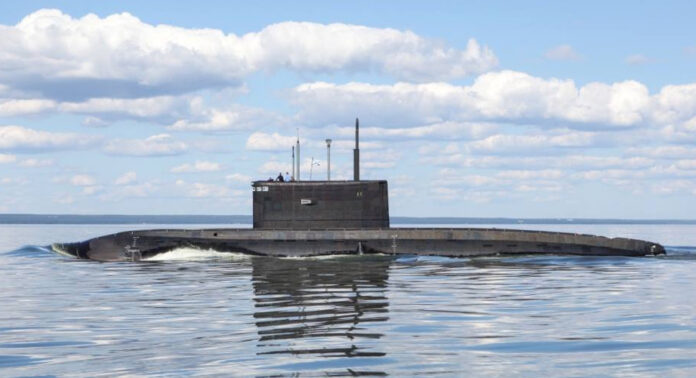
In the past couple of months, much has been written about the commissioning in China of the first of the Chinese- built conventional attack submarines (usually designated SSK) on 30 April this year for the Pakistan Navy(PN) . It reached its home port, Karachi on 11 June, having made a visit to Colombo enroute with an escorting flotilla.
Background on the Hangor-class
The basic design is called the Yuan Type 039 A and its evolved, export variant the S-26. The genealogy of the Yuan class itself traces to the Soviet/ Russian conventional boats of the 877/636 Classes. Much of the world knows them by the NATO “reporting name” as Kilo-class. In fact, the Indian Navy (IN) purchased 10 of the type Project 877-EKM variant from the mid- 1980s which were name Sindhughosh class after the first submarine. A few of the class have been decommissioned over the years. The aim of this article is not to go into the contractual or build-history and plans of the PN’s Hangor class, except to say that the contract between Pakistan and China was signed in 2015 and, of course a few years of discussion must have preceded that.
What’s in a name?
The choice of name for the class is of interest to Indian readers. It was the first PNS Hangor (of French origin Daphne-class) that torpedoed the Indian frigate INS Khukri off the coast of Gujarat during the night of 09 Dec 1971. The IN frigate’s dynamic and brave skipper, Captain Mahendra Nath Mulla went down with his ship. He occupies an iconic position in the folklore and in the enduring memory of the Indian Navy. Likewise, on the Pakistani side, not only is the class- of- ship name Hangor, the fifth submarine of the class is to be commissioned as PNS Tasnim after its then skipper, Commander Ahmad Tasnim. This would also be the initial of the final four to be built at the Karachi Shipyard and Engineering Works (KSEW). The first four have been/are being built in China.
Pakistan’s submarine arm develops
Setting the symbolism of the class-name aside, there are a few noteworthy aspects of PN’s stress on its submarine arm which are important in understanding such projects. Their quest for this capability started in 1958, although the need for one submarine was part of their 1953 -1958 Plan. After some scouting around, including for Sweden’s Draken class, they leased the former USS Diablo from the US as PNS Ghazi. This submarine is well known as the boat that was sunk/ sank off Visakhapatnam on 03 Dec 1971 (as per IN’s official account) on the eve of the Indo-Pak war breaking out. She had been deployed in the 1965 war as well. Of note, the IN had started proposals for submarine acquisition much earlier in its first plan of 1947-48. Its quest met with rebuffs as well as some hope with Britian and France, but fruition was possible only after an agreement was initiated with the Soviet Union for the purchase of the Project 641 variant which NATO code-named the Foxtrot (or F) class. Twenty years after the first proposal in 1947, INS Kalveri was commissioned at Riga in on 08 Dec 1967.
In 1971, the PN deployed the Ghazi at long range off our East coast in the Bay of Bengal, having sailed from Karachi several days earlier. Her deployment was expected. Of course, it had the option of entering East Pakistani harbours for turn around if required later in the war. At that stage, war planners in Rawalpindi and Karachi would not have expected such a swift and complete loss of its eastern half leading to the birth of Bangladesh after its own civil war and liberation struggle from March that year. This article will return to the Bay of Bengal in today’s context a little later.
A PN Lead in some areas?
After this war, the PN could be said to be a little ahead of the IN the matter of submarine as well as anti-submarine warfare in three ways:
First, it began acquiring three French Atlantique maritime patrol aircraft (MPA) in 1973. These were capable of not only long range ASW, but with the Exocet missiles on board, of anti-ship attacks as well.
Second, they were quite astute in buying a fourth Daphne (in 1975), this one from Portugal, which was experiencing financial trouble. Notably, they acquired three Agosta 90B boats from France, two of which were licensed built in KSEW in a way similar to how IN purchased two of the Type 209 German SSKs and built two at Mazagon Docks Ltd (MDL). The Agosta’s were equipped with Exocet underwater-launched SM-39 anti-ship missiles and for its time, this was an early and astute step taken by the Pakistan Navy.
Third, they took an early step somewhere around 2008-09 to begin retrofitting their Agostas with Air independent Propulsion (AIP) systems at the KSEW. They took a considerable operational risk because in sequence at least one of their boats would be out of service for a long time for the retrofit of the imported French MESMA AIP, at a time when their submarine force levels were low as it is.
So, how could Hangors matter for Pakistan and for India?
First, a few general considerations and reiteration of fundamentals are important. This is partly because of misconceptions that span terms like sea control, sea denial and naval power projection and even naval presence. It is also because submarine operations need to be looked at not only from their operational history of the past 112 years since the start of the First World War in 1914 but also their place in changes to maritime warfare.
Sea control is an enabling conditions for naval operations and functions in a state of conflict — or when conflict is imminent– where a nation and its forces need to use the sea for military operations and for keeping maritime trade going in the face of challenges. The stress is on the need to use the sea for one’s own purposes. On the other hand, sea denial is an enabling condition when one side does not need to use the sea but sees strategic, operational and tactical advantages in denying the adversary the use of that space. Neither condition, just like favourable air situation in air warfare, or battlefield exploitation on land, is absolutely one-sided. These enablers are also limited in time and space. The third tasking often for navies has been power projection which can be taken to be military actions that directly put pressure on land via strikes from multiple dimensions mainly from the sea. This could be via air, missile and drone strikes including missiles launched by submarines; or, amphibious assaults or raids; or special ops. At its most strategically significant spectrum is the nuclear- strike capability of nuclear or conventional submarines firing ballistic or even cruise missiles with nuclear warheads. A commensurate degree of sea control becomes a necessary condition for power projection to be effective. Sea control and sea denial should not be mistaken for strategy, or linked to a pecking order, with sea control as “prestigious” and behoving a larger navy or linked as illogical binaries to platforms for e.g ‘carriers are for sea control and submarines are for sea denial.” A relatively recent misconception, born perhaps of older ones, is that manned, conventional and expensive assets are somehow better for sea control, while cheaper, more numerous unmanned craft are great for sea denial. The history of naval operations demonstrates many example of forces moving from sea control (“to use the sea”) to sea denial (“to deny the enemy use of the sea”) or the other way around in different theatres and in different phases of a campaign or conflict. Space prevents one from explaining via illustrations here, but the Mediterranean theatre in WW2 illustrates how the fort and fleet of both the western Allies as well as the Axis fought under conditions of competitive sea control until sometime into 1944. The battle of the Coral Sea (May 1942) demonstrated Japanese carriers, submarines and shore-based aircraft as well as troops fighting for sea control as an enabler. The US led coalition used a largely similar spread of forces and dimensions in countering them by denying the Japanese the ability and determination to land troops on the Papua Peninsula, thereby stemming the tide to an extent even where their losses were higher in some ways of bean counting. A month later, in the battle of Midway in June 1942, a similar spread of forces but on a larger scale, fought hard over two- three days. Japan wanted to occupy Midway for military purposes (power projection). The Americans needed to retain the island as a vital base for further military operations and SLOC protection. Both sides needed to use the sea, hence the condition required was competitive sea control. Of essence is that, in terms of tactical actions and competence, forces often have to do similar things to obtain varying degrees of sea control and/or sea denial. Secondly, these conditions are essentially platform agnostic. Importantly, submarines, due to their continuing and actually improving attributes of endurance, operating ranges, stealth, connectivity, ordnance variety and magazine capacity can and will be used with greater flexibility in years to come.
Space does not permit giving longer explanations and examples of the many ways in which submarines, manned and unmanned, large and small, nuclear and conventionally propelled could play at a time when surface and air domain awareness is improving with corresponding benefits and disadvantages depending on circumstances. Submarines of many navies today are almost as well networked with their national and maritime domain awareness (MDA) as are surface and airborne units because of trailing wire antennas but with the added advantage of a much higher ability to maintain stealth due to being submerged for a lot longer.
On the point of fundamentals, one may also flag that stealthy, submerged submarines add to the value “presence” provides to naval missions. Presence as a virtue of surface ships is, of course, well understood. In some cases, presence can be coercive, as in creating silent pressure. With surface ships, this is overt and obvious, but with caveats that a sudden outbreak of conflict (i.e. the “shooting” starts or is imminent) may disadvantage ships and aircraft thus deployed. Here is where this author had coined an obvious oxymoron that submarines have great value via the uncertainty, and pressure they can create via the virtue of “covert presence” that cannot be replicated by surface forces. A submarine missing from an adversary’s bases creates positional uncertainty from the moment it is not seen in ISR reports.
Back to Hangors
That brings us back to the Hangors! It should not surprise us that a Pakistan Navy senior officer mentioned while the Hangor and accompanying ships were in Colombo, mid-June 2026, that the PN could maintain a submarine presence in the Bay of Bengal. It got a fair bit of media attention not only in India but also elsewhere. Examples form the very early days of submarine warfare in the First World War (1914-1918) show that the “legs” they had were surprisingly long even when navies thought they would be useful for limited, close-coast warfare and scouting before the war broke out. Notably, the Germans deployed their U-boats at long ranges including off the Atlantic coast with no base support other than some resupply by cleverly coordinated supply ships, captured ships and from a few “milch cow” U-boats they had built. In WW2, the Germans, Japanese and American navies deployed at even longer distances, for more days (at considerable hardship to crews) and for various missions. After all, Netaji Subhash took a perilous passage on a German U-boat from European waters and transferred several weeks later at sea to a Japanese Navy submarine which took him to SE Asia where he continued leading the Indian National Army. Fascinating accounts exist of the “odyssey” including one by as serving naval officer.
Deploying in the Bay of Bengal
From the PN point of view, deployments in the Bay at some distance from bases like Karachi is operationally and tactically possible, especially with the addition of AIP which, despite the distance to say, a central point in the Bay, may still permit some endurance for a Hangor. Pakistan is cultivating friends around the Bay who may provide permission for port visits during peacetime and friends like China and perhaps others may assist with domain awareness.
Strategic Rationale?
Strategically, they may have more things on their minds. There are media reports, globally as well as within India, that Indian ballistic missile submarines (SSBN) may operate from so-called “bastions” somewhere within the Bay on deterrent patrols. Such reports would be speculative, because deterrent patrol areas for any nation’s SSBNs would be a very closely held secret. Besides, as this author has written elsewhere, the term “bastion”, used in forts on land is a Western term somewhat incorrectly applied to Soviet SSBN patrol areas. The nature of maritime geography does not provide for bastions. Oceans and seas are relatively permeable and in non-conflict conditions, high seas are open for all. So, it can be expected that navies may deploy a range of manned- unmanned assets, including conventional and nuclear submarines, to shadow someone else’s SSBNs. After all Japanese and NATO conventional boats and maritime patrol aircraft were regularly deployed to try and “mark” Soviet SSBNs. Likewise, the Soviets also would try and track NATO SSBNs, but this task was a little more difficult because their deterrent patrols were probably in relatively open and dispersed ocean areas. These tasks are termed Strategic Offensive and Strategic Defensive Anti-Submarine Warfare (SOASW and SDASW) and are an important national-naval effort.
Hangors as part of Pakistan’s nuclear architecture?
For long the PN has strived to create a tube-launched nuclear tipped cruise missile capability as part of its own triad. Although definite information is not available, it is very likely that the HN-3 “Babur” can carry nuclear warheads. Torpedo tubes are usually 533mm (or 21 inches) in diameter and that is not a small size for fitting a warhead considering that 155mm (6 inches) artillery shells can also be adapted to have a small nuclear warhead. The implications of equipping SSKs with nuclear cruise missiles are elaborated in a Policy Brief written for the Asia Pacific Leadership Network, o7 May 2026 (APLN, Seoul). (See https://www.apln.network/analysis/policy-briefs/naval-competition-in-south-asia-and-the-limits-of-confidence-building-measures)
The eight Hangors could pose concerns and to dent this, India would need to have an extensive set of capabilities for underwater awareness; manned and unmanned submarines; intelligence fusion that includes space and cyber dimensions; and an ability to exert pressure on PN’s boats and unmanned underwater vehicles. Daunting, but necessary.
Submarines of various types remain a bulwark of naval ability for sea control, sea denial, power projection and covert presence. There is little justification for further delays in building Indian conventional and nuclear attack submarines and investing in a variety of USVs. This is not only to counter Hangors or any other adversarial submarines, but enable sustained robust outcomes across the IOR and even beyond. An axiom for submariners goes, Run Silent Run Deep but can be suffixed to “Ruin the Enemy” like little else can.