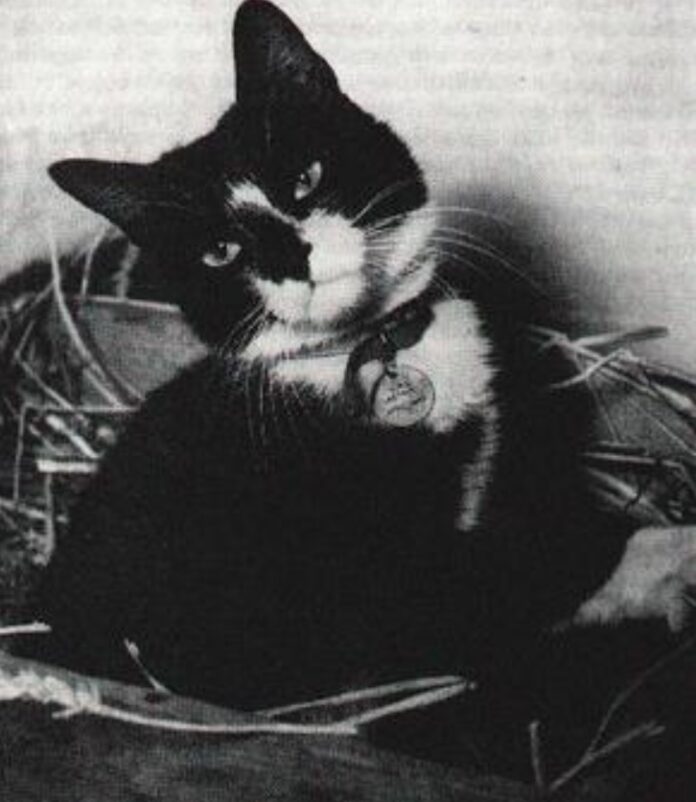
A less known aspect of the ‘Amethyst incident’ on the Yangtze in 1949 was that it could well have been the ‘Shoalhaven Incident’. Lieutenant Commander Desmond Woods wrote of this aspect as well as the heroics of the Amethyst’s men and Able Seacat Simon in Headmark 133 in September 2009.
HMS Amethyst: Simon the ship’s cat, and John Kerans, the black sheep of the RN
In Australia it is a little remembered fact that 60 years ago, in April 1949, the Admiralty came close to sending the RAN frigate HMAS Shoalhaven, then serving with the Royal Navy’s Far East Fleet, into an unwinnable fight with Chinese communist gunners. It was only a wise appraisal, and timely decision, made first in Canberra by the Menzies Government and then by the Flag Officer Far East Fleet that prevented the ship’s company of Shoalhaven from being put in mortal danger on the Yangtze River and being needlessly killed and wounded.
In April, 1949 as Nationalist forces were being defeated across China, Chiang Kai Chek’s beleaguered government hung on to a shrinking perimeter in Nanking (now Nanjing), 200 miles up the Yangtze from Shanghai and the sea. Also in Nanking were many international delegations made up of diplomats who, despite their status as neutral and protected persons, their governments feared they might need to be guarded from Communist attack. For that purpose the RN’s 3rd Frigate Flotilla and 8th Destroyer Flotilla had provided a guardship at Nanking.
Quite what the guardship’s function would be in the event of a Communist attack on Nanking was not made clear. Her purpose was to ‘show the flag’ and could only be symbolic. In theory she could provide a place of safety for diplomats and evacuate them down river. In practice this was never a likely or practical scenario. Britain was a neutral power in the civil war wracking China and this led the Admiralty to naively believe that RN or RAN ships, well marked with white ensigns and national flags, would continue to be allowed to pass on the Yangtze ‘on their lawful occasions’ as they had done for a century.
Their Lordships were sadly mistaken. The Communists, who held and fortified the north bank of the great river, planned to cross it within weeks. They had no intention of allowing their waterway to be used by Chiang Kai Chek or any foreign power in support of the Nationalists, or as a neutral highway for foreign commerce. The old pre-war ‘Rules of the Game’ had been altered forever by the Japanese occupation and the consequent rise of the PLA. The continued existence of the old RN China Station was now a fiction rather than the reality it had been during the pre-war decades when China was effectively run by the West. Neutrality was a meaningless concept to Mao.
The destroyer HMS Consort, the Nanking guardship, was due to sail from Nanking on 19 April. The plan was for her relief ship to sail simultaneously upstream from Shanghai and the two ships would pass on the river. The timing of the guardships’ changeover was considered critical and needed to be completed before the expected Communist crossing of the Yangtze to engage the Nationalists on the south bank. What no one in the Far East Fleet high command appreciated was that the Communists ‘ever victorious army’ would swiftly occupy Nanking on 24th of April. Consort being scheduled to sail on 19 April would mean she would be just in time to escape being trapped at Nanking. Her relief ship would never get there.
Shoalhaven would have been that unlucky relief ship had the Australian government not decided that she should only be used if there was a clear and definable humanitarian role for her in rescuing foreign nationals from peril. It was decided in Canberra that she was available for mercy missions, but not for guardship duties. In practice the foreign delegations started to evacuate Nanking by road and rail as soon as it became obvious that Chiang Kai Chek’s forces were unable to hold his capital, so river based mercy missions were not needed.
When the Menzies Government made known its decision not to permit Shoalhaven to be used solely as a Nanking guardship, the Admiralty might have reconsidered its whole position on the Yangtze. Their Lordships might have decided that if the Australian government was unprepared to hazard sailors’ lives, for no achievable aim, then a prudent policy might be to bring Consort down the river and not to relieve her. There is no evidence that any change of policy was considered either in London or in the Far East. Instead the Flag Officer of the Far East Fleet, Vice Admiral Alexander Madden, aware of the Australian reservation on Shoalhaven’s use, decided that the next available frigate, HMS Amethyst, was to come out of refit in Hong Kong and under the command of Lieutenant Commander Bernard Skinner sail from Shanghai for Nanking. By now the river was the immediate front line in the civil war and was about to be crossed by the Communists to attack their enemies. For any foreign warship to venture up the river under these changed circumstances was, to say the least, a “courageous” decision. It could also be characterised as a foolhardy and pointless one.
Possible interdiction or challenge by PLA artillery was anticipated by Madden, and both Amethyst and Consort were ordered to sail in a state of readiness to meet the fast changing developments in the civil war. The ships’ main armaments were to be provided with ready use ammunition in case of the need to open fire without delay and they had large Union Jacks prepared on their upper decks which could be displayed over their sides at the first sign of any trouble. As Skinner took his shallow draft frigate out into the strong currents of the Yangtze Amethyst started a tragic four month trial by fire from which the shell shattered ship would eventually return, but which would cost him, and the RN, his life and those of 22 of his ship’s company.
On her first night on the river Amethyst anchored where Chinese nationalist warships normally did so. It has been speculated that this was the initial cause of the Communist gunners mistaking her for an enemy ship. Whatever the truth, within 24 hours of her sailing from Shanghai the illusion that a declaration of British neutrality would protect the Amethyst, was shattered by communist small arms fire from the river bank. Thinking this was not aimed at him, but part of the regular general firing between combatants, Skinner ordered the unfurling of the Union Jacks over his sides. This made no difference to the rapid fire which was soon accompanied by artillery shells. Amethyst was hit hard and often and Skinner was mortally wounded on his wrecked bridge. The combination of a jammed starboard engine telegraph and an injured coxswain resulted in Amethyst going aground on Rose Island. Though also seriously injured Lieutenant Geoffrey Weston, the First Lieutenant, took command and ordered the after guns to return fire at the PLA batteries. Chinese shells exploded in the sick bay, the port engine room, and finally hit the generator. Weston with great coolness signalled: “Under heavy fire. Am aground in approx position 31.10’ North 119.50’ East. Large number of casualties.”
The angle at which Amethyst went aground meant neither A or B gun mountings could be brought to bear on the PLA batteries, leaving only the twin stern mounting to return fire. 30 4-inch shells were fired before the mounting was hit, knocking out one of its two guns. The remaining gun returned a few more shots until ordered by Weston to cease fire in the hope that this would cause the PLA to do likewise. The shore batteries, however, continued to fire both medium and heavy artillery, causing more damage and casualties to the ship. Weston ordered the uninjured to prepare to repel boarders with Bren guns and rifles.
With her bow aground on Rose Island, the ship was a sitting target only some 200 yards from the communist shore batteries which continued to pound the frigate. To save lives Weston ordered the immediate evacuation of most of the crew. Everyone capable of swimming to the bank was ordered over the side, while the non-swimmers and walking wounded used the only one of the ship’s boats left undamaged. 59 ratings and four Chinese mess boys made it to the Nationalist controlled southern bank, but several more were cut down in the water by PLA machine gun and artillery fire before they could reach safety. Those that survived were taken to a nearby Nationalist Army hospital, and returned to Shanghai.
Amethyst now had left onboard only 40 unwounded men, 12 wounded, and 15 dead. The shelling had stopped, but no one could move on the upper deck without drawing the attention of PLA snipers. Damage control parties plugged shell holes below the waterline with bedding. Amethyst had sustained 50 hits from heavy shellfire and had been repeatedly raked with machine gun fire and was full of holes. While the ship’s doctor, Surgeon Lieutenant Alderton and his sick berth attendant worked at speed to treat the growing number of wounded another shell exploded nearby killing them both instantly. For the next six days Lieutenant Peter Berger, the navigator, and Weston dosed themselves on morphine and benzedrine so they could remain awake and able to treat the wounded, and prepare to defend the ship against the expected boarding by the communists.
On hearing of the attack on Amethyst, the Consort sailed from Nanking with seven white ensigns flying and large Union Jacks unfurled over her sides. She steamed to the rescue, with all guns’ crews stood to, at 29 knots with the river current behind her, a speed never before attempted and which made her hard to keep on course. As she neared Amethyst she too came under heavy accurate shore fire to which she replied very effectively with rapid 4.5 inch salvoes which knocked out one shore battery. However when she slowed to prepare to pass a tow to Amethyst she was then hit several times. Like Amethyst her bridge and wheelhouse were badly damaged. Her captain was wounded and her coxswain and nine others killed. Both 4.5 inch guns were put out of action and she was forced to steer from aft, no mean feat for a ship manoeuvring at high speed in restricted water and under fire. But given Consort’s damage and casualties, further attempts to tow Amethyst were out of the question and reluctantly she was forced to clear the area and pass down river. Consort had taken 56 direct hits and suffered not only nine killed but 30 men wounded. She had no choice but to leave Amethyst to her fate or suffer the same one herself.
Under cover of darkness Weston and his exhausted men floated Amethyst off the sandbank moved her into the middle of the river and anchored. The ship was still within artillery range but not that of small arms fire. Notwithstanding this success their situation was still desperate. They were 170 miles upstream and seven hours steaming from the fleet and safety. Between them and Shanghai were numerous PLA artillery pieces and the 6-inch gun batteries of the Woosan Forts past which they would have to run the gauntlet. There were critically injured men onboard and they were without a doctor or sick berth attendant. Without effective treatment Skinner had died of his wounds and Weston, now in command, was seriously injured. Supplies of medicine and dressings were ebbing swiftly, along with morale, as the ship’s company stifled in the summer heat.
Madden, flying his flag in the Town class heavy cruiser HMS London, decided to try to extricate Amethystfrom her deadly trap. He asked the RAF to try and get a replacement medical officer to the frigate and a Sunderland flying boat, carrying a doctor, duly departed from RAF Kai Tak in Hong Kong for the 800 mile flight. On its second attempt the Sunderland managed to land on the river close enough to Amethyst to disembark the doctor, before it had to depart in a hurry, as Communist artillery ranged on it.
Madden was determined to go to the frigate’s rescue himself in his flagship and with Black Swan and the damaged Consort as his escorts. He took his three ships from Shanghai up river with officers and a steaming party standing by to relieve Amethyst’s exhausted ship’s company. The plan was to escort the battered frigate back to the fleet under the protection of the guns of the big cruiser but London and her escorts ran into trouble very swiftly. London made a huge target for the communist gunners. She and her escorts came under accurate and heavy fire and although Madden blasted at the gun batteries with London’s 8-inch main armament and all ships fired their 4-inch guns they were all hit hard and often. With 23 sailors killed and 20 more wounded it became obvious to Madden that he stood to lose far more than he could possibly gain by forcing a passage to Amethyst. Reluctantly he took his ships back to Shanghai for repairs and to bury his dead sailors. Shoalhaven provided the firing party for the burial service in Hung-Jao cemetery. By now the PLA had lost 252 gunners killed in these artillery duels with the RN and were not in a forgiving frame of mind. Amethyst was still as far from safety as ever.
At this point a most remarkable figure enters the story. Lieutenant Commander John Simon Kerans, the assistant naval attaché in Nanking, was the only RN executive officer remotely close enough to be able to get to Amethyst and to take command. He was an unlikely hero. Kerans had faced one Board of Inquiry after another, with offences which included running ships aground. He had even faced a court martial for accepting bribes of wine. He had been posted to Nanking as a punishment for having become ‘over refreshed’ ashore in Malta on a Saturday night and deciding on Sunday morning to swim back to his battleship. He arrived in a state of dripping disorder on the quarterdeck during divine service, which the Admiral and his wife were attending, still clearly unfit for duty and missing many essential garments. Nanking was as far from the fleet as their Lordships could send him; so they did. Now the RN’s pride and the survival of Amethyst’s ship’s company depended on this seaman officer and black sheep of the fleet. Comes the moment, comes the man!
Kerans knew that there would be no more costly rescue attempts from Shanghai. It was now up to him to get on board and turn Amethyst back into a warship capable of moving and fighting again. It is hard to imagine a more daunting leadership challenge. He bribed a sampan owner to take him down river and boarded her under cover of darkness and river mist. Then he started the process of restoring hope to traumatised men who understandably believed themselves to be beyond salvation.
Throughout May, June and July a diplomatic game was conducted between the UK Foreign office and Mao Tse Tung in an effort to get the stricken ship released. The Communists were determined that this would not occur unless the British made a grovelling apology and confessed that they had opened fire on 19 April without provocation. This untrue statement the RN and the British government categorically refused to give. Consequently Amethyst became a pawn in a geopolitical seismic shift in world affairs as the PLA triumphed over all its Nationalist enemies and Mao proclaimed the People’s Republic of China.
Conditions onboard the cramped frigate deteriorated further in the heat and airless humidity of high summer. The ship’s systems were seriously damaged by shellfire and short of the ability to make fresh water. The gyro compass was beyond repair. Fuel for generators was getting low and food was rationed. Rats, and the risk of disease they brought, were increasing rapidly and the physical condition of the ship’s company was diminishing along with morale. But the ship’s cat, Simon, despite being seriously injured by shell splinters and burns, not only recovered from his wounds but took on the rat population including the fattest and most fearless rat on board, named, inevitably, Mao Tse Tung, and slew him in single combat. He then put himself down for duty to protect the ship’s dwindling food stores from all rodents.
With the Foreign Office having failed to win permission for the ship to move down river it became obvious to Kerans that he and his men had no alternative but to break out before they lost the ability to do so. With the encouragement and blessing of the acting C-in-C Far East Fleet, Admiral Sir Patrick Brind, Kerans decided to risk all and make a run for it on the moonless night of 30 July. This was the ship’s 101st day of captivity. Timing was all important. The river was as high as it was going to get and as the river charts in the wheelhouse had been destroyed in the attack on the bridge it was essential that the dangerous shoals and sandbanks were well covered with water. Kerans would be sailing in darkness and at speed through treacherous waters he had never navigated before and without a river pilot.
Kerans’ yeoman managed to get a rudimentary homemade encrypted signal off to Admiral Brind alerting him to his intention and asking for all possible support on the morning of 31 July abreast of the guns of the Woosan Forts. The faithful Concord duly moved up river to give Amethyst covering fire if she was attacked. All other frigates in the flotilla prepared to go up river and fight it out with the PLA batteries if necessary. RAF Sunderlands were on standby to pick up any survivors if Amethyst was sunk or had to be scuttled on her seven hour, 100 mile dash to the open sea and safety.
At sunset on 30July Kerans manned his B gun mounting, the only one with ammunition. There were not enough fit hands on board to man the other two mountings and 4-inch ammunition was limited after the expenditure of shells. Almost as soon as she moved the ship came under fire and was hit. It seemed to the anxious Admiral Brind and his staff waiting aboard HMS Belfast monitoring Keran’s signals that courage and a stiff upper lip were not going to be enough to save the situation. But the hit was not serious and Amethystworked up her boilers to maximum power and moved out of range. With the river running in flood behind him, steaming at 22 knots with no charts, no compass, no moon and little fuel Amethyst surged down the river. It was an act of desperate bravery and reckless faith made necessary by an acute lack of alternatives. Kerans the ‘black sheep’ of the fleet was proving to be the ‘man of the match.’
As he neared the halfway point and was approaching the 6-inch guns of the Woosan Forts, Kerans sent a two word flash signal in clear to Concord somewhere downriver from him. It was a masterpiece of brevity; it simply read, ‘Come quick’ Kerans’ close friend, Lieutenant Commander Nigel Rodney in Concord, had anticipated him and was waiting for him in the pre dawn darkness with a welcoming smoke screen into which Kerans steamed Amethyst at speed while she too made smoke. As the sun rose illuminating the forts both ships passed them unchallenged. ‘Fancy meeting you again’ signalled Rodney; to which Kerans signalled by light ‘Never, never has a ship been more welcome’. Kerans then made the signal to Admiral Brind which was splashed across newspapers in Britain and America and which made him a household name – ‘Have rejoined the Fleet south of Woo Sung. No damage or casualties. God save the King’.
King George VI on hearing of the escape of one of his smallest ships signalled: ‘Please convey to the commanding officer and ship’s company of HMS Amethyst my hearty congratulations on their daring exploit to rejoin the Fleet. The courage, skill and determination shown by all on board have my highest commendation. Splice the mainbrace. George R”
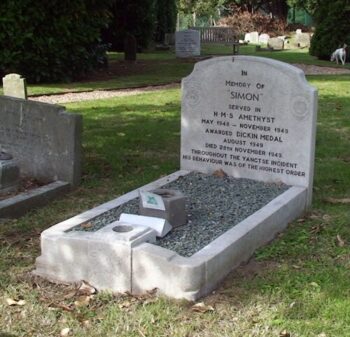
Once his story was known Simon, the ship’s cat, became an instant celebrity and was awarded the Dickin Medal (the only cat to be a recipient), which is the British serving animal’s equivalent of the VC. Despite a difficult start to their relationship Simon and his new CO had come to appreciate each other’s importance to the ship and it was Kerans who wrote the bravery citation and put Simon up for his medal. Once the award was made known thousands of letters were written to Simon, so many that one of Amethyst’s officers was detailed solely to answer Simon’s post. Sadly he died while under quarantine in UK due to an infection from his war wounds. His funeral was attended by hundreds including Amethyst’s ship’s company. In 1993 Simon’s Dickin medal was auctioned for $US32, 000 and is now displayed in the Imperial War Museum.
HMS Amethyst was repaired and refitted and returned to duty and saw action off Korea. She played herself in the film version of her 1949 escape before she was scrapped in 1956. John Kerans was promoted to Commander and awarded the Distinguished Service Order. However given his chequered early career he was clearly not destined for a glittering career as a senior officer. After being eased out of the Navy he became a British conservative MP and died in 1985 aged 70. It was Lieutenant Peter Berger, the intrepid navigator, who went on to be a Vice Admiral.
It is only possible to speculate on the possible political ramifications that might have flowed in Australia’s relationship with Britain had the Menzies government permitted Shoalhaven to attempt to become the last Nanking guardship. Had that happened and had 22 RAN lives been lost to PLA shellfire the disaster might easily have been widely interpreted by Australians as the British government once again losing young servicemen’s lives with the same nonchalance allegedly shown throughout both world wars. Memories of Gallipoli were still fresh and the recent Singapore debacle a matter of deep division and bitterness. The passionate enthusiasm with which the young Queen was greeted on her tour of Australia in 1954 confirms that most Australians in that era were still intensely loyal to the British crown. Notwithstanding this undoubted affection for the person of the sovereign, dead Australian sailors would have been a potent cause for anger directed by the Australian government and people at the British government.
Menzies’ decision to restrict Shoalhaven’s use was not only strategically correct but also politically astute. He set aside his anglophile instincts in denying his permission for the RAN to be placed in harm’s way. ‘Pig Iron Bob’ might have found himself at the centre of national fury if he had not acted to protect Shoalhavenand her men from predictable disaster with unknowable consequences for his career.
If is impossible now to assess the long term political consequences of an Australian frigate being shelled or sunk on a Chinese river 60 years ago one can reasonably assert that if it had been not Amethyst but Shoalhaven that made her daring escape down the Yangtze the event would still be well remembered in Australia, taught in school history classes and celebrated every year in all RAN messes. The extraordinary events that unfolded on the Yangtze, as the PRC was being born in the summer of 1949, can be fairly considered to have resulted in a very lucky escape for Amethyst and the RN and also indirectly for Shoalhaven, the RAN and Australia.
About the Author
Lieutenant Commander Desmond Woods OAM RAN (retired) served in the RNZN, the RN, the British Army and RAN as an education officer teaching naval and military history and strategic studies to junior officers and senior NCOs. He retired from the RAN in June 2023. He holds an MSc in Political Science from the University of Southampton and a Masters in Defence Studies from the University of NSW. He is a Vice President of the Australian Institute for International Affairs (ACT Branch) and a Councillor of the ANI and an active member of the Naval Historical Society of Australia, Legacy and the Rotary Club of Canberra. He was awarded an OAM in 2022 for preservation of the Navy’s heritage and care for the families of deceased RAN veterans.