By Tom Lewis*
It would make a great movie.
Only James Cook, a rising young officer in the Royal Navy, already known for his spectacular navigation skills, can get the ships’ boats secretly up the river at night.
On the northern bank, the French are complacent, confident that the steep cliffs above Canada’s St Lawrence river will continue to provide a barrier.
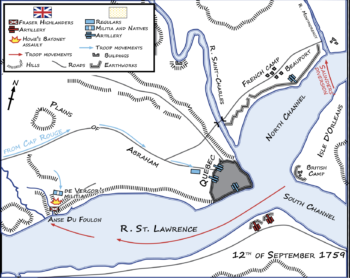
On the southern bank, the British are restless. Their ships command the river, but they have been unable to establish a beachhead, despite months of attempted landings and gunnery attacks. But tonight, brilliant young General Wolfe will task Colonel William Howe with leading a small force of infantry up an obscure path in secret. If all goes well a surprise attack on the French rear will eventuate.
If the attempt fails then the French may end up dominating all of what is now Canada and the USA. The American Revolution may never happen. If Cook had been wounded enough not to command a ship then Australia’s east coast may never have been charted. The landing where he claimed the new country for Britain may never have happened. Indeed, the world would largely be speaking French now.
Can all this come down to what happened on a small plain on the morning of 13 September 1759?
Visiting Quebec recently, this was what dominated my mind as we looked over the peaceful Canadian river.
250 years ago, it was all about who was going to possess the New World. Columbus’s four voyages of 1492 to 1504 had opened up the Americas to Europe. The Italian explorer and navigator had been commissioned by Spain, but they largely began to dominate below the equator. To the north both the French and the British began landings and then settlements. There was much at stake, with the fur trade offering immense riches.
Both countries pushed inland. The local Indian tribes attacked some of the settlements; were eventually beaten back by superior firearm technology, and then some made allegiances as best they could. Indians were to be present on both sides in the combat actions of the future.
Before Quebec’s decisive battle, it became obvious that the rivers and the lakes would be a significant part of the military movement. If your side could control an important ford, then the other side could not get across to attack you. If your side could use the water to move heavy guns, then they could be landed to aid your firepower.
Before the battle at Quebec, there had been many a fight. A significant local identity was beginning to emerge, those who we might label even then “Americans”, and they favoured taking advantage of camouflage; ambushes, and blending in with the massive forests rather than the open-plain brightly uniformed traditional tactics of the British.
Even then there were some grumblings about how far-off Britain did not understand the needs and desires of those who lived in the New World, but that was to begin in Boston years later. For now, the struggle was between the French and the British, although in what was becoming known as the Seven Years War there were plenty of other countries joining in for hopeful spoils: Prussia siding with Britain, and Austria joining France. And Portugal, Spain, Sweden, and Russia and several small states were in there too, hoping for good returns.
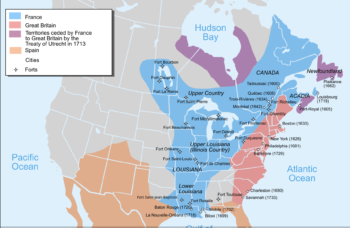
France did very well, as a glance at the map shows. But by 1759 the British had realised that taking the isolated forts at key points was working. In mid-1759, they took Fort Niagara and Fort Carillon, cutting off French forts further west. Quebec was going to be the big key. If Britain could turn it to their advantage, then they could deny the French.
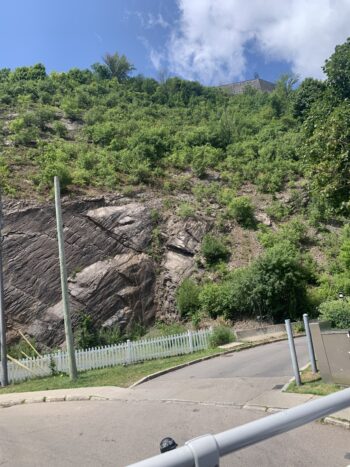
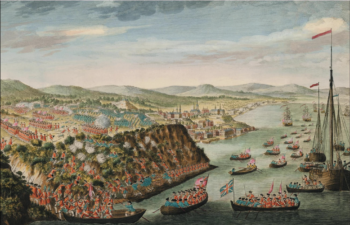
Once Colonel Howe had his initial force up the tortuous 50m cliff path, he cautiously formed it into a line while remaining quiet. More and more men followed, along with two small artillery pieces. Meanwhile, a feint attack was going on from the river: the artillery pieces of Royal Navy warships belched flame and smoke as a landing was simulated to draw off the defenders.
The French, under the brave and resourceful Marquis de Montcalm, were some two kilometres to the east of Wolfe’s men behind some defences. As the news reached him of a surprise attack, Montcalm decided to wait no longer for more enemy soldiers to ascend the heights but to fight.
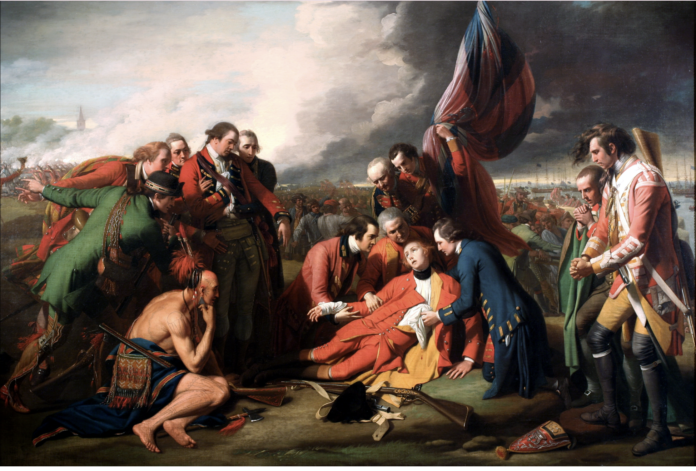
It was an infantry versus infantry slugging match. Montcalm had around the same number of troops, and he advanced while the British lines waited. Some accounts say the first volley they fired from their Brown Bess muskets was from only 40 metres range. The British control of their fire was more devastating, and soon the French retreated; the British resolutely following. Both generals, leading with immense courage, were both were fatally wounded, Wolfe dying that night, and Montcalm the next day.
The French forces retreated west to Montreal in the summer of 1760, but after a two-month campaign by overwhelming British forces, they surrendered on 8 September, essentially ending the French Empire in North America.
The battlefield of the Plains of Abraham – named after a local farmer – are worth visiting. Although much of the area was resumed as farmland, and later part of it used an airstrip, it has today been preserved as parklands and sports grounds. Driving along the lower part of the cliffs is possible, and the courage of the men who climbed up those heights is brought into your mind as you glance up at the cliffs.
James Cook was only at the start of his great career. After Quebec he was sent to chart the coastline of Newfoundland. His skills brought him to the attention of the Royal Society, and in 1768 as commander of HMS Endeavour he began the first of his three voyages. For which we may well be thankful.
*Dr Tom Lewis OAM is a military historian. His latest book is The Battle of the Coral Sea – Explained – “how America saved Australia”, published by Avonmore
Captions:
It’s all about where you are allowed to cross the river. Quebec today, with the wide St Lawrence River separating what was then the British to the south from the French north. (Google Maps)
An official portrait of James Cook in 1775 (Royal Museums Greenwich, now public domain)
The Death of General Wolfe (1771), on the Plains of Abraham, near Quebec. Painting by Benjamin West, 1770. (Public domain)
A monument to Generals Wolfe and Montcalm – the French leader’s name is on the other side. (Author photo)
A mortally wounded Montcalm being taken to the close-by town of Quebec after being wounded in the battle. (By Eugène Guénin; public domain)
At the base of the 50m cliffs which were thought to provide enough protection to prevent a British attack (Author photo)
Battle is joined; some reports say it only lasted 40 minutes before the French broke and retreated. (Hoodinski)
Engraving based on a sketch by Wolfe’s aide-de-camp, Hervey Smythe, depicting the climb by Wolfe’s soldiers. (Public domain)
How history changes in a morning, and prevents what might have been today. North America in 1750, before what was to become known by the Americans as the French and Indian War, by Britain and France the Seven Years War. (Courtesy Pinpin)
Part of the battlefield of the Plains of Abraham today – there are some 50m square of this sort of terrain, but the rest is flat. (Author photo)
Part of the battlefield of the Plains of Abraham today. (Author photo)
The Death of General Wolfe (1771), on the Plains of Abraham, near Quebec. James Wolfe was only 32. Painting by Benjamin West, 1770. (Public domain)
The landing phase on 12 September 1759 preceding the Battle of the Plains of Abraham. (Hoodinski)
What might have been today – North America in 1750, before what was to become known by the Americans as the French and Indian War, by Britain and France the Seven Years War. (Courtesy Pinpin)