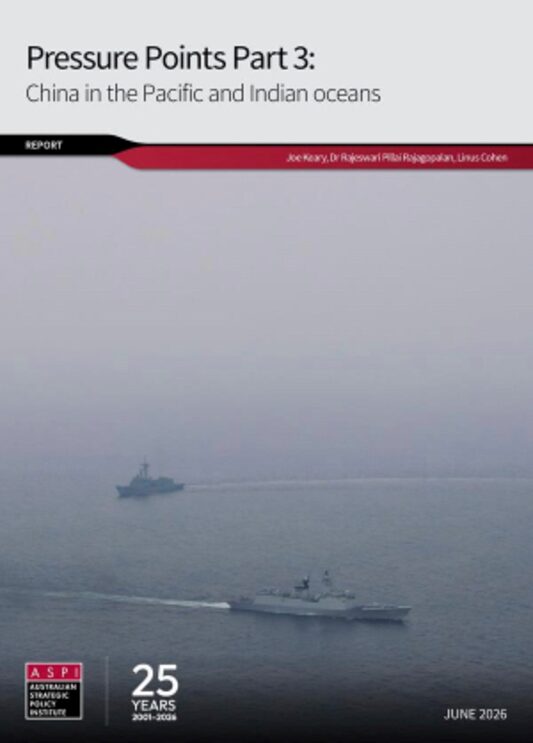
New research from the Australian Strategic Policy Institute details how and why China is expanding its security engagement across the Pacific and Indian ocean regions, the tools and actions it’s using, and what this means for regional states. What emerges is a pattern of engagement that blends military power, paramilitary forces, policing cooperation and civilian capabilities.
Too often democracies and smaller nations assess those activities, often described as hybrid or grey-zone, as below acts of war and struggle to deter them. But, together, those tools enable China to build familiarity with operating environments, normalise its presence, and pursue strategic objectives far from home waters.
Today ASPI is pleased to release the third and final instalment of Pressure Points – its online resource that has tracked the activity and behaviour of the People’s Liberation Army in the South China Sea, Taiwan Strait and now the Pacific and Indian oceans.
Authored by Joe Keary, Dr Rajeswari Pillai Rajagopalan and Linus Cohen, Part 3 unpacks the evolving landscape of the Indo-Pacific. It maps China’s activities, analyses regional responses, and considers how current trends may develop in the years ahead. The central question isn’t whether China will be present across the Indo-Pacific, but how that presence will shape the region’s future security order.
The report finds that China’s defence and security presence beyond the First Island Chain is no longer an abstract concern, but a defining feature of the Indo-Pacific strategic environment. Across the Southwest Pacific, Indian Ocean and Australia’s maritime approaches, Beijing is steadily building a pattern of access, presence and influence that’s reshaping regional security dynamics.
“Across all three regions, China’s activity is becoming more regular, more capable and more geographically distributed. Naval task groups, CCG vessels, research platforms and maritime militia assets are increasingly operating alongside regional and partner forces,” the report states.
“The result is a denser operating environment. Encounters that were once rare are becoming routine. Surveillance, shadowing and signalling activities are no longer exceptional, but are becoming part of the baseline. That reduces warning time, increases the complexity of day-to-day operations and raises the risk of miscalculation.”
The report finds that competition with China will be enduring, and recommends that Australia, India, Japan and the United States collectively step up through minilateral initiatives—such as the Quad’s Indo-Pacific Partnership for Maritime Domain Awareness (IPMDA)—to expand insight into China’s actions, invest in regional infrastructure resilience and preserve the sovereign choices of smaller littoral states.
The report authors outline the opportunities for Australia and its partners to shape the regional environment. These include:
- strengthening regional partnerships
- strengthening regional frameworks
- enhancing presence, access and denial
- investing in resilience
- competing through economic and technological statecraft
- shaping regional norms
The report finds that “China’s presence is growing, but its impact isn’t predetermined. The regional environment will be shaped by how states respond. For Australia and its partners, that requires sustained engagement, clear priorities and a willingness to compete across security, economic and political domains.”