By Tom Sharpe*
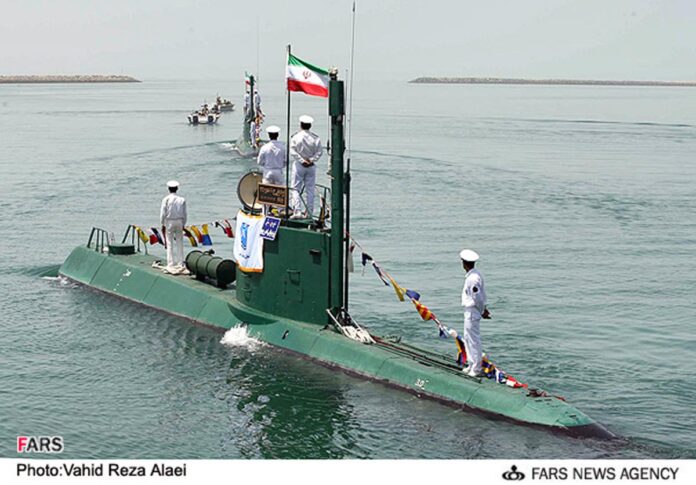
The Strait of Hormuz remains in a state of near lockdown. Many things worry merchant captains thinking of running the gauntlet there: drones, missiles, fast boats, mines. But now we have something new. This time, it’s the Ghadir mini-submarine.
Rear Admiral Shahram Irani, commander of the Islamic Republic of Iran Navy (IRIN), referred to them recently as the “dolphins of the Persian Gulf” and has said they are now deployed. These boats belong to IRIN, the regular navy, not to the separate Islamic Revolutionary Guard Corps Navy (IRGCN) which controls the surface fast attack craft. It doesn’t really matter whether they are deployed or not, the deterrent effect is the same.
Iran has around 20 of these small diesel-electric subs. They are much smaller than a normal submarine: they’re 29 metres long, displace around 150 tons and have a crew of seven. They can operate for seven to 10 days at sea on patrol, although they can extend this if they sit on the bottom and shut down most of their systems.
Ghadirs are armed with two heavyweight torpedoes and mines. If one of these gets a decent firing solution on a surface vessel, it will kill it. This isn’t like drones and missiles that often bounce off, or fast attack craft that cause a fire, or limpet mines that may just blow a hole in a ship; these torpedoes will break the ship’s back and send it down.
It goes without saying, therefore, that they need to be taken out early in any fight against Iran. When we used to wargame such scenarios on the staff, we always aimed to get them before they left harbour: I have no doubt that will have been the plan this time too. But in our wargames there were often a few that were already at sea when we started bombing. Once at sea, they are hard to find.
I know this because back when I was in the Gulf of Oman, commanding my frigate and acting as the anti-submarine warfare commander for a US carrier strike group, we went looking for them a few times. More interestingly, Commander Ryan Ramsey was out there as captain of the Royal Navy nuclear-powered attack submarine HMS Turbulent, and was also tasked to see what he could find.
Turbulent found three mini-subs and noted that they were closely coordinating, not operating as “lone dolphins” as had previously been assumed. This had not been seen before. Whilst they can dive in the conventional sense and also operate at periscope depth with snort masts up to run their diesels – which in turn charge their batteries – Ryan noted that they actually spent much of their time just below the surface, effectively as a semi-submerged vessel.
They can run diesels normally in this state and do so whilst remaining acoustically very quiet. They have only a tiny sonar signature and are painted the same colour as the water. Having some of the hull out of the water makes them more vulnerable to radar detection, particularly from the air, but again this signature is very small. There are other non-sonar detection methods that have come on since Ryan and I were last involved in this, but as ever, none of them are a magic bullet. This is warfare, not Hollywood.
Killing such a mini-sub at sea is not that easy. There is a very good chance that both the heavyweight torpedoes from Ryan’s submarine or the lightweight ones from my frigate or its helicopter would not detonate correctly because the target size is so small. In very shallow water, where the mini-subs spend much of their time, air-dropped torpedoes might have extra problems as they dive on entering the water and could strike the bottom before recovering.
My ship was carrying old-school depth charges to solve these problems if necessary and my team spent a lot of time working out how to use our main gun on a semi-submerged contact as well. Sometimes the old ways are still the best.
As with all non-nuclear-powered submarines, the Iranian boats do have limitations when it comes to getting in position to strike you. The faster they go, the more noise they make and the more they consume their battery life and then have to come back to the surface to recharge. All of these things increase vulnerability.
They have a special impeller clearly visible on the casing which enables them to hover almost noiselessly into the tide in the Hormuz Traffic Separation Schemebut Ryan noted that they actually moved around quite a lot, again, more than we expected. Hat tip to him following that activity in a busy shipping lane in a dived, full-size nuclear submarine. This is why submariners get paid more.
Getting back to the current situation, it’s not unreasonable to assume that these mini-subs could operate in very shallow water off the coast of Oman and wait for ships trying to stay away from Iran and its fast boats, drones etc. The mini-subs could sit and wait for the targets to come to them, thus negating the non-nuclear sub’s great weakness: lack of sustainable underwater speed.
It’s not possible to know how many remain unaccounted for and how they may have remained undetected since the start of the war, but as ever with submarines, unless you know for certain that number is zero – and that is hard to know – then you have to act accordingly. This whole thing could be Iranian misinformation, we have seen plenty of that, but to assure merchant shipping, you need proof.
*Tom Sharpe OBE served for 27 years as a Royal Navy officer, commanding four different warships
This article first appeared in The Telegraph and is republished with the author’s permission.