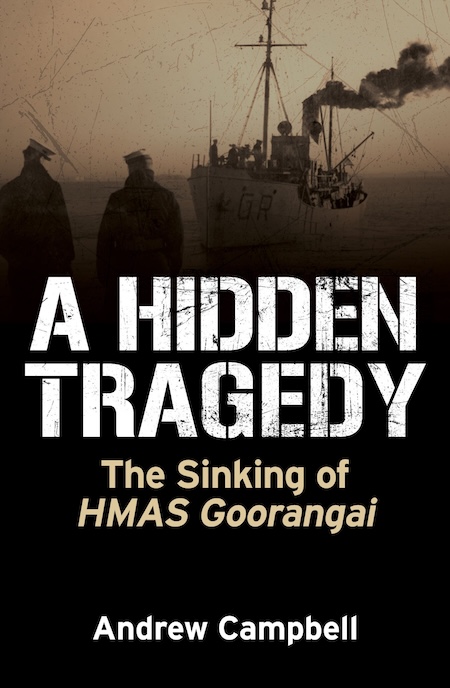
Hidden Tragedy – The Sinking of HMAS Goorangai. By Andrew Campbell. Big Sky Publishing (December 30, 2025). 273 pages. ISBN13: 9781923514164. Price AUD $ 36.99.
Reviewed by Greg Swinden
Australia had been at war with Germany since early Septembers 1939 and Italy from June 1940. RAN ships had been in action in the Mediterranean and Red Sea against Axis naval and air forces with only minor damage and few casualties incurred. The first RAN ship to be lost was not due to enemy action but from a collision in Port Phillip Bay; with all 24 members of the ships company killed. This tragedy has been often overlooked by the RAN and the Australian people yet these men died doing their duty in keeping Australia’s sea lines of communication open.
At the outbreak of war in September 1939 several vessel of all shapes and sizes were requisitioned by the navy for use as minesweepers to keep Australians ports open. During World War I a German raider had laid mines in Australian waters and this was repeated in World War II when the raider Penguin laid mines in Bass Strait in late October/early November 1940. Two merchant ships were sunk in early November and mine-sweeping commenced in earnest. Among the minesweeping force was HMAS Goorangai, a converted trawler that had been requisitioned by the RAN early September 1939 and crewed by naval reserve personnel from Victoria. German mines were found by Goorangai, and other minesweepers, and destroyed.
Minesweeping was hard work, especially in Bass Strait with its often harsh weather conditions, and the Goorangai would often anchor in Port Phillip Bay to allow the men some time for recreation and a hot shower ashore. On the evening of 20 November Goorangai anchored off Queenscliff. The weather became more inclement, and the decision was made to move the ship to an anchorage off Portsea. Goorangai weighed anchor and began the transit across the bay. At the same time the 10,000-ton merchant ship MV Duntroon was departing Port Phillip Bay with most of her upper deck lighting extinguished in accordance with RAN orders to exit the bay in a darkened state; shortly after the Duntroon collided with Goorangai. The minesweeper sank quickly and all her crew perished. Only six bodies were eventually recovered – one of which could not be identified.
Andrew Campbell has analysed the event leading up to the collision in depth and there is little doubt the master of the Duntroon failed to take the necessary actions to avoid the collision. Equally of note is the RAN’s less than robust recovery of the deceased crew which was conducted in a somewhat haphazard manner and lengthy manner. Andrew also spent many years researching the crew of the Goorangai. Part of his research included locating the gravesite, in Williamstown Cemetery, of the unidentified Goorangai sailor and having a Commonwealth War Graves Commission (CWGC) headstone placed on his grave. The headstone is of an ‘unknown sailor’ as when he was buried his identity was not known and as he now has a marked grave he cannot be exhumed for DNA analysis in accordance with CWGC policy.
Overall, this is a good read about a little known RAN tragedy and highly recommended .
*Andrew Campbell served in the Royal Australian Naval Reserve for more than 40 years, including work in Mine Warfare Group 54 (the same group that HMAS Goorangai was part of). Andrew was a technical specialist (procurement and explosive ordnance with the Department of Defence). He has written articles on naval history that have been published in Navy News, Australian Warship, The Australian Reservist, and The Australian Naval Institute Journal. He is the recipient of the Orchard Prize and a commendation from the commanding officer of HMAS Cerberus for his research into Goorangai’s unidentified sailor.