On 22 May 2026 the Australian National Audit Office (ANAO) released its report Defence’s Collins Class Submarines Life of Type Extension — Planning and Implementation. Below is a summary by the ANAO.
Why did the ANAO do this audit?
- Australia relies on the Collins class submarines as a core element of its maritime defence capability.
- As the fleet ages, a Life of Type Extension (LOTE) is required to maintain submarine capability and availability until Australia transitions to a future nuclear-powered submarine fleet under AUKUS.
- Without a service life extension, these submarines would be withdrawn from service between 2026 and 2036.
- The LOTE project involves significant public expenditure. It is critical to avoiding a submarine capability gap during the transition to nuclear-powered submarines under the AUKUS partnership.
- The audit provides independent assurance to Parliament on the effectiveness of the Department of Defence’s (Defence) planning and implementation of the LOTE project to date.
Key Facts
- Since the system and detailed design contract was awarded in February 2022, it has been varied 53 times, increasing by $688 million to more than five times its original value.
- Four of the five key design reviews were not achieved as scheduled.
What did ANAO Find?
- Defence’s planning and implementation of the Collins class LOTE project was partly effective.
- Defence adopted a delivery strategy that involved major redesign and replacement of key submarine systems using common equipment, suppliers and technologies selected for the former Attack class submarine program, to reduce risks in that program. This decision significantly increased the technical complexity and risk profile of the LOTE project.
- When the Attack class submarine program was cancelled in 2021, Defence did not reassess the LOTE delivery approach or present government with alternative options.
- The risks associated with this approach have been realised. Costs have grown, delays have accumulated and the scope of the project was reduced.
- In May 2026, Defence proposed and government agreed, a revised service LOTE strategy.
What did ANAO Recommend?
- There were five recommendations to the Defence aimed at improving project planning, risk management and the quality of advice provided to government.
- Defence agreed to all five recommendations. (see details below)
Summary & Recommendations
Background
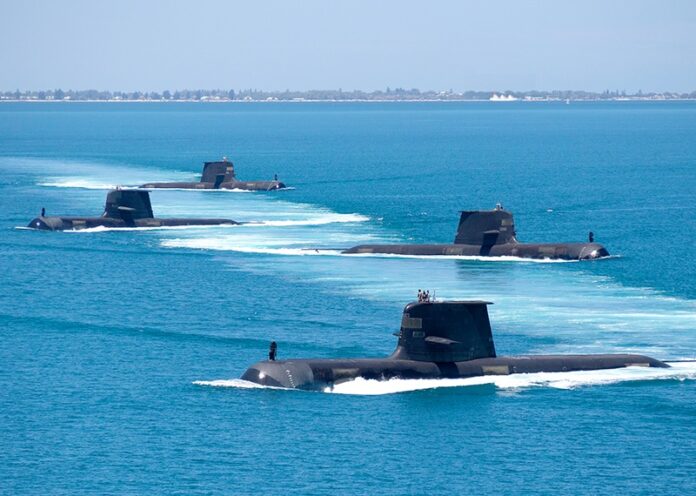
The RAN operates a fleet of six Collins class submarines. These submarines are among the Australian Government’s key strategic military assets, providing anti-submarine warfare, anti-surface warfare, intelligence, surveillance and reconnaissance, mine warfare capabilities and support to special operations.The Collins class fleet entered service between 1996 and 2003. Each submarine has a design life (life of type) of 28 years and, without an extension, was scheduled to be withdrawn from service between 2026 and 2036.
The Collins LOTE project was established to avoid a submarine capability gap by extending the service life of the Collins class during Defence’s transition to a larger and more capable submarine fleet. At the time the LOTE was initiated, the program to replace the Collins class submarines – the Future Submarine Program – envisaged a conventionally powered replacement fleet. The program was announced in April 2016 and later designated the Attack class in December 2018. That program has since been superseded by the nuclear-powered submarines to be delivered under the AUKUS agreement.
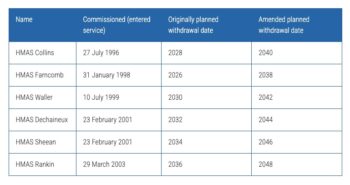
Work to determine the scope of the Collins class LOTE commenced in June 2016, initially focused on extending the service life of three submarines — HMAS Farncomb, HMAS Collins and HMAS Waller. The LOTE project formally commenced in September 2018. In September 2021, the Australian Government announced that the service life of all six Collins class submarines would be extended by a further 12 years. The original planned withdrawal dates and the amended planned withdrawal dates for each submarine are set out in the table below.
Rationale for undertaking the audit
The Collins class submarines are a key strategic asset for Australia. Successful execution of the LOTE project is critical to maintaining Australia’s submarine capability during the transition to a future fleet of nuclear-powered submarines under the AUKUS partnership. The LOTE project has an approved budget of $1.56 billion (2021–22 to 2031–32) and has been assessed by Defence as a ‘high’ risk project. Given ongoing parliamentary interest in the project, this audit provides independent assurance to Parliament on the effectiveness of Defence’s planning and implementation of the LOTE, including progress achieved to date.
Audit objective and criteria
The audit objective was to examine the effectiveness of Defence’s planning and implementation of the LOTE for the Collins class submarine fleet. To form a conclusion against the objective the following high-level criteria were adopted.
- Did Defence effectively identify requirements and assess options?
- Has Defence established effective governance, oversight and risk management arrangements?
- Has Defence effectively undertaken the planning and implementation activities required to commence the life of type extension?
The audit examined Defence’s planning, governance, risk management and project management arrangements for the Collins class submarines LOTE, including implementation against agreed project plans and milestones, and the monitoring and reporting of progress. The audit did not examine Collins class submarines operations, the effectiveness of sustainment arrangements, or the management of capability upgrades.
Conclusion
Defence’s planning and implementation of the Collins class LOTE project was partly effective, with the project not managed in a way that was commensurate with its complexity, risk profile and strategic purpose. The project was intended to sustain Collins class capability and availability through the transition to the future submarine fleet. Against that strategic purpose, Defence’s approach to defining the scope, assessing options and advising government did not adequately adapt following the cancellation of the Attack class submarine program. As a result, substantial further expenditure has been incurred, delays have accumulated and capability risks have remained. This means that Defence is not well-placed, as at May 2026, to demonstrate that the project will achieve its intended capability outcomes or represent value for money.
Defence’s arrangements to identify requirements and assess options for the Collins class LOTE were partly effective. Defence identified a business need to avoid a capability gap by extending the service life of the Collins class submarines. The LOTE project was originally positioned to mitigate risks with Defence’s transition from the Collins class submarines to the Attack class. Defence did not ensure that emerging risks to the Attack class program, or the fact that alternative submarine capability options were being examined, were disclosed to the personnel making key LOTE scope, procurement and design decisions. Following the cancellation of the Attack class program, the LOTE became critical as the bridging capability to support the transition to the nuclear-powered submarines under the AUKUS trilateral partnership. This heightened the importance of robust option-setting and clear, timely advice to government when key assumptions changed.
From 2019, Defence shaped the scope and delivery approach for the LOTE around an explicit decision to align the LOTE with the Attack class submarine program. This alignment involved a major redesign of the Collins class submarines that required the replacement of key equipment and systems. This decision was driven by an expectation of cost and schedule benefits, from having common systems and as a method to mitigate risks in the Attack class program. Alignment of the Collins LOTE with the Attack class program was adopted without robust options analysis or a comprehensive risk assessment. This effectively foreclosed consideration of alternative delivery strategies and constrained advice to government at key decision points. Subsequent reviews found the decision to align the LOTE with the Attack class program transferred significant design, schedule and integration risks to the project.
When the Attack class program was cancelled in 2021, the rationale for the alignment strategy no longer held. Defence did not systematically reassess the scope, delivery strategy or available options for the LOTE, nor did it present alternatives or advise government of the risks in a timely way. In May 2026, Defence proposed, and the government agreed, to a revised delivery approach for the LOTE. This revised approach is centred on refurbishing and retaining existing systems and equipment to maintain availability of the Collins class submarines out to 2048.
Governance, oversight and risk management arrangements were partly effective. Defence had oversight mechanisms that supported senior visibility of project status and emerging risks. The governance and risk management settings did not provide commensurate assurance that key risks were being managed in line with the project’s complexity and risk profile. Capability development framework requirements supporting disciplined risk-based decision-making were not consistently met, including articulation of the risk tolerance and evaluation of whether controls and mitigation measures were operating effectively.
Oversight arrangements provided multiple avenues for risk reporting and senior visibility, supported by independent assurance activity and advisory scrutiny. These arrangements did not provide clear, centralised assurance that risk treatments and controls were effective, and several strategic risks remained above tolerance levels during the period examined. Weaknesses in the mandated risk reporting system also affected the reliability of risk information, requiring project personnel to implement workarounds to support data integrity.
Planning and implementation of the LOTE project has not been effective. Defence was slow to establish project and contract management arrangements commensurate with the scale, complexity and risks of the project. Key management artefacts were absent or delayed, and baseline controls were not established when design work was initiated and progressed, reducing Defence’s ability to manage delivery in a disciplined way during critical early phases.
Defence has committed substantial funding without demonstrating commensurate progress against contracted milestones. The system and detailed design contract, awarded in February 2022, has been amended 53 times and increased from $125 million to $813 million. By February 2026, Defence had spent $693 million on project definition and design activities, and related equipment procurements to replace key systems and extend the service life of the Collins class submarines. While the project was under its approved budget as at March 2026, this reflects missed milestones and scope reductions rather than delivery efficiencies.
Delays have accumulated and Defence has adjusted the delivery strategy and scope of the project to manage emerging risks. As at May 2026, Defence was not on track to install the LOTE updates on the first submarine in June 2026 as originally planned. Ten years after the initial decision to establish the LOTE project, Defence was also not well-placed to demonstrate that the project will achieve its objective to maintain Collins class capability and availability to 2048. In May 2026, Defence proposed, and government agreed to, an alternative service life extension strategy, changing the direction of the project after ten years of planning and design activity.
Supporting findings
Identify requirements and assess options
Defence identified that the business need for the Collins class LOTE was to maintain submarine capability and availability through the transition to the future submarine fleet. From 2019, however, Defence shaped the project scope to align the LOTE with the Attack class submarine program, including the adoption of common designs, systems and equipment. This approach established a significant interdependency and materially increased the scope’s complexity by introducing major system replacement and integration activities on an ageing platform before feasibility, whole-of-platform impacts and workforce requirements were well understood.
Following the cancellation of the Attack class program, Defence did not adequately reassess the project scope to reflect the changed circumstances. Subsequent scope reviews, revisions and reductions indicate that this interdependency altered the project’s risk profile and reduced the stability and defensibility of the scope approved at key decision points.
Defence’s approach to identifying, assessing and evaluating options for the LOTE was constrained by its decision to align the project with the Attack class submarine program. Once adopted, this approach effectively foreclosed consideration of alternative delivery strategies. Defence did not present government with alternative options to deliver the LOTE, including after the cancellation of the Attack class program in 2021, and this constraint persisted despite the changed circumstances.
Although Defence undertook a LOTE project scope review in 2022, the review did not examine alternative delivery approaches or test whether continuing with major system replacement remained justified. Work to identify possible alternative approaches to deliver a LOTE for the Collins class submarines commenced in June 2024, however Defence continued to progress major system replacement as the preferred approach until October 2025, when risks were unable to be reduced to an acceptable level.
In March 2026, Defence proposed an alternative option to deliver a LOTE for the Collins class submarines. The recommended option was presented to government in May 2026 and involves refurbishing and maintaining existing systems instead of redesigning and replacing them for five of the six Collins class submarines. This is a fundamental shift in the delivery strategy for the project.
Prior to the cancellation of the Attack class submarine program, Defence’s advice to government and senior Defence leadership emphasised the anticipated benefits and opportunities associated with aligning the Collins class LOTE with the Attack class submarine program.
Following the cancellation of the Attack class program, Defence did not clearly advise government of the implications of continuing the original LOTE delivery approach. Nor was government presented at that time with alternative delivery options or a reassessment of the LOTE strategy. In contrast, senior Defence leadership was progressively informed of the significance, challenges and risks that had been transferred to the LOTE project.
Governance, oversight and risk management
Defence was slow to establish governance arrangements that reflected the project needs and risk profile. Governance forums included overlapping membership of key decision-makers, which provided redundancy and supported visibility of the risks and issues, yet these arrangements were not efficient in practice. Governance bodies largely operated as information sharing forums and decisions were largely made by individual authorised delegates. Delays in reporting, escalating and addressing high and very high risks occurred. Decisions were not recorded in a centrally managed register or captured in Defence’s enterprise task and action tracking tool, limiting transparency and Defence’s ability to monitor the implementation of decisions.
In contrast, the oversight arrangements were fit for purpose, with Independent Assurance Reviews conducted and recommendations largely implemented. Capability Manager Gateway Reviews and reporting from the Submarine Advisory Committee provided ongoing scrutiny and visibility to senior leaders of emerging and persistent risks.
Risk management arrangements were not mature and did not operate effectively. The project risk management plan was not approved until October 2022 and did not include a project risk appetite or tolerance statement as required. Strategic risks exceeded tolerance levels, and the mandated risk reporting system often lacked documented controls and assessments of control effectiveness. Deficiencies in the risk reporting tool and data governance affected the reliability of risk information and required the development of workarounds, limiting assurance that risk controls and treatments were effective.
Planning and implementation
Defence’s project and contract management arrangements were not commensurate with the LOTE project’s complexity and risk profile during critical early phases. Key project and contract management documents were absent or delayed, including the late establishment of baseline schedule controls and delayed approval of the integrated project management plan in June 2024. The system and detailed design contract has been amended 53 times, since it was awarded in February 2022, increasing from $125 million to $813 million. This indicates that scope, complexity, cost and risks were not well understood when the contract was awarded.
Defence has not achieved planned milestones and delays have accumulated over the life of the project. Only one of five key design reviews (contract milestones) was achieved on schedule, and Defence has modified milestone approaches and baselines as design issues emerged. The accumulated delays contributed to the decision to reduce the scope planned for installation on HMAS Farncomb, with design work for the full core work package not complete as at early 2026.
A separate performance management framework for the LOTE project was not established, and no project-specific performance measures were included in either the In-Service Support Contract or the system and detailed design contract. Defence advised that LOTE performance is managed through the projects’ governance arrangements and milestone-linked profit payments, and that overall outcomes would be assessed through the In-Service Support Contract performance management framework.
In practice, these arrangements provided limited leverage over performance. Key design milestones were amended or replaced as delays accumulated, reducing the effectiveness of milestone-linked payments as an incentive for delivery. Project reporting did not provide an effective basis for oversight during earlier phases of the project and, in October 2022, was not adequate to support proper governance. Reporting arrangements improved from late 2024 following the transition to acquisition-project reporting requirements, with regular scope, cost, schedule, workforce and risk updates provided to Defence senior leadership and relevant governance committees.
Recommendations
No.1. The Department of Defence ensure that, following significant program changes or shifts in its strategic environment, all underlying assumptions, risks and delivery approaches are systematically reassessed, and alternative options are presented for government consideration. Department of Defence response:Agreed
No.2. The Department of Defence strengthen its processes for documenting and presenting the rationale, value for money analyses, and risks of establishing significant interdependencies with other projects or programs when making major capability investment decisions. Department of Defence response: Agreed
No. 3 The Department of Defence ensure that its advice to government on strategically important projects such as the Collins class LOTE clearly articulates both risks and opportunities, including interdependencies with other major projects. Department of Defence response: Agreed
No 4. Department of Defence ensure that decisions that are likely to materially affect the dependent programs or projects are disclosed to relevant stakeholders where a clear ‘need to know’ exists, so that risk management and project direction can be appropriately informed. Department of Defence response:Agreed
No.5. The Department of Defence ensure that the effectiveness of the controls and mitigation measures are evaluated, recorded and regularly reviewed, in line with the requirements of the Risk Management Manual. Department of Defence response: Agreed
The Full report can be accessed at:
Source: ANAO