The relationship between technology and maritime strategy has been a common thread running through many articles that appeared in the Journal of the Australian Naval Institute. In the 2005 Winter edition, it was specifically addressed by, soon to be Admiral, Mark Hammond. He was then a Lieutenant Commander and about to assume command of the submarine HMAS Farncomb.
An effects based approach to Technology and Strategy
I would not put so many dollars and so many people into so good a target. Come to think of it, I would not put anything on the surface of the ocean – it’s too good a target.
Edward Teller: the Aircraft Carrier after 1945
I must confess that my imagination…refuses to see any sort of submarine doing anything, but suffocate its crew and founder at sea.
H.G. Wells: the impact of the submarine in 1902
Teller, the father of the Hydrogen bomb, can be forgiven for suggesting that surface vessels were obsolete over 50 years ago. He knew little about nuclear fallout and collateral issues that today limit the usefulness of atomic weapons. Besides, as demonstrated by H.G. Wells, predicting the impact of new technology on future naval operations and strategy has always been problematic.
The industrial revolution heralded an unprecedented arrival of new technologies. Steam propulsion replaced wind. The aircraft carrier and submarine added new dimensions to maritime warfare. These new ship designs found many navies unprepared for their impact, essentially because they revolutionised the maritime battlespace and provided the Means for wars to be fought in different, unprecedented Ways.
Today, the Defence Science and Technology Organisation (DSTO) suggests that the driving factor in ship design in the 21st century will be emergent technologies. Given that ship designs dictate their capabilities, and that naval operations are both enabled and limited by these capabilities, it may be possible to draw conclusions about how future naval forces will operate by interpreting the impact of forecast technologies on the capabilities of future vessels. Furthermore, an examination of the past thirty years, the era of the information revolution, may yield insights that enhance our understanding of developments expected in the next thirty years.
This article discusses how forecast technological developments in hull forms, propulsion systems, sensors and weapons might impact on how medium power navies operate over the next 30 years. Firstly, forecast developments or ’emergent technologies’ are reviewed and interpreted using Effects Based philosophy a prism that enables clear articulation of the impact of new technologies on naval capabilities. Trends are then summarised and assessed to determine dominant developments. Next, a medium naval force of 1974 is glimpsed to provide insight into what has really changed during the technology revolution of the past 30 years. Finally, the article summarises the likely impact of future technologies on medium-power naval operations over the next 30 years.
Effects based interpretation of emergent technologies
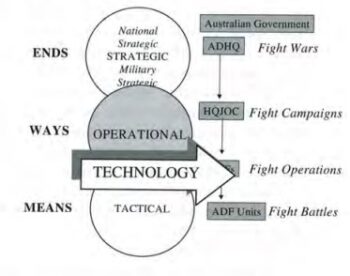
Effects based philosophy describes physical, functional or psychological outcomes, events or consequences that result from specific actions. The Australian Defence Force (ADF) will operate its future forces within a National Effects Based construct. Another medium navy, the Royal Navy (RN) also embraces Effects Based Operations. As shown in the diagram below, the philosophy views military units (Means) as providing a variety of military options (Ways) for achieving strategic objectives (Ends). In this manner, technological changes to naval forces (Means) impact the effects that they can generate and, therefore, the Ways in which Ends can be achieved. Hence, the close relationship between strategy and technology. It is therefore both practical and appropriate to use this philosophy to interpret the impact of emerging technologies upon our future capabilities.
Emergent technologies are ‘…technologies that may impact on future Naval ship design and construction’. Typically, this genre is constrained to relatively mature, prototype proven or funded technologies. Whilst other concepts, theories and ideas exist, it is difficult and perhaps premature to attempt qualitative description of their potential impact until they have made the difficult transition from theory to prototype. For the purpose of this article, therefore, forecast developments will be limited to emergent technologies in four areas – hull forms, propulsion systems, sensors and weapons.
Hull forms
Today’s modern warship is typically a monohull vessel of varying length, breadth and draught, designed as required to maximise capabilities in terms of payload, sea-keeping ability, power projection and survivability. Forecast developments in hull design include advanced monohull (planing hulls, hydrofoils, wave piercing and Deep Vee hulls) and multi-hull designs (catamaran and trimaran, wave piercing, Small Waterplane Twin Hull (SWATH) and Surface Effect Ships (SES)). To gauge their impact on naval operations, these developments should be interpreted in the context of the effect created by the technology upon the platform.
All of these forecast developments increase vessel speed (Hydrofoils > 60 knots, Deep Vee > 55kts, Wave Piercing Mono-hulls: sea transport> 30 knots) and efficiency. As such, it is possible to predict a trend toward faster, more efficient naval vessels that have greater endurance. It is also noteworthy that the majority of designs inherently reduce vessel draught and acoustic signature. Three of these attributes speed, efficiency and shallow draught were examined in the context of High Speed Vessels (HSVs) in the RAN’s 2003 Headmark Experiment. The experiment demonstrated that HSVs provide excellent manoeuvre warfare capability in shallow littoral environments whilst producing significant targeting problems for air, surface and sub-surface opponents. However, as discovered by a US HSV project, operational effectiveness of current prototypes is attenuated by relatively poor sea-keeping in sea states greater than eight feet, although this deficiency might be overcome by advanced trimaran designs.
Trimaran designs afford hull-drag reductions of 20% or more whilst simultaneously enhancing the sea-keeping qualities expected of conventional mono-hull designs. Similarly, Surface Effect designs permit a catamaran hull to ‘ride’ over a cushion of air maintained between the hulls, reducing drag and noise signature and permitting beaching in some conditions. Clearly, the trend is toward faster, quieter and more efficient shallow draught vessels.
There will also be continued advances in submarine hull design. Whilst propeller and propulsion changes account for the majority of speed improvements in current diesel-electric and nuclear submarines, advanced streamlining is becoming increasingly important. Vortex control devices and eddy break-up devices were used to counter hydrodynamic flow issues (with associated noise and speed consequences) on both the RAN Collins and US Navy Seawolf class submarines. This has had the effect of reducing acoustic signature and fuel consumption whilst increasing speed and endurance.
In summary, potential improvements in hull design produce the physical effects of improved fuel efficiency/endurance, reduced acoustic signatures, increased vessel speeds and improved access to shallow (or shallower) water. This bodes well for tempo-based strategy such as manoeuvre warfare, especially in the littoral. These trends may be further enhanced by propulsion system developments.
Propulsion systems
Propulsion Systems include propellers, propulsors and associated fuel and auxiliary systems. Forecast developments include enhanced electric propulsion, fuel cell technology, water-jet propulsors and super-cavitating propellers. Again, these developments seek to increase vessel speed, efficiency/endurance and/or to reduce acoustic signatures. In the context of a naval vessel however, it is important to note that propulsion efficiencies can also enable greater power generation to support weapons and sensors.
Conventional marine propulsion systems convert mechanical, gas or steam energy into rotational propeller or directional water jet motion, whilst separate power generation sources provide for sensor, weapons and ancillary demands. Enhanced electric propulsion systems, as envisaged by the US Electric Ship concept, centre on Integrated Power Systems that use electric motors driven by a common power generation system to simultaneously provide power for sensors, weapons and auxiliary demands. This reduces the size and complexity of the power generation/propulsion system, freeing up space for other capabilities whilst improving fuel economy by 15-19%. Developments in battery technology are evidenced by improved performance amid reduced size/weight of mobile phone batteries in recent years. Translated to the maritime environment, this has produced more effective conventional submarines with greater endurance and increased stealth.
Just as the automotive industry is investing increasing amounts of money in electric propulsion and hybrid car designs, it can be expected that hybrid ship designs will follow. Perhaps the RN’s Type 23 frigates and Type 45 destroyers represent a portal to the future of quiet, fuel efficient ship design. Fuel Cell technology and Air Independent Propulsion are also likely to become more common. German Type 212 submarines are at sea today, propelled by fuel cells. The technology has also been tested in a USN surface vessel.
Fuel cells create electrical energy from chemical reactions without moving parts, generating less heat and acoustic noise than conventional combustion processes. However, there are associated speed limitations. Overall, the technology affords increased stealth, endurance and efficiencу.
Water-jets provide increased efficiency for vessels in the range 25 to 40 knots. Located near the surface, they also allow a shallower vessel draught. Super-cavitating propellers also improve vessel efficiency by increasing thrust, allowing speeds measured in hundreds of miles an hour. The cavitation effect does increase noise signature, however, super-cavitation technology may yet revolutionise naval power in the same way that the supersonic jet impacted air power.
To summarise, advances in propulsion technology are likely to increase naval vessel stealth, speed and efficiency, with some technologies again enhancing shallow water efficiency and access. These improvements appear to reinforce hull design advances, potentially auguring an era of faster, shallower draught, quieter, and more efficient naval vessels. Again, manoeuvre warfare concepts are reinforced. However, future naval forces will require an array of intelligent sensors to maintain situational awareness to exploit enhanced battlespace access and manoeuvre.
Sensors
DSTO notes that ‘Sensor development appears to be growing at an exponential rate in miniaturisation, sensitivity and applications. Furthermore, predicting future sensor capabilities out to 30 years is significantly problematic because ‘…unpredicted technological advances can render systems obsolete mid development’. That said, it may be possible to draw some relatively robust conclusions by reviewing current developmental efforts.
Some remote-controlled and autonomous sensors are already mature, particularly Unmanned Aerial Vehicles (UAVs) and Unmanned Underwater Vehicles (UUVs). HMAS Warramunga has controlled, tasked and received sensor information from a UAV. The US has completed more than 300 UUV missions including mine-warfare operations in Umm Qasr during Operation Iraqi Freedom. Future developments may include submarine launched UUVs capable of conducting reconnaissance, mine-laying, inshore photography and beach survey work. UAVs similarly permit operations behind enemy lines, or in contested air space where the risk of casualties is unacceptable. Both UUVSs and UAVs are embedded components of future forces for the RAN and RN. Further advances in robotics and miniaturisation of power sources will inevitably increase the endurance, dexterity, reliability and flexibility of these platforms, perhaps rendering current maritime aircraft redundant.
In terms of communications, data-rates have steadily increased in the past 30 years and this trend is likely to continue. Directional Extra High Frequency (EHF) and Super High Frequency (SHF) communications enable platforms to transmit high volumes of information (including video) instantaneously, rendering forward deployed units (eg submarines and special forces) almost undetectable by today’s interception technology. Furthermore, there have been significant advances in covert underwater communications that enable submarines to communicate with other submarines, ships, bottom sensors or sonobuoys without being detected. The technology can also be adapted to control UUVS, or to switch on or off remotely activated mines without the need for an umbilical. The effect created by this technology is one of enabling and exploiting covert, integrated operations in hostile environments – again, enhanced battlespace access.
Sonar technology is also proceeding apаce. Multi-beam technology has enabled three dimensional seabed mapping for commercial purposes. An early derivative called ‘Petrel’ is now being fitted to RAN frigates. The equipment enables real-time seabed analysis for mine avoidance, navigation and submarine detection. Similarly, submarines will be able to exploit this technology to aid navigation in shallow water, opening safe access to previously unsurveyed (or poorly surveyed) archipelagic waters, and enabling inshore mine-laying operations without the need to return to periscope depth to receive satellite navigation data. Other advances include Explosive Echo Ranging, Low Probability of Intercept sonar and Low Frequency Active Passive Sonar (to detect submerged submarines at greater distances).
Radar surveillance is becoming increasingly supported by satellite technology. Medium navies, embracing the network enabled concept, are realising the theatre level surveillance opportunities afforded by real-time satellite observations using a range of detection, classification, intelligence collection and communications capabilities. However, other technological advances are decreasing platform vulnerability by improving stealth, counter-detection, early-warning and decoy systems.
It is therefore difficult to quantify the gains that might be realised in the next 30 years as improvements in related fields vie for ascendancy in detection capability on the one hand, and stealth on the other. However, it is possible to surmise that the net effect on the future maritime battlespace will be networked forces informed by a diverse array of advanced organic and remote sensors, enabling greater access to the maritime battlespace and greater certainty in the maritime picture than is currently available. Naval forces will consequently demand longer range, more responsive and increasingly accurate weapons systems to maintain a reach advantage over their adversaries.
Weapons
Naval weapon systems can be broadly categorised as either above water or below water. Above water weapons are employed against surface vessels, aircraft and, increasingly, land targets. Below water weapons target a vessel on or below the sea surface – primarily submarines and ships. The objective is usually to destroy or damage the target; though in effects based philosophy the right terminology might be to ‘neutralise the effectiveness of the target. Future weapon systems will also exploit emergent technologies, and increasingly target them too.
Naval gunnery now employs rocket propelled munitions, improved computer-aided targeting and rapid-fire technology such as Metal Storm (1 million rounds per minute, infinitely variable rate of fire). Rail guns and pulsed power systems are now being developed for electric ships that will still be in service in 2034. Missile technology, whether ship, submarine or air launched, arguably demonstrates the same trends. Terminal homing capabilities now exploit third party guidance (eg laser designation) as well as providing options to home on heat or infra red signatures.
Similarly, laser technology continues to produce potential weapon applications, possibly in the area of missile defence. DSTO assesses that solid state laser technology will permit efficiencies that allow employment on naval vessels. High power microwave weapons are also on the horizon (2010), and variants called Masers (Microwave Amplification by Stimulated Emitted Radiation) may permit the employment of multi-megawatt pulses of radio energy against the electronics in missiles, UAVs or aircraft. The ‘effects’ of these developments (against air, land or sea targets) include extended range, improved rate of fire and, in some instances, improved accuracy and lethality.
Advances in underwater weaponry, like sonar technology, continue relatively unabated. The 2034 generation of torpedoes and mines may be able to: recognise and counter most decoy systems; recognise and target specific vessels; exploit bottom topography to aid stealth whilst homing; engage at extended ranges that negate improvements in counter-detection technology, whilst remaining undetected until a point at which the kill probability approaches certainty. However, other advances may provide new challenges. Super-cavitating bullets could produce an underwater Close-In Weapon System (CIWS) capable of engaging torpedos and mobile mines during their terminal homing phase. Anti-torpedo torpedos and Submarine Launched Anti-aircraft Missiles (SLAM) may also arrive as technology continues to advance, perhaps maturing before 2034. In fact, Graeme Dunk suggests that submarine technology advances will outpace anti-submarine developments, citing a reduction in effectiveness of maritime patrol aircraft as one likely result.
Again, the pace, complexity and diversity of developments render it difficult to predict a resultant ‘balance of power’ between stealth and detection on the future battlefield. Perhaps it is more productive to simply surmise that weapon engagement ranges and accuracy are likely to improve.
However, a significant shift in the balance may yet result from a revolutionary development, such as the ability to ‘see’ underwater to a range of thirty nautical miles or more, or the ability to consistently destroy torpedos or mines prior to impact/detonation. Alternately, the significant weapon developments of the next 30 years may in fact produce capabilities that reliably target and disrupt an adversary’s computer systems and information exchange capabilities. Perhaps the key to tactical and strategic advantage in 2034 may reside in the ability to employ weapons against sensors rather than platforms, to lever advantage by attacking the ‘eyes’, ‘ears’ and ‘brain’ of the opponent, before threatening the ‘body’ with lethal, surgically precise strikes. Developments in electromagnetic interference technologies, including Masers, may yet find more targets in a network-enabled battlespace.
Hypotheses aside, the net effect of naval weapon development seems to point toward increasingly accurate, longer range, more reliable systems with greater rates of fire and lethality. The arrival of laser and microwave weapons, as well as highly advanced underwater systems, may shift the focus from attrition of equipment to neutralisation of systems through targeted electromagnetic interference. The continuing battle between development of detection and targeting systems versus counter-detection and counter-targeting systems render it difficult to predict revolutionary changes in this field.
Observed trends and their likely impact on medium-power naval operations
Interpreting forecast technological developments in terms of the effects they might have on naval platforms yields several conclusions. Firstly, future platforms will benefit from hull and propulsion improvements that provide more speed, stealth, endurance and efficiency. In many instances, they will also be increasingly effective in shallow water. Future platforms will maintain improved situational awareness provided by a diverse array of advanced organic and remote sensors, many of which can operate in hostile environments without risking human lives, enabling greater certainty in the maritime picture than is currently available.
All of this points toward future forces that are increasingly ‘aware’, more integrated, and therefore, perhaps, more difficult to effectively neutralise or defeat. Superficially, it would seem that survivability, efficiency and effectiveness are the big winners, particularly in shallow water. Perhaps this indicates improved capacity to exploit high-tempo manoeuvre warfare in Littoral environments.
However, improvements in sensors must be weighed against increased platform stealth and extended range, stealthier weapons. New missile and torpedo technology may yet be countered by new defence systems (eg underwater CIWS). Whilst increasingly accurate, longer range, more reliable systems with greater rates of fire, and perhaps greater lethality, are being developed, so are more effective countermeasures and ‘anti-weapon weapons’ (eg anti-torpedo torpedoes, Masers). Therefore, apparent gains must be taken in context. It may therefore be prudent to contemplate how technology has historically impacted the way naval forces operate.
In broad terms, the RAN of 1974 consisted of aircraft carriers, submarines, destroyers and frigates, as well as logistic support ships, amphibious ships, patrol craft, mine warfare vessels and hydrographic vessels. Based on current plans, the fleet of 2034 is likely to include submarines, air warfare destroyers, frigates, logistic support ships, amphibious ships, patrol craft, mine warfare vessels and hydrographic vessels. Aircraft carrier aside, the force structure appears fairly static. Similar comparisons can be made with the RN.
Over the past 30 years the RAN has engaged in operations in environments ranging from benign (eg humanitarian assistance) to hostile (eg 1991 and 2002 Gulf Wars). The RN has a similar history. Today’s RAN employs advanced weapons and sensors, compared to the fleet of 1974, and its current ships and submarines are quieter and more tactically ‘aware’ than their predecessors were. Although they exploit technology to improve communication and cooperation between units (eg common operating picture, coordinated operations etc), the RAN and RN still operate their forces in much the same way that they did thirty years ago. That is, collectively or independently to project force in order to protect or disrupt Sea Lines of Communication, to provide Sealift, and to exercise or contest Sea Control. In war, they still detect, classify and engage targets.
Emergent technologies will enhance detection, classification and engagement capabilities, undoubtedly impacting on the way some naval operations are conducted, but these impacts appear predominantly marginal and consistent with past experience. Barring massive development of unmanned platforms, such as UAVs and UUVs, there are potentially no revolutionary inventions (such as would rival the invention of the submarine or aircraft carrier) on the immediate horizon. Therefore, if the past thirty years are any indication, it appears that force structures and roles will change very little as a result of forecast technological possibilities.
That said, new weapons (eg Masers) are being developed that can target the technology that enables Network Centric Warfare in the first place. This may create an opportunity to shift strategic focus from attrition of equipment or platforms, to neutralisation of the systems that enable them to see, hear, fly, float, move and fight, using targeted electromagnetic interference weapons. We may yet witness the emergence of new battlespace effects and therefore options, or Ways, as a result of technological changes to the Means.
Put simply, although the RAN and RN have evolved during the information technology revolution that continues today, their force structure has remained static. Apart from a trend to greater internal and external interoperability and joint/combined operations, the battlespace effects they generate and the way in which these forces operate has not fundamentally changed as a result of new technology. Noting the continuing technology trends, the same might also be predicted for the naval forces of 2034.
Conclusion
Certainty is relative… Technological changes to naval platforms impact their capabilities, adding, subtracting or altering the combat effects that they can create within the maritime battlespace. These ‘effects’ contribute to providing various military options for achieving strategic objectives. In this manner, technology impacts strategy through the Ends, Ways, Means construct of Effects Based Operations.
Medium power naval forces have changed little in terms of force structure in the past thirty years despite variations in tasking and operational tempo that have ranged from benign humanitarian assistance roles to war in the Falklands and the Gulf. These insights have been gleaned during the information technology revolution that continues today. It therefore serves a useful pointer to the potential impact of technology in the future.
Objective Effects Based analysis of emergent technologies, coupled with a retrospective appreciation of the past thirty years, yields several conclusions. Firstly, forecast technological improvements will continue to impact on medium power naval forces in much the same way as during the past thirty years – evolutionary, rather than revolutionary. Trends toward improved stealth, speed, efficiency, endurance and effectiveness will be enhanced by greater computer power and communications, enabling unprecedented battlespace awareness. Future forces will be reliably networked but they may be vulnerable to new weapons such as Masers. High-tech unmanned vehicles will increasingly permeate the battlespace, bringing with them new opportunities and new threats. Access to the littoral will be improved. These new capabilities may enable battlespace effects that yield new options for achieving warfare objectives. Technology will therefore continue to impact on naval strategy through the Ends, Ways, Means construct.
The way that naval forces operate over the next thirty years will gradually evolve along current lines as a result of forecast technological improvements. However, unless revolutionary changes render entire platforms obsolete, as Edward Teller predicted would happen to the aircraft carrier after 1945, these changes are unlikely to be revolutionary.
A fully annotated version of Mark Hammond’s article can be accessed at:
https://navalinstitute.com.au/wp-content/uploads/2014/04/Headmark-117-Winter-2005-part-1.pdf
About the Author
Vice Admiral Mark Hammond AO RAN joined the RAN in 1986 as a sailor. In 1988 he joined the Australian Defence Force Academy as a midshipman, graduating with a Bachelor of Science. He went on to become a submariner and completed both the Principal Warfare Officers and Submarine Warfare Officers courses. His appointments have included command of HMAS Farncomb, CDF Liaison Officer to Chairman of the Joint Chiefs of Staff, Commander Australian Fleet, Deputy Chief of Navy and Chief of Navy. He is a graduate of the Australian Command and Staff College. In July 2026 Admiral Hammond will become first submariner to become the Chief of Defence Force.