Vietnam continues to expand the size and scope of its Spratly Island outposts, maintaining the pace of island building seen over the past several years while also beginning to construct specialized infrastructure at features where land reclamation is already complete, the Asia Maritime Transparency Initiative reports.
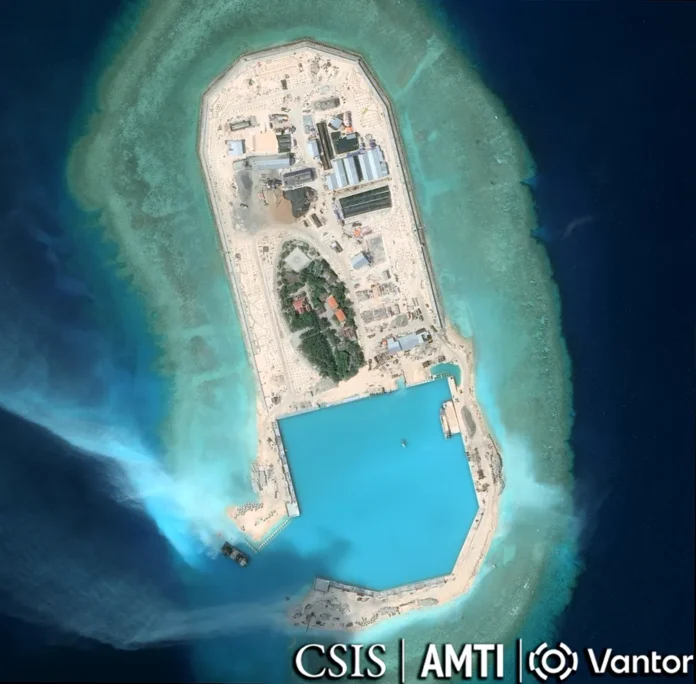
Since AMTI’s last measurement in March 2025, Hanoi has proceeded with its dredging and landfilling activities at a remarkable pace. Over the past year, Vietnam has created an additional 534 acres of land across the Spratlys despite having already finished landfill operations at several features. Those include Barque Canada Reef, now Vietnam’s largest base, where the new artificial landmass was completed by the spring of 2025. Since then, Hanoi’s dredging and landfill has focused on smaller expansions at several new features beginning in the second half of 2025. The new dredging brings Vietnam’s total area of artificial land reclaimed to approximately 2,771 acres.
This expansion also translates to additional environmental damage. Vietnam’s total reef destruction, which includes both reef covered by landfill as well as areas dredged to create channels and harbors, now stands at roughly 4,120 acres, approaching the total area China had destroyed by dredging and landfill as measured in 2023.
While Vietnam’s island-building activities appeared to be catching up to China’s in early 2025, Beijing’s new reclamation activities at Antelope Reef have widened the gap. The inclusion of Antelope—likely now the largest island in the South China Sea—has pushed China’s totals to approximately 5,460 acres of artificial land and 6,224 acres of reef destruction.
Without the development of Antelope Reef, Vietnam’s total reef destruction would have amounted to 89 percent of China’s total, but now instead amounts to only 66 percent.
Vietnam is still in the process of adding landfill at several smaller features where initial dredging activities began at the end of last year. In the meantime, there have been notable infrastructure developments on the larger, more developed reefs.
Hanoi already hosted a total of twelve harbors across its outposts in 2025. Satellite imagery shows that an additional three harbors are taking shape at Grierson Reef, Petley Reef, and South Reef.
This brings Vietnam’s current number of harbors in the Spratlys to 15, with 11 of them newly created since 2021. And given that Hanoi is still actively reclaiming land at several features, this number is almost certain to expand further. Initial construction of another likely harbor can already be seen at Landsdowne Reef:
Recent satellite imagery shows the installation a new communications structure that has not been previously observed on other Vietnamese occupied features. Construction began in August 2025 and appears to have been completed by April 2026.
The installation appears to be a Doppler VHF Omnidirectional Range (DVOR) navigation beacon, with its appearance and size being strikingly similar to those identified at each of China’s Spratly airstrips. Given its similar size, it’s likely that Barque Canada’s DVOR beacon will have a similar range, providing accurate navigation for Vietnamese aircraft within 100 nautical miles of the island.
China’s rapid expansion of Antelope Reef has cemented Beijing’s lead in island-building—and environmentally destructive dredging. But, unless Beijing continues to expand other islands or installs radically different capabilities at Antelope than at its other bases, Vietnam’s overhaul of its Spratly outposts is likely to have the greater impact on the operating environment in the South China Sea. With most of Hanoi’s expanded islands now fully formed, the transition to infrastructure construction has begun. It won’t be until these facilities are complete and Vietnamese military and law enforcement begin to operate from them, however, that the full effects of Hanoi’s expansion will be felt.