By Tom Sharpe*
Interest in the Falkland Islands rises and falls predictably. The anniversary of the 1982 liberation is usually a peak. Argentina generally stirs the pot on the day they think we took the “Malvinas” from them. Domestic political pressure in Buenos Aires, frequently linked to economic difficulties, often sees the islands used as a distraction.
This time the trigger is different as reports emerge that the United States is reviewing aspects of its support for British sovereignty there, apparently as a way of registering irritation with our perceived lack of help in Iran.
Militarily, could Argentina invade us tomorrow given what we both have in place? The answer to that is no. They lack the logistic capability to support such an attack. In 1982 they deployed a credible power-projection force: an aircraft carrier, a cruiser – the famous General Belgrano – destroyers, submarines and an air force of more than a hundred fighter jets, including Super Etendards equipped with ship-killing Exocet missiles, along with Skyhawks, Daggers and Mirages. Much of the airpower was operating at the limit of its range but as history tells us, some of it worked. The Argentine army was large, even if not well prepared for amphibious assault. The junta calculated that a rapid operation might create a fait accompli before Britain could respond effectively. It was a gamble that didn’t pay off.
Our own footing on the islands has also changed markedly since 1982. Before the Argentine invasion the garrison consisted of a small detachment of Royal Marines and the part-time reservist Falkland Island Defence Force. The Marines didn’t surrender tamely: they put up a stiff resistance, defeating an Argentine commando force sent to seize the Governor and only laying down arms when surrounded by two battalions of Argentine armour. The Argentines then released them back to the UK: on arrival there they promptly volunteered to join the task force preparing to retake the islands, and returned with their comrades to do just that.
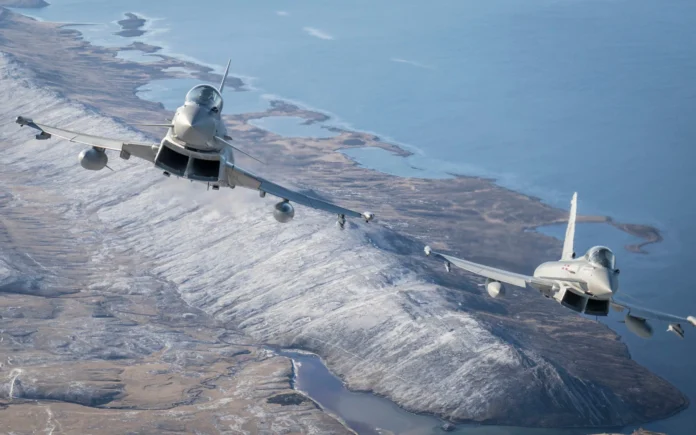
Today, Mount Pleasant airfield on East Falkland is a decently equipped facility. It hosts a permanent detachment of four Typhoon fighters on quick-reaction alert with an A400M transport aircraft in support and until recently a Voyager tanker. The tanker has just been seconded to the Middle East. In terms of tactical military effect in support of the Typhoons this aircraft isn’t actually that important, but like the withdrawal of HMS Endurance in 1981, the optics aren’t great. Distressingly, the Falklands Typhoons are the Tranche 1 variant, with very limited ability to attack moving surface targets such as ships.
There’s also a roulement infantry company from the Army, supported by engineers, logistics specialists and air-defence assets, which brings the total strength to between 1,300 and 1,700 personnel. An almost unarmed River-class offshore patrol vessel has been our permanent naval presence there since the destroyers and frigates of the standing Atlantic Patrol Task (South) stopped heading that way in the early noughties. Radar coverage, hardened aircraft shelters and prepositioned supplies would further complicate any surprise attack.
Overall, it’s not exactly Finland preparing for Russia, and you just know that munition stocks will be limited, but it’s a much tougher nut to crack than it was in 1982: and the Argentines no longer have as much in the way of nutcrackers. Even once the second-hand F-16 fleet is up and running, their air force will be much smaller than it was then and it has only two tanker planes.
Of course the Argentines might manage to neutralise Mount Pleasant by means of a special forces operation or a mass drone swarm or something, and with the Typhoons out of the picture they might well be able to overwhelm the resident infantry company. Possibly a fifth column might be infiltrated among the numerous migrant workers nowadays to be found in the Islands. What could we do then?
In some respects we are actually more capable than we were in 1982, despite the lost big budgets of the Cold War. A submarine with a war stock of Tomahawk land-attack missiles would mean a completely different situation to 1982, but only if one were available. Likewise, an aircraft carrier with a decent force of F-35B stealth jets – and, crucially, the radar helicopters we lacked in 1982 – would be formidable, completely outclassing and even potentially outnumbering the Argentine F-16s, but we would struggle to assemble a carrier escort group or an air wing of any size right now.
Worse still, we have no solid support ships at the moment, so our carrier could only fight for a limited period before running low on supplies and munitions. Normally we get help in this respect from allies, but they might not see such a war as their business. The Royal Marines and their army counterparts are just as tough as they were in 1982, but today we have almost no amphibious shipping to transport them in.
Falklands 2 would be so different from Falklands 1 that it would be hard to call. Much would depend on grit and determination at the political level: Mrs Thatcher had plenty, but we might not be so lucky this time.
We can say for sure, however, that a renewed boots-on-ground invasion attempt would run a severe risk of defeat, which would be a political disaster for President Javier Milei: he would probably be very reluctant to take that gamble.
But what about grey zone tactics? We used to wargame a submarine-inserted special forces team landing on West Falkland, placing a flag and claiming a PR coup. Argentina doesn’t have submarines any more, but what if a fishing vessel or a cargo ship deployed drones against the islands? Is our intelligence good enough to know if that was coming? If not, the Typhoons might be late on the scene. What if we thought this wasn’t just grey-zone provocation but was in fact the start of an attack? Before you know it you are firing very expensive missiles at very cheap drones – lesson 101 from the latest Iran war and the Red Sea. What if it is a real attack and they crater the runway, stopping reinforcements from flying in?
None of this constitutes an invasion but all of it is possible. We should have proper anti-drone defences in place. These weren’t in place for Cyprus, which suggests they aren’t in place down south either. Argentina could fairly easily push us into shooting ourselves out of munitions at very little cost or risk, and then the islands would be under genuine threat of invasion.
The Falklands remain British territory, inhabited by people who have repeatedly and overwhelmingly affirmed their wish to stay that way. Their location astride important sea lanes and resource-rich waters gives them enduring strategic value. We should defend them robustly, both politically and militarily: anti-drone kit permanently deployed could save us a lot of money and blood down the road.
*Tom Sharpe OBE served for 27 years as a Royal Navy officer, commanding four different warships. This article is republished from The Telegraph with the author’s permission.