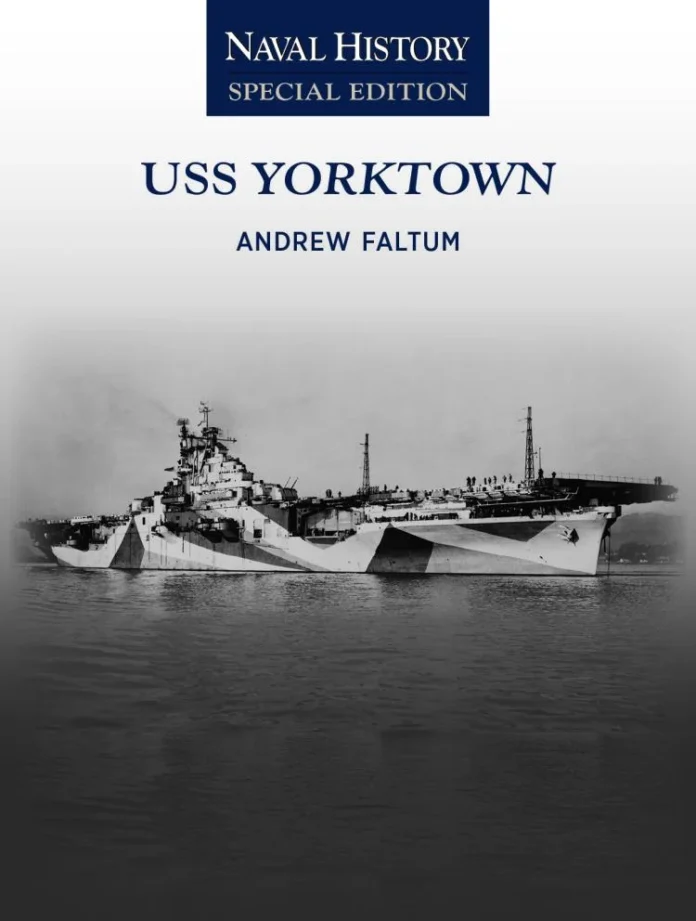
USS Yorktown. By Andrew Faltum. Naval Institute Press, Annapolis, Maryland, 2026 ISBN 978-1-68247-981-0 (Printed softback). ISBN 978-1-68247-984-1 (eBook)
Reviewed by David Hobbs
This slim paperback book is one of the United States Naval Institute’s Naval History series which describe individual ships, aircraft types and battles. It describes the USN Essex class aircraft carrier Yorktown, CV-10, built by the Newport News Shipbuilding & Dry Dock Company and completed in 1943.
There are 100 pages of text illustrated with 132 excellent photographs from the USNI’s collection. Most are black and white but there are a significant number, especially those relating to the ship’s later years, that are in colour.
The text is brief but informative, divided into twenty sections which describe the ship’s career with the US Pacific Fleet from 1943 to 1945 and, after a period of eight years in reserve, her modernisation and subsequent operational career, mainly in the Pacific including deployments into the Vietnam war zone. Boxed inserts describe the ship’s 5-inch and quadruple 40 mm gun mountings; Mark 37 directors; the camouflage schemes applied to both the ship and her aircraft; the various aircraft types she operated throughout her career and significant individuals who commanded her or flew from her. These are interesting and add depth to the text.
Apart from her significant operational career, Yorktown starred in several films including the 1944 documentary film The fighting Lady which was awarded an Oscar in 1945. Scenes filmed on board the carrier were also included in the 1944 action drama A Wing and a Prayer. In 1970 she appeared in Tora! Tora! Tora! repainted to resemble the Imperial Japanese Navy’s Akagi during the attack on Pearl Harbor with a number of AT-6 and BT-13 trainers on deck modified to look like Japanese Zero, Kate and Val carrier aircraft. When these took off many of Yorktown’s flight deck sailors wore appropriate Japanese naval uniforms while filming took place. The aircraft could not land back on board and so, after the filmed launch sequences they flew back to NAS North island near San Diego. In 1968 helicopters from Yorktown recovered the crew of Apollo 8, amid widespread media coverage, after their splashdown in the Pacific a thousand miles southwest of Hawaii. The three astronauts had been the first to launch from the Kennedy Space Centre in Florida and had orbited the Moon ten times before returning to earth. In 1970 Yorktown was decommissioned into the Atlantic Reserve Fleet Reserve and in 1975 she was donated by the USN to the Patriot’s Point Naval & Maritime Museum at the mouth of the Cooper River in Charleston Harbor. She remains there today with a collection of historic aircraft on board together with artefacts from the Apollo 8 space mission.
This book certainly does justice to Yorktown and will be an interesting addition to the library of any readers interested in the fast carriers that played such an important part in the Pacific War and the decades that followed it. I thoroughly recommend Andrew Faltum’s book on Yorktown to anyone interested in the USN fast carriers that fought in the Pacific and formed the core of the fleet in the immediate post war years.