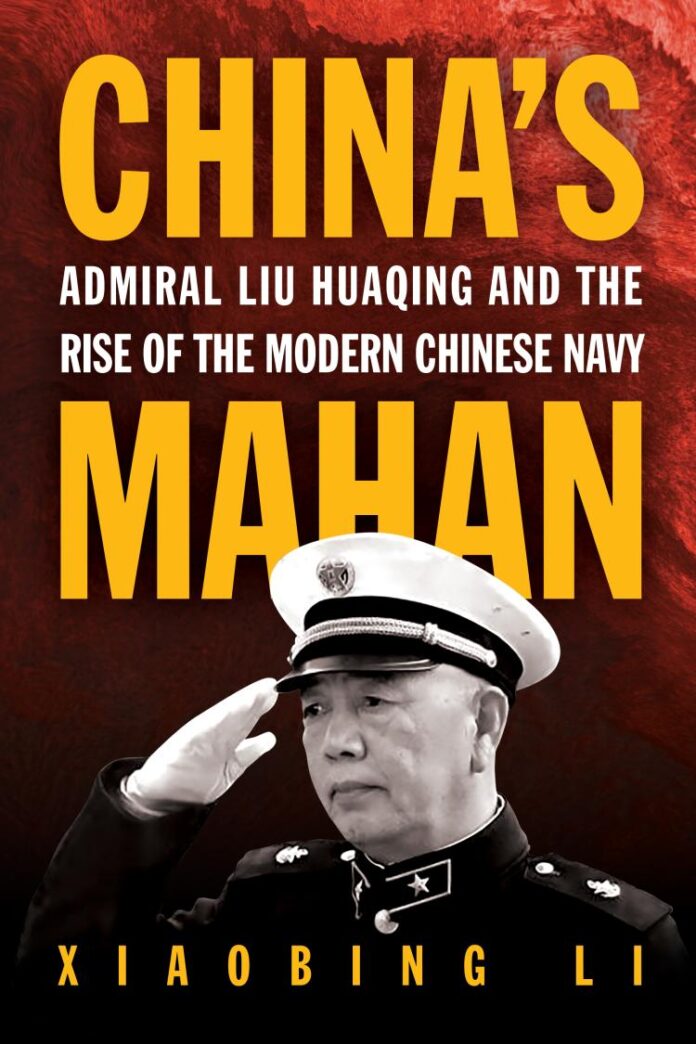
China’s Mahan. Admiral Liu Huaqing and the Rise of the Modern Chinese Navy. By Xiobing Li. Naval Institute Press, Annapolis, 2026
Reviewed by Tim Coyle
The development of naval thinking in the late 19th and the early to mid-20th century were largely guided through the theories of formidable maritime intellectuals. These relatively few theoreticians strove to influence the stolid conservatism of senior officers and their political masters.
The first rank of these visionaries is invariably considered to be Alfred Thayer Mahan, Julian Corbett, and Sergey Gorshkov. To this select group must be added Liu Huaqing of the People’s Liberation Army-Navy (PLAN).
Lui Huaqing is a worthy inclusion to the firmament of great naval thinkers as he is credited for the rise and rise of the PLAN from the earliest period of the PLA’s victory over Chiang Kai Sheck’s Kuomintang (KMT) on the Chinese mainland in 1949. Liu Huaqing’s single-minded visionary zeal for the creation of a powerful Chinese navy is evident today in the US Navy quaint referral to the PLAN as its ‘pacing challenge’.
The book’s author, Xiaobing Li, is well qualified to write Lui Huaqing’s professional biography. He is a professor of history at the University of Central Oklahoma and has written several books on Chinese military history. Perhaps his most apposite claim to expertise on the PLA is that he served in it.
One might question whether Liu Huaqing was actually ‘China’s Gorshkov’ rather than a Chinese version of Mahan. Both Liu Huaqing and Gorshkov were visionary pioneers of their countries’ sea power and shared similar backgrounds and service conditions. Both worked in communist authoritarian political environments. Both were naval power advocates in army-dominated conservative politburos. Gorshkov battled against the Red Army establishment which had emerged victorious from the Great Patriotic War in 1945. The Soviet Union was essentially a land power – the navy was a maritime force subservient to the army.
By the early 1950s Gorshkov, having achieved universal reputational respect for his heroic war service, was appointed Commander-in-Chief of the Soviet Navy. It was from the position that he transformed the service into a powerful worldwide naval capability which was the US Navy’s ‘pacing challenge’ of the 1950s to the 1980s.
While the Soviet Navy had a history and tradition forged in war this was not the case for the PLAN; it didn’t exist before April 1949. Having achieved victory over the KMT on the mainland, there arose an urgent requirement for a maritime force to capture littoral islands and, with the decampment of the KMT to Taiwan, the coup-de-grace of seizing and incorporating that island into the People’s Republic of China (for the definitive work on the PLAN establishment and early operations see ‘Mao’s Army Goes to Sea’, Georgetown University Press, 2023, reviewed in these columns).
To achieve this challenge, PLA officers were posted to embryonic naval appointments which they regarded with some trepidation as the majority – having endured the famous Long March from October 1934 to October 1935 and then battling the KMT and the Japanese occupiers – were now faced with a totally alien concept of creating a maritime force.
As with Gorshkov, Liu Huaqing had a distinguished military career. A veteran of the Long March, Lui Huaqing had joined the Red Army in 1930. He became head of the 25th Army Political Department during the the March and, by 1949, had passed through several prestigious political commissar postings. His military career underwent a drastic change when he was appointed deputy political commissar of the Dalian Naval Academy in 1952, despite him claiming he had ‘never seen the sea’.
As mentioned above, this appointment was not unusual at this stage of the development of the PLAN. Most of the emergent navy’s personnel were KMT navy defectors. These had been trained by the US Navy on American ships and equipment, so their professional skills were in demand as operators and instructors. However, the PLA required trustworthy cadres with demonstrated party and leadership capabilities to take the navy forward; Liu Huaqing was in a prime position to embark on a totally new direction.
The Soviet Navy was the logical source of training and naval management expertise to which Liu Huaqing and his colleagues were tasked to emulate. He was sent to the Voroshilov Naval Academy in 1954, promoted to Admiral and, in 1958, was appointed to senior positions at the Lushun Naval Base and as Deputy Commander of the North Sea Fleet.
The PLAN officers at the Soviet naval colleges were willing students and voraciously absorbed the Soviet naval practices and procedures. The PLAN became a Soviet clone until the Sino-Soviet split of 1960 by which time the Soviet influence began to wane as Chinese local technical expertise grew in capability.
Lui Huaqing’s managerial qualities were widely respected in the PLA bureaucracy to the extent that he was seconded to defence industry in the mid-1960s. He survived the manic upheavals instigated by Mao Zedung’s Great Leap Forward (1958-62 – for rapid industrialisation and collectivised agriculture), and the Cultural Revolution (1966-76 – a disastrous sociopolitical movement to preserve communism by purging suspected capitalists and seditious elements).
Many of Liu Huaqing’s colleagues in high party positions were purged and sent to the fields to work as labourers. Many of these were rehabilitated years later and returned to their former positions; one of those affected was Xi Jinping.
Liu Huaqing’s industrial position protected him from these maelstroms and by 1969 he was back in the navy as director of the Naval Shipbuilding Industrial Group, as well as PLAN Deputy Chief of Staff and a senior position in the Chinese Academy of Sciences.
It was in these influential positions that he was to exercise his visionary PLAN development initiatives. Rejecting the still prominent PLA views that saw the navy as a maritime support to the army, he redirected PLAN thinking from favouring a largely coastal defence force fielding quantities of fast attack craft with destroyers and frigates as the major fleet units. Rather, Liu Huaqing saw the PLAN as a first-class navy to be developed to rival the US Navy and as a fitting branch of service to carry PRC power and prestige, not only in the Indo-Pacific but the wider maritime world. He would accomplish this aim in a three-stage program; his vision was powerfully accelerated by his appointment as PLAN Commander-in-Chief in 1982.
Liu Huaqing required a fleet which would initially dominate out to the First Island Chain – extending from the Kuril Islands to Borneo – as a natural and military barrier to access from East Asia to the Pacific Ocean; this was to be achieved between 2000 and 2010.
Stage Two was to take PLAN dominance to the Second Island Chain – extending from the Japanese Bonin and Volcano Islands through the Mariana and western Caroline Islands to Western New Guinea. This was to be accomplished between 2010 to 2020. By 2040 the PLAN would be a navy of the first rank, leaving behind its US ‘pacing challenge’ status to achieve the full capability as a ‘peer competitor’.
Liu Huaqing’s priority was the construction of nuclear submarines and aircraft carriers. The latter was aided by the acquisition of the decommissioned Australian carrier HMAS Melbourne when it was controversially bought for scrapping in the 1980s.
Lui Huaqing’s drive and dedication to building the PLAN is exhaustedly covered in China’s Mahan. It demonstrates the patient learning process the PLA has followed over decades in studying Western equipment designs, procedures, tactics and strategies. Some commentators have decried the PLA as having little or no combat experience since the confrontations with Vietnam in the 1970s. Such commentaries are ill-advised as the PLA has grounded its expansion on the forensic examination of the conduct of operations and technical exploitation of foreign actors. The West must not underestimate the PLA’s intent and capabilities.
It is cadres such as Liu Huaqing, who brought the PLA to be the ‘apex challenger’ to the West, particularly the US. His driving ambition, in the wake of Sergey Gorshkov, has delivered a most formidable PLAN which deserves the utmost respect as a potential protagonist.
Xiaobing Li has documented Liu Huaqing’s biography with the unique knowledge and experience of a PLA ‘insider’ and, as such, he gives us much to learn and ponder as we review the People’s Liberation Army-Navy’s spectacular growth and assess how we might interact with it at sea.