
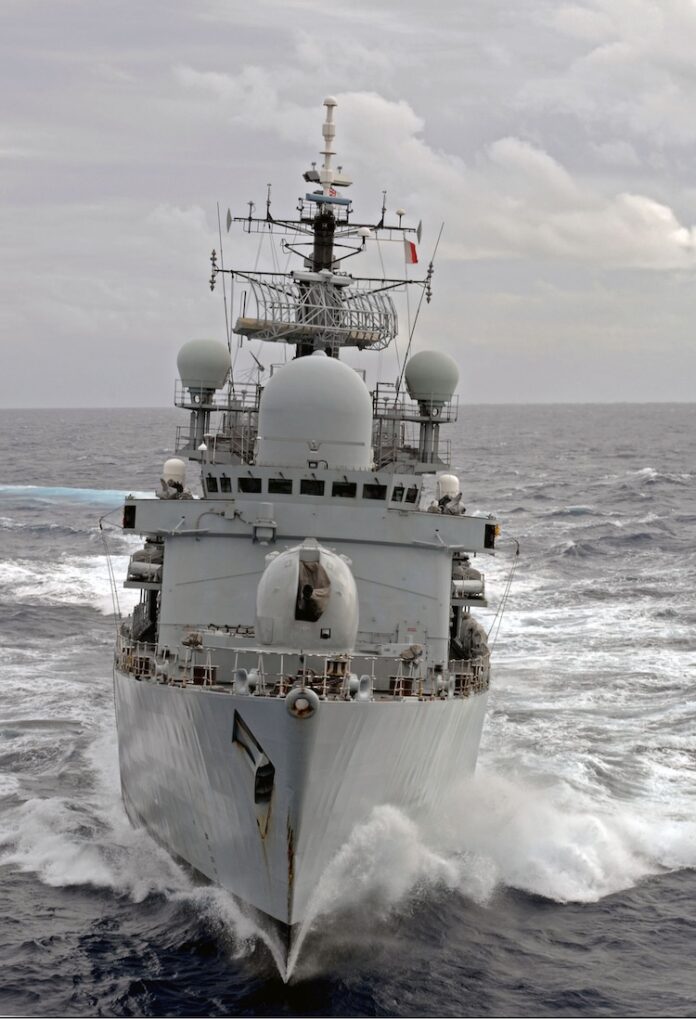
In 2002 the British destroyer HMS Nottingham (Commander Richard Farrington) ran aground off Lord Howe Island. The ship survived thanks to the damage control effort of her ship’s company. At the centre of that effort was her Marine Engineering Officer (MEO), Lieutenant Commander Ian Groom who wrote this illuminating article on the incident. In appeared in the Winter 2004 edition of the Journal of the Australian Naval Institute.
The grounding of HMS Nottingham – The view from HQ1
Author’s Note: The ship is divided along its length into watertight sections which are labelled alphabetically from A (Foremost section) to R (Aftermost section). The section letter is generally preceded by a number, which gives the deck the compartment it is on. 1-Deck is the weather deck, and all decks below are numbered consecutively down with the lowest deck being 5. Any deck above the weather deck is preceded by a 0, and numbered up, eg 01, 02 and 03.
In July 2002, HMS Nottingham, a Royal Navy Type 42 destroyer, was conducting a Five Powers Defence Agreement deployment in the Far East, having left the UK in March of that year. The ship was in transit from Cairns, Australia to Wellington, New Zealand and had spent an afternoon at anchor off Lord Howe Island. After sailing from the island later that evening, the ship reduced her watertight status from Condition Y (intermediate state of watertight integrity) to Condition X (lowest state of watertight integrity). A short time later, at approximately 2203 when in State 3 (peacetime readiness state) and making 12 knots with a single Tyne gas turbine driving one shaft and with the second shaft trailing, the ship struck Wolf Rock. Simultaneously the bridge piped ‘Emergency, emergency, standby collision forward’.
Establishing the picture
Immediately on hearing this call, the ship’s company reactions were instinctive and there could be no doubt that Nottingham had hit something very large. As the ship’s MEO, the author, made his way directly to the permanently-manned HQ1, which is the focal point for all damage control operations, and heard the bridge pipe ‘Close all red openings’. On his arrival in HQ1, there were flood alarm, indications from C, D and E sections, and the crunching and grinding noises from the hull were still ongoing. The ship was brought to Emergency Stations and the general alarm was sounded. All spare hands were mustered in the Junior Ratings dining hall, which was clear of the incident and clear of the upper-deck, as it was night and the weather was inclement.
The machinery control room staff had started all fire pumps and generators as a standard operating procedure, but C-section fire pump was lost immediately. Full astern on both propellers had been rung on, the bridge having ordered the second engine to be started. The first report received from the forward fire and repair party post was a request to shut 2/3 E port and starboard hatches as the water was approaching the hatch level and there was concern that it would spill into the cross passage. As the water had reached this level in less than two minutes, it was clear that first-aid leak stopping was not going to be effective in E section. Therefore the 2-Deck hatches were dropped.
It was reported that 3/5 C hatch was shut but water was leaking through the hatch and fixed hatch waterwall into compartment 3C. The water level was rising, but the incident was being attacked by the Standing Sea Emergency Party (SSEP), which was attempting to shore the hatch. Compartments 2B and 2A were reported clear of damage. The 3D/4D hatch was also reported as being shut, but leaking severely with the water rising in 3D mess deck. This incident was being attacked by the forward fire and repair party post. A slow flood in the forward engine room was reported by the machinery control room and was believed to be coming from the starboard stabiliser. This ingress was being attacked by the emergency station machinery space crews who requested a salvage eductor which was then put into operation.
Shortly after these initial reports, the Executive Officer (XO) arrived in HQ1 and reported that there was also flooding in 4F and 4G. This was discovered after he had initiated a further overall search, as the forward fire and repair party post had initially concentrated on searching the E to A sections of the ship. The HQ1 camera was used to check the conversion machinery room, 4G, and this showed the water level to be approximately 2.5cm deep at this point. The aft fire and repair party post was instructed to attack the flooding in 4G and 4F.
During this period the author spoke to the Weapons Engineer Officer (WEO) on the bridge and reported the extent of known damage. The WEO for the command wanted to know if it was safe for the ship to come off the rock, and whether it was stable. The author informed him that the ship was stable, and that it was imperative it should be taken off the rock. This information was based on the fact that the ship was still taking damage on the rock, and that with the flooding it had sustained at that time was well within the damage example shown in the ships’ documentation as being survivable. This example showed flooding up to 2-Deck and back as far as H section. The author also knew that following the modification of Nottingham‘s fuel tanks, she was in a better liquid state than shown in the Class book.
Initial priorities
It is not entirely clear how long it took to identify all the damaged compartments but it is estimated by the author that within 5-10 minutes an outline picture had been formed and there were damage control teams conducting initial actions. There was no way of knowing the extent of the underwater damage and those onboard could only deal with what was known, which meant establishing sealed boundaries to prevent further damage and flooding. The challenge was to prioritise equipment and effort to each of the incidents. Initially, it was considered that the flood in 3C was containable and being addressed, as was the flood in 3D mess deck, while the flood in E section was contained. The author believed that the forward engine room flooding would be held using the salvage eductors and pumps, and therefore the priority incident should be 4G conversion machinery room – because of the effect it would have on the ship’s communication and control systems – closely followed by 4F. He was confident that if all flooding could be held below 3-Deck level the ship would not sink, provided no further damage was sustained. A check of the damage and survivability data, confirmed that view.
As a result, both salvage eductors were started in the forward engine room and a portable eductor was rigged in 3C. In addition, WEDA submersible electric pumps, each with a capacity of about 100t/hr, were sent to 3D, 4F and 4G.
The Electrical Damage Control Officer (DCO (L)) was instructed that his priority was to make isolations to the conversion machinery room in order to safeguard the personnel there. The Propulsion Manager was dealing with the incident in the forward engine room whilst also ensuring the continued availability of propulsion to the command. Following the initial ‘Command Huddle’ in HQ1 and setting of priorities, Nottingham was taken off the rock and reached a safe anchorage, as with both engines now running and the primary steering available she was judged capable of this evolution.
Nothing is ever as straightforward as it sounds. Once the ship had come off the rock, and as the teams began attacking the flood in the conversion machinery room, it was necessary to isolate the 450V supplies to the space. Either during the isolations or as a result of the water ingress into the conversion machinery room, the following equipment power was lost:
- both gyro compasses,
- main broadcast,
- bridge services, including rudder angle indication and telegraphs,
- electrical supplies to bot gyro compasses,
- rationalised internal communication equipment (RICE) and the telex, and
- conning
Clearly, this added further complications and confusion, particularly with regard to navigation. Due to the loss of rudder angle indication, the bridge assumed that there was a steering failure and, correctly, went to mechanical wheel operation. Unfortunately, on assuming mechanical wheel the Bosun’s Mate, who was a first sea-draft operator mechanic, was not confident. He was unfamiliar with the use of the emergency conning, which was the only means of communications available to him and, because the tiller-flat rudder angle indicator was also defective, he stated that he had no control of the rudder in mechanical wheel. The Leading Regulator and the maintainer quickly resolved this problem, and steering control was re-established. A sound-powered telephone was rigged between the bridge and the tiller flat to safeguard communications.
Interestingly, despite the loss of telegraphs, RICE and conning, the link between the machinery control room and the bridge using emergency conning was established quickly and easily, proving that machinery breakdown drills do work! This was further demonstrated when, as the forward engine room water level rose, the throttle control of the engines was lost in the machinery control room, requiring local control of the engines to be effected from the plates, an action that was swiftly taken without removing power from the command.
The loss of both gyro compasses meant that the pelorus on the bridge was inoperative, and radar and SatNav had lost their gyro inputs. The bridge had to try to navigate back to the anchorage, with no effective instruments, and no clear idea of ship’s head. Innovation again came to the fore, and the Flight Commander began reporting ship’s head to the bridge from the helicopter’s magnetic compass, allowing the bridge team to use visual landmarks to estimate Nottingham‘s position.
Between decks, the loss of all normal communications added complications, but handheld radios were rapidly passed about, together with a sound-powered telephone rigged from HQ1 to the forward fire and repair party post. The recently fitted NBCD communications, (VCS 1005), which had been the source of much frustration previously, proved to be excellent and provided uninterrupted communications to the command team throughout.
From Bad to Worse
Meanwhile back below decks, things were taking a turn for the worse. The water level in 4F had risen rapidly and despite a WEDA pump and the best efforts of the damage control team, the space was quickly lost, requiring the hatch to be shut. This was done and shoring was rigged, however, slow flooding continued into 3F through cable glands, vent trunking and deck seals.
Similarly the fight to save 4G was not going well. The team believed that the water was coming in from a split in the starboard forward corner but it was situated behind a set of fitted cages and could not be accessed. Although two WEDA pumps were in operation, the water level was still rising and it was only a matter of time before this space was also lost. The incident manager, a Chief Petty Officer Marine Engineer Artificer, used the time he was fighting the flood to fully prepare the shoring for the hatch above, including the removal of the ladder above the hatch. He also recovered a considerable amount of stores from the cages, including virtually all of the Chief Stokers’ ‘stash’ of additional NBCD equipment. In 3D despite the team’s best efforts to shore the magazine hatch and blow off plate (a form of soft patch used to reduce the effect of blast) and the use of a WEDA pump, the water level was still rising. The water level in the forward engine room was also still rising and it had become evident that this water was heavily contaminated with fuel/fuel oil.
In addition, as the water level in the machinery space continued to rise, so the threat to equipment was becoming the primary concern. The fuel system had to be reconfigured to prevent saltwater contamination, and the freshwater cooling pump that provides cooling to most auxiliaries was lost. The priorities were reassessed as:
- contain the floods forward in 3C, 3D, 3F and 3G, hold the 3-deck boundary,
- hold the boundary at G section by shoring-up 4H bulkhead, and
- concentrate on saving the forward engine room.
To achieve this, four WEDA pumps were sent to the forward engine room, in addition to both salvage eductors. In order to get the pumps working in the forward engine room, extension cables and ‘rabbit runs’ (temporary cable runs) were needed due to the lack of portable pump sockets available, and discharge hoses were run back as far N section both port and starboard. Approximately two hours after the grounding, the water level in the forward engine room was still rising, and K fire pump, which had run submerged for about an hour, stopped. The loss of this unit, given the salvage eductors and portable eductors that were in use, resulted in a reduction in the fire main pressure to about 50lb/in2. The Godiva diesel-driven emergency fire pump was started but overheated, and was subsequently found to have a crushed suction pipe. The Rover gas turbine driven pump was started, and after some initial problems in getting a suction, ran for 36hrs continuously, supplementing the fire main and giving an increased pressure of about 60lb/in2.
Meanwhile, the situation in 3D was not good as the water level was still rising slowly and the slow floods in 3F and 3G were by no means contained.
The Turning Point
It was then again time for the priorities to be assessed. Throughout the evening the ship’s personnel had been fighting a losing battle and desperately needed a victory somewhere to raise morale. In addition, it was clear that it was not going to be possible to hold the forward engine room, and as the water level rose there was increasing concern about the aft engine room. Water was then flooding into the after engine room through the sullage system, the isolating valves of which were in the forward engine room only.
The decision was taken to leave the forward engine room, withdraw as many pumps as could be recovered, and re-deploy them to 3D mess deck. This would give the desired victory and safeguard the 3-Deck boundary. Also it freed up the manpower in the forward engine room to concentrate on the after engine room bulkhead. Protecting this bulkhead then became the priority for the main machinery space crews, and was the turning point of the evening. However, things were far from over. The water level in the after engine room continued rising and was threatening the controllable pitch propeller actuators in the bilge. The WEDA pump could not be lowered into the bilge to get a suction due to pipework, while the routine eductor in the after engine room was not keeping up with the flow of water, probably due to the reduced fire main pressure. To add to the problems, water started leaking through the forward engine room bulkhead soft patches. Elsewhere the steady leakage of all cable glands, fixed-hatch water walls and other deck penetrations was still causing problems. There was a small fire in G electrical distribution centre due to capillary action of water up the cables from the conversion machinery room below, requiring complete electrical isolation. Small fires also broke out in the forward engine room as the fire pump starter and other fuse panels were submerged.
To assist with the pumping of the water, the electrically-driven pumps for sewage shore transfer collection were used; these required ‘rabbit runs’ to rig them, but it was impossible to get the lift for them to discharge overboard. The same was true with the Hathaway (small Diesel pump). However, the advantage of these pumps was that their suction hoses could be lowered into the after engine room bilge and other inaccessible spaces. At about midnight some portable diesel pumps were received from ashore, and these were quickly deployed around the slow floods on 3- Deck.
By about 0230 the ship was approaching a steady state. The forward engine room had free flooded, with the water level settling about 90cm (3ft) below the deckhead, level with the top of the Olympus gas turbine main engine. The water level in 3D was dropping and that flood was under control. The water levels in all other 3-Deck compartments were steady or falling. The salvage eductors in the forward engine room had been isolated, which meant the water level in the after engine room could be controlled on the routine eductor and by the use of a small diesel pump discharging straight into the forward engine room hatch.
The ship had reached an anchorage, and although far from ideal, all the cable had been laid out and was holding and the weather was abating. Word had been received that a RAAF Hercules transport aircraft was en-route with assistance and should arrive by first light. At about that time, oil started to come out from the gearbox vents indicating that there was sea water contamination of the gearboxes, probably through the Olympus power turbine shaft-line. Therefore, in order to safeguard the machinery and because the bridge was confident the anchor was holding and the wind was dropping, the decision was taken to shut down both engines.
Consolidation
It was time to start looking at priorities again. The ship’s refrigerators were supplied from G electrical distribution centre, which had been lost and, because it was clear Nottingham would not be leaving Lord Howe Island for some time, it became a priority to re-establish supplies to these units. The DCO(L) did a ‘rabbit run’ with electrical cabling and swiftly had these refrigerators back in operation. It also became necessary to rig portable fans to clear away the diesel fumes from the pumps operating in the passageways and again the electrical teams managed this in short order, as well as rigging lighting necklaces to areas affected by flooding. The Weapons Engineers managed to restore some communications and the telephone exchange was also recovered. The supply department issued action snacks and the caterers started to bake rolls for bacon.
A major concern at that time was the shortage of fresh water. The main fresh water tanks in G section were submerged and contaminated, and although there were three small tanks aft, because of the heavily bows-down trim of the ship, the use of this water could not be risked. Fortunately, there was about 5,000 litres of bottled water on board, and this would suffice for drinking. However, there were going to be no showers or washing facilities available for the near future.
Once again it was time for the position to be consolidated and it was necessary to confirm the exact flooding boundaries, particularly with respect to the fuel and oil tanks and the forward part of the ship. Furthermore, all the shoring around the flooding boundaries had to be reinforced, but by this stage Nottingham had virtually run out of timber.
Throughout the remainder of the night the weather had continued to improve, and morale was very high as personnel who had been involved in incidents, and were unaware of the extent of the damage, began to realise what had been achieved. However, thoughts quickly began turning to what was going to happen next.
At about 0330 the Captain and the author determined that it was necessary for them to get ashore to speak to the UK Ministry of Defence (Navy) Fleet to clarify the situation. The author also wanted to talk to the naval architects to satisfy himself that his stability assumptions and estimates were correct. Not surprisingly, it was determined that the entire ship’s company should not be informed that the Captain and MEO were getting off, although the command team was fully briefed with the XO standing-in in HQ1 with a simple instruction to hold the after engine room bulkhead.
On arrival at the airfield in Lord Howe Island, the two officers were met by the Lord Howe Island Harbour Master, who was to become their main contact with the island and the island council. It was the Harbour Master who had been monitoring Nottingham‘s situation by VHF and had arranged the supply of pumps earlier in the evening. The Harbour Master drove the Captain and the author to his house, where he had a small office with two telephone lines. The author telephoned the Fleet Operations Maintenance Officer who was able to confirm the view that the ship was stable and safe, provided that the after engine room bulkhead was held and the existing boundaries were maintained. The author expressed concern that water was going to be the biggest issue in the immediate future. He was relieved to hear that a salvage team, consisting of salvage master, naval architect and explosives expert, was on en route although they were not expected for a couple of days.
Both officers were extremely keen to return to the ship as quickly as possible, which they did, although not before the Harbour Master informed them that at least 20 different press personnel were arriving the next morning, and he wanted to know what should be done with them. The Captain at this point agreed that he would attend a press conference at 1100 at the airfield. Both the Commanding Officer and the author returned to the ship by 0400, to discover that the situation had not deteriorated’, and the ship was still afloat!
During the absence ashore of the Captain and the author, Nottingham‘s XO had begun to organise the watches and had sent one watch to bed, although not many had actually gone. The remainder of that night was spent moving about the ship, inspecting the shoring, consolidating equipment and chatting to the crew members, all of whom were very fired up, but were also clearly tired. Some were clearly very frightened, and were sleeping in the hangar. This was largely confined to the young first sea draft Operator Mechanics who had not been directly involved in the damage control efforts, and many of whom had lost all their possessions when 3D mess flooded.
The Morning After
As ever, the new morning, which was bright and calm, lifted spirits onboard still further, and a further boost was the sight of a Hercules transport aircraft landing at the airstrip. Nottingham‘s helicopter collected the RAN clearance divers from the airfield together with their gear which included salvage equipment, underwater video, a number of additional diesel and submersible pumps, and a limited amount of extra timber.
The diving team was excellent, and within an hour of arriving they had two divers in the water making an initial assessment of the damage. By about 1000 the first clear picture of the damage that Nottingham had sustained became available, and it was not good. Briefly, the front 6-7 metres (20-23 Ft) of the hull had been torn open and peeled back, and the hull had suffered severe damage along the keel and bottom plating all the way back to the sonar dome at F section. Half the sonar dome was missing. There was a very large hole estimated to be about 1.8m x 1.3m (6ft x 4ft) in E section with another hole in F section estimated to be about 61cm (2ft) diameter.
Elsewhere there were multiple splits along the hull and significant plate distortion back to K section. The starboard forward stabiliser fin was missing. It was quickly determined that the divers could do nothing to the large holes (the bow section was too badly damaged). In addition, the hole at E section was too large to be dealt with and, because of the movement of the ship, the divers did not want to get close for fear of being drawn into the hole. The priority was the forward engine room hole, and so attention was concentrated on dealing with that one with the aim of reducing the ingress of water sufficiently so that the water could be pumped out.
Various options for plugging or covering the hole were discussed, including cutting off the stabiliser shaft, or boxing-in around the shaft. The main drawbacks with these were the amount of plate distortion around the shaft, which would prevent a seal being achieved, and the proximity of fuel tanks inboard. The divers suggested that as a temporary measure they would try and pack the holes around the shaft, and they proposed doing this by putting cordage around the shaft and allowing it to be sucked into the gap, where it would then swell and provide a seal. This would be a quick and easy repair and the decision was taken to try it. The results were impressive. Almost immediately it was found that the water level in the forward engine room could be lowered.
However, it was decided not to empty the forward engine room without first fully exploring the effects such an action would have on stability and trim. Consequently the water level was reduced, but held at about 50%. Simultaneously, the divers were being used to explore 3E from inside the ship. It was known that the water level in 3E port and starboard was level with the hatch, allowing the hatches to be opened. With this done, the RAN divers were able to swim down and shut the hatches 3/5 port and starboard enabling the ship’s teams to shore the hatches underwater. This allowed 3E port and starboard to be emptied, which was done simultaneously so as not to induce list.
The operation was achieved by approximately 1600 when the author was requested ashore to speak with Major Warships Naval Architects (MWNA). The author briefed them on what was being done onboard Nottingham and explained that the plan was to empty the forward engine room and counter-flood 5Q cofferdams to adjust the trim. He anticipated that the removal of 450 tons of water from the forward engine room would effectively give the vessel a parallel rise, whilst the counter flooding aft would raise her bow. The MWNA, agreed with the theory, although the immortal words, ‘It’s your call’ reminded the author that his responsibilities could not be offloaded quite so easily!
The recovery of the forward engine rooms and 3E port and starboard, marked the completion of the operation to recover all the spaces which were going to be recovered while Nottingham was afloat. Despite various suggestions and ideas, because of the damage to the hull beneath, there was no safe way of recovering any further compartments with the ship afloat. Unless there could be certainty of a seal around the damage, it would be impossible to take the head of water off the hatches. Also, the constant flow of water into the ship through glands, etc ruled out any notion of pressurising the compartments with air from below. Instead, efforts were concentrated on recovering systems and preserving what had been achieved. As previously stated water, for while the adjustment of the trim meant that it was possible to use the water in the aft tanks, only about 15 tons of water was available. This amount could easily be used in an afternoon if the showers were opened, and there was no way of replenishing the tanks. The evaporators were working but were heavily contaminated with diesel, producing water that tasted and smelled foul!
It was decided that bottled water would continue to be used for drinking and cooking and that the showers would be opened up for limited periods only, with the water supply replenished from the evaporators. This allowed the ship’s personnel to wash, but the water being used was not good. However, the only way the evaporators could be recovered was to flush them through continuously. Another issue that required consideration was the fuel situation. The forward tanks were largely contaminated, and the fuel separators in the forward engine room, which would clean the fuel, had been lost. There was a small separator aft, but the aft tanks were virtually empty as the ship had been on passage for three days. Consequently there was only sufficient clean fuel to run the diesels and boilers for approximately 10 days. Furthermore, the fuel system was heavily contaminated with saltwater and the system needed to be managed as best as possible to prevent any further damage to machinery.
The main gearboxes had been flooded with sea water, and needed to be washed through with fresh water, as did all the flooded machinery in the forward engine room. However, as stated earlier in this paper, only a limited supply of fresh water was available.
The arrival of the two RNZN ships, Te Mana and Endeavour provided great relief to all, allowing Nottingham‘s company to transfer across to them and have decent showers, have laundry done, and tell their stories, which was the best form of counselling they could have. At the same time these two vessels supplied Nottingham with jerry cans of drinking water each day, as well as some additional timber, and manpower. Their contribution cannot be overstated.
Throughout this period Nottingham‘s personnel were constantly reviewing the ship’s flooding boundaries, reinforcing shoring, and attempting more and more novel ways to stem the flow of water entering through cable glands. An additional 200m (656ft) of timber and other essential damage control materials, were also received which allowed the work onboard to continue.
The Long Road to Recovery
On day three the Salvage and Mooring Organisation (SALMO) team arrived, led by the Salvage Master. Prior to the team’s arrival very few people onboard were even aware of SALMO’s existence, its capabilities or mode of operation. The organisation has a very different style from that to which the RN is accustomed and, in the author’s opinion, it is fair to say that the SALMO personnel were not used to working closely with the RN on salvage. The first few days with the salvage team on board were used primarily to familiarise SALMO with the ship, its systems and current capabilities, and for the ship’s company to understand the SALMO priorities. It was also during this period that the fundamental shift from being a rescue operation to a salvage operation occurred. This was fundamental in a number of areas but primarily because it meant that the level of acceptable risk in all evolutions suddenly reduced dramatically as the urgency of achieving tasks to safeguard life was significantly reduced. There was also a degree of debate about the exact nature of the relationship between Nottingham‘s Commanding Officer, the Salvage Master and the assisting RNZN units.
SALMO’s overriding priority in salvage is to reduce risk to zero whenever possible, whereas the RN tends to manage risk within acceptable limits that are determined by the urgency of the task. This difference in approach required close liaison and understanding on both sides and, on occasion, led to frustration on behalf of ship’s staff due to the lack of progress and action.
The task of recovering the ship from Lord Howe Island was never going to be simple. The logistics chain was a nightmare. Not only is Lord Howe Island in the middle of an ocean, but there was no easy method of transporting items from the island to the ship. Because of the state of Nottingham‘s bow and underwater condition, together with the prevailing weather which was blowing onto a lee shore, another vessel could not be secured alongside. Therefore the only means of transporting equipment to the ship was by helicopter, or small boat. The only access to load a boat was on the other side of the island inside the lagoon, and this was untenable at least 60% of the time the ship was at the island. Also the only means of lifting large items from a boat onto Nottingham‘s deck would be to use the ship’s rigid inflatable boat’s (RIB) crane.
The problem with the helicopter was always going to be one of reliability. The Lynx had worked tirelessly for the first week, but then developed a fault that prevented it from flying. This meant that unless another helicopter could be found, the movement of equipment was going to be totally weather-dependent.
The alternative was to have all items delivered by sea from the mainland. However the problem with this was the timescale to procure the items, and then get a ship to Sydney and back. In addition there was an issue with how to transfer the large items, such as generators and steel girders, from the delivery vessel to Nottingham. It became obvious that a helicopter was required, and therefore SALMO chartered one. However this in itself was not simple, as Lord Howe Island was out of range for most helicopters. Ultimately the one that arrived had been flown out with a jerry can and plastic hose in its cab as in-flight refuelling.
Once the decision had been taken that a helicopter was required to carry loads from the island to the ship, the best way of transporting equipment and supplies to Lord Howe Island would be by Hercules, rather than by another vessel. When this supply chain had been established, equipment began to flow in earnest. However the process of acquiring the helicopter and beginning to get the salvage equipment arriving in Lord Howe Island had taken at least two weeks, during which time very little was achieved materially apart from maintaining boundaries and re-enforcing shoring. Once the equipment started to arrive onboard, Nottinghambegan to look like a building site, with the upper-deck turned into a ready use store for salvage equipment and diving equipment. Over 20 submersible pumps, together with separate starters, were pre-positioned around all high-risk compartments. These pumps had their own power supply, provided by seven generators secured on the focsle, so they were independent of the ship.
Cupboards, lockers and a large amount of lagging had to be removed to allow for additional shoring and welding. This created further problems as there were very limited waste disposal facilities ashore, and the objective was not to leave any footprint on Lord Howe Island. To overcome this, the air intakes for the Olympus gas turbines were boarded-over and turned into storerooms. The initial stabiliser repair was holding up well, but there was concern that once the tow started, the repair may fail. Again various options for the permanent repair of this were looked at but, due to hot work concerns, it was decided the best way was to fill the well with concrete. This was done over a five-day period, using about a 1,000 buckets of cement mixed on the upper deck and carried down below.
In addition to the constant effort required to stay on top of the existing shoring and leaks – the monitoring of which still required some 10 personnel constantly bailing and monitoring the eductors and hoses which were running – the ship’s crew together with SALMO personnel had to carry out a number of preparations for the tow. These included the construction of a second towing point on the quarter deck, the construction of an aft breakwater, and the reinforcement of the transom, the hangar door, the F section and the focsle. A significant amount of welding was required to achieve this, and six contract welders were flown from the mainland so they could work around the clock to perform this work, which took about five days in total. Once the ship had been physically prepared, it became clear that the critical path to move from Lord Howe Island concerned the politics involved in obtaining permission for Nottingham to move and the preparation of a facility for de-ammunitioning at the Australian mainland. To further complicate matters the tow was weather-dependent.
Agreement was also required on who was required for the tow in terms of personnel. The Salvage Master’s position was that only essential personnel should be on the ship, as this was unnecessary risk, and he was considering a figure of around 10-15 people in total. Ship’s staff were looking at the minimum numbers required to deal with an emergency based on its normal procedures, and were looking at about 100! After much discussion, the figure agreed on was 50, comprising about 35 RN and 15 SALMO personnel, split into two watches. This arrangement would provide the ship with the personnel required to monitor the flood boundaries, a watch for the running machinery, galley staff, and an on-watch command and control team from which a basic emergency party could be made up.
The ship finally left Lord Howe Island some five weeks after the initial incident and arrived in Newcastle, New South Wales some four days later. The tow itself was uneventful, other than the ship rolling very heavily.
Lessons to be taken forward
Clearly there were a number of lessons to be learned from this incident, and a comprehensive list of these has been compiled by the ship and is being reviewed. Perhaps one of the most positive issues is that training works. Whether it concerned the basic damage-control techniques, the command and control training, machinery breakdown drills, leadership training or electrical party training, it was all used that night within the first few hours, and it was all carried out without a single casualty. This has to be a testament to the quality of the training that the RN gives to its people. Some of them were cold, very wet and frightened but, without exception, they were all confident in their ability to apply their training, and that is what saved the ship.
Another important point to draw from this incident is related to watertight integrity. The watertight subdivision below 2-Deck allowed the damage to be contained. Had there been no boundary at 3-Deck, the flooding would then have reached 2-Deck, and there may have been a very different outcome. The subdivision is essential if ships have to be able to survive major damage, either in peacetime or battle. That said, the watertight boundaries were not fully effective because of the numerous deck penetrations that had been poorly fitted. The incident would have been contained faster and more easily had these penetrations held. Closer monitoring of enhancements and more attention to this important area is required if this is to be improved. This will reduce flooding damage to equipment and fittings and therefore reduce the overall impact of damage on the ship. With regard to carrying additional NBCD equipment such as timber and cement, there is certainly a case to be looked at. However there was sufficient material onboard to carry out the initial actions, with the additional timber and cement being used to reinforce the initial shoring. The author certainly advocates that ships carry as much timber as possible, and regularly replenished after it has been used for training periods, and that it should be spread around the ship to allow for more storage.
Clearly, the running aground of Nottingham was a deeply regrettable incident; however, from the point when the ship grounded, the reactions of her company were excellent, and certainly in keeping with the best traditions of the service.
What is important now is that as much benefit as possible is taken from this incident, and that experiences, observations and lessons are gripped and passed around as swiftly and accurately as possible. In this way, all can draw on those experiences, and the lessons can be applied to both current and new-build ships.
Reprinted by kind permission of The Institute of Marine Engineering, Science and Technology. Copyright IMarEST Proceedings Part B3 Journal of Marine Design and Operations 2003.
About the Author
Commodore Ian Groom MBE RN joined Nottingham as her Marine Engineer Officer in March 2000. He was appointed a Member of the Order of the British Empire in recognition of his contribution to saving her. His later appointments included being on the staff of Flag Officer Sea Training, and later as a Captain, he was Senior Naval Officer in charge of the construction phase for the aircraft carrier HMS Prince of Wales. He was promoted to Commodore in September 2020, with his final four years in service as the Defence Maritime Regulator. Commodore Groom, retired from the RN after 38 years service.
Editor’s Note
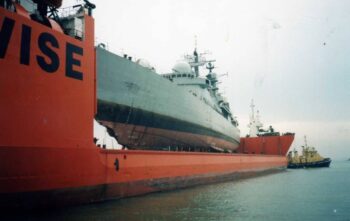
Nottingham was de-ammunitioned in Newcastle and towed to Sydney on 15 October. She was transferred to the heavy lifting ship MV Swan and arrived in UK on 9 December. One day short of two years after Nottingham ran aground, she returned to service (repairs cost A$98m). She was decommissioned on 28 March 2011.
Some of the images that I have seen of both the damage and the damage control efforts to save her are truly amazing. The crew did a fantastic job.