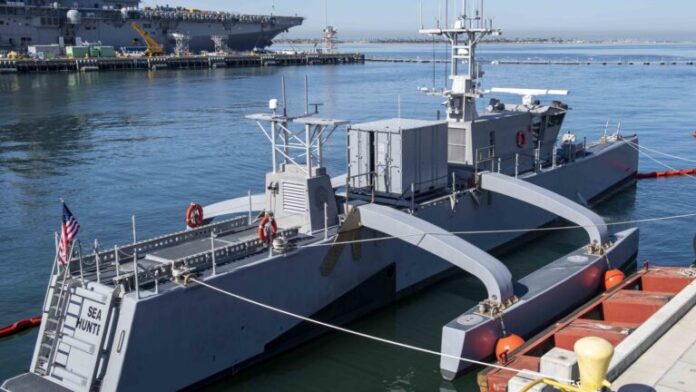
After rounds of prototyping, the US Navy is ready to deploy two of its medium-sized drone vessels this year and even integrate one with a carrier strike group, according to a service official, Breaking Defense reports.
Capt. Garrett Miller told the Surface Navy Association conference in Washington on Wednesday that the two drones — the Sea Hunter and Seahawk, dubbed medium displacement uncrewed surface vessels or MDUSVs — “will no longer be experimental vessels. They will actually be under fleet control, assigned to surface forces to be able to actually go out and do great things.”
Miller, the commodore of Surface Development Group One, said one of the drones would deploy with a carrier strike group in 2026, though he did not say which drone or group. (Defense News reported the drone in question is the Seahawk.)
Additionally, Miller said the Navy “next week” plans to stand up three “early command” USV divisions that can grow alongside the service’s foray into unmanned technologies. Eventually the Navy will have “operationalized USV squadrons in every fleet.” By 2027, Miller said the Navy expects to have 11 MDUSVs in its inventory, which should grow to over 30 by 2030.
Both manufactured by Leidos, the Seahawk and Sea Hunter have served as pathfinder prototypes in Navy exercises. The Sea Hunter came first under a DARPA program, developed as an unmanned sub tracker and sensing platform. Drawing lessons from the Sea Hunter, the Navy awarded a contract for the Seahawk in 2017, and the drone was delivered to the service in 2021.
Conrad Chun, Leidos Defense communications vice president, told Breaking Defense today the firm is “committed to delivering these dynamic capabilities to the Navy through our innovative unmanned surface vessels, underpinned by proven mission-ready Leidos Autonomous Vessel Architecture (LAVA) that has been validated through years of rigorous testing and real-world deployments.”
Navy officials say the uncrewed ships can bolster a range of maritime missions, from counter-mine activities to kinetic strikes and intelligence, surveillance and reconnaissance. Still, service representatives say work lies ahead for crafting specific concepts of operation.
Drones will constitute a considerable bulk of the Navy’s overall displacement in the coming years, including in the envisioned future Golden Fleet, though officials stress the uncrewed vessels will add to manned ships instead of replacing them. In a separate panel conversation on Thursday, Rear Adm. Christopher Alexander said the Navy anticipates an exponential growth of unmanned systems over the coming decades, mirroring a wider push by the Pentagon to harness drone technology.
“Looking at some projections moving out over the future, by 2045 we expect about 45 percent of the surface force to be unmanned systems,” Alexander, special assistant to the commander for naval surface forces at the US Pacific Fleet, told conference attendees.
“The future is now,” he added. “Unmanned systems, autonomous systems. AI, it’s not the future. It’s happening right now.”