Over the years Shiphandling Corner in the Journal of the Australian Naval Institute, offered cautionary navigation tales. In the July edition 1995 was a reprint of a 1977 article, written by ‘DHDS’, on one such incident that occurred at Frederick Reef (about 220 nautical miles northeast of Gladstone).
Frederick Reef
The Second World War was over and we were gliding gently back to civilization over the placid waters of the Pacific. It seemed a good idea to ‘keep clear of the putty’ by fixes from the lighthouse on Frederick Reef. But suddenly we had an uneasy feeling that all was not well…
Every year throughout the world hundreds of ships go aground; or in the polite naval way of phrasing it, “touch the bottom’. In every case there is subsequent heartburn and investigation, and often legal action, be it a Naval court martial or a civil damages claim, and eventually some sort of a reason for the grounding is arrived at to the satisfaction of the majority of those concerned.
The story I am about to tell is not one of a grounding. Consequently it never became public, and only three or four of the participants know the details, such as they were. In the art of navigation there are dozens of well tried principles. Additional lessons are always being learnt by navigators, but it is normally safe to generalise to the extent of saying that every situation begins with known facts. The only trouble is that sometimes the fact is wrong. So it was in this case. I tell this story because I think it holds a lesson which may be new to some seamen.
Necessary risks only
The middle watch is always a lengthy period in a ship by herself in the middle of an ocean. The middle watch of my story was no exception. In our destroyer, at the end of 1945, we were gratefully steaming away from the Pacific battleground after the completion of a successful war. In the preceding few years we had many times taken navigational risks in badly charted waters and got away with it. Our Captain was an able and reliable seaman, who, whilst taking these necessary risks, had always stuck by the rather sensible maxim of keeping as far away from the putty, as he put it, as he possibly could. This even gave rise to the invention of one or two nicknames for him which I shan’t record.
When the dust of Hiroshima had settled (which, incidentally, we had seen in the distance from the ship), there followed the peace and the occupation. In Tokyo we had wandered, with interest, through the desolated bombed ruins and had taken part in a victory parade at the British Embassy (miraculously still standing and still kept immaculately clean by the same caretaker who had looked after it for twenty years before the war). Now, with all this behind us, we were hurrying south through the Coral Sea with high hopes of being in port for Christmas. The Coral Sea, as every seaman who has been in that part of the world will confirm, is a dangerous place. Mostly the depth of the water is in the region of one or two thousand fathoms, but every now and again there suddenly rises from the sea bottom a towering mountain, atop which a coronet of coral has thrust itself to the surface, giving rise to the well-known lagoons and atolls of this area. The average atoll (I won’t say typical because no one case is the same as another) is therefore rather like the top of a submerged volcano. The rim either breaks the surface, forming little islets which may even have vegetation growing precariously in their sandy crevices, or lurks menacingly below the surface at a depth, one would think, designed especially to trap the unwary mariner. In places a deep channel may exist between the sunken reefs or the visible islets. Inside the rim the lagoons usually have sufficient depth of water for a ship to navigate, provided she dodges rocky outcrops and knows the way in and the way out.
Turtle and tea-fowl eggs
Quite good charts exist of the majority of the Coral Sea reefs, many of which reveal safe havens and anchorages. These plans, as one of the Admiralty charts explains, will, “with the help of a masthead lookout, enable a ship to round-to under the lee of the reefs where she may caulk topsides, set up rigging, and obtain turtle, fish and sea-fowl eggs. On some of the salient reefs, beacons have been erected and, for the sake of castaways, coconuts, shrubs, grasses and every description of seed likely to grow have been sown in the sparse soil to promote the superstructure; and it is most desirable that these refuge spots should be held sacred for universal benefit and not ruthlessly destroyed.
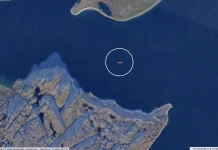
In latitude 21° 01′ 46″ South, longitude 154° 23′ 29″ East, there exists just such a coral atoll. This is Frederick Reef.
Oval in shape with the longer axis lying north and south, Frederick Reef is as near to being a typical coral atoll as one could wish. Right across the southern end, and halfway up the eastern side, the reef is just above the water. In the centre of the southern part, in fact, there is a small islet called Observatory Cay, which rises eleven feet above low water. The south-western part of the reef is called Danger Ridge, and here the reef varies in depth from five fathoms to nothing, with one or two rocks that just break the surface. Needless to say this area is labelled on the chart as an unsafe passage for ships. At the northern end of Danger Ridge, which is halfway up the western side of the atoll, lies Ridge Rock, over which the sea is always breaking, and northward of this the water deepens and is safe for ships. Halfway up the eastern side another safe entrance exists, but north of this, on the north-eastern corner of the atoll, the reef again rises to the surface and sand cays and rocks are just visible. At the northern part of the atoll, or the ‘top of the egg’, and in the whole of the lagoon inside, measuring about six miles by three, there is clear water with a depth of between ten and thirty fathoms. All round Frederick Reef the sea-bottom drops sharply away, down the steep-to sides of the sunken mountain, to depths of many hundreds and even thousands of fathoms.
We planned to keep clear
As we approached this lonely speck in the Coral Sea that middle watch, we had few worries and certainly no premonitions, for on the southwestern corner there existed an unwatched lighthouse which we knew we would see at least ten miles away. Our course was set to pass four miles to the west of this light, steering due south. Sure enough, the light was raised on time, and although we found as we approached that we would pass rather closer to the light than the planned four miles, the water was clear to the west of it and we were not worried. Being a dutiful officer of the watch I informed the Captain and the Navigator and the latter came up to the bridge. There we shared a cup of cocoa together as we watched the light draw nearer over the moonlit sea. By running fixes and later by a small radar contact, it soon became apparent that we would pass two miles to the west of the atoll.
At about this stage the Asdic Operator, whom we still had closed-up in case there were any Japanese submarines who had not heard that the war had ended, reported indications of a deep reef ahead. This interested me, but gave no cause for alarm even when he later reported that the reef was fairly shallow. Knowing that we were in deep water. I successfully persuaded myself, with the Navigator’s concurrence, that what was being picked up was a tidal eddy sweeping round the southern end of the reef across our path. Sure enough, as the light drew aft towards the beam we passed over the alleged sunken reef and were then certain that it was, in fact, tidal effect.
The night, as I have said earlier, was a brilliant moonlit one, and as the lighthouse came abeam to port we could even see the rocks and strips of sand on which it was constructed. One of the officers on the bridge commented at this stage that he thought the sea had become very calm. Admittedly there had only been a gentle swell and a light breeze previously, but the Navigator and I had to admit that even the swell seemed now to have departed. As the light drew abaft the beam, we knew that we were well clear of all dangers, because the light was situated on the extreme south-western corner of the southerly reef.
Imagine my surprise, therefore, when the Starboard Lookout awoke from his reverie to report, in a rather startled voice, his sighting of a small island broad on the starboard bow. Sure enough, at first glance it did appear to be a small island or rock, but knowing there was no rock there we persuaded ourselves successfully that it was a whale spouting on the surface. I should point out, perhaps, that the visibility to westward was not as good as in other quarters, and our supposition about this object can therefore perhaps be forgiven.
An odd effect
We have all read in meteorological books of that ‘uneasy feeling that all is not well’ that often attends the approach of a tropical revolving storm. This feeling, as many seamen know, also appears at other times. Perhaps it was a slight attack of this feeling that caused me to sweep the horizon a little more carefully through my binoculars at this stage (though, of course, I knew I would see nothing). The calm sea was producing many lines of light from the reflected moon, and right across the horizon directly ahead of us was one of these. As it drew nearer, however, I could not help likening it, as perhaps explorers in the Sahara have often done with mirages for which that desert is famous, to something more materialistic: in this case it looked for all the world like a reef!
We discussed this odd effect for a few minutes during which we were also busy in preparing our second cup of cocoa. When I again looked ahead through the binoculars, the uneasy feeling suddenly turned into one of early fright. Leaping into action I
(a) called the Captain and told him there seemed to be a reef ahead,
(b) ordered an operator to close up in the echo sounder (just, of course, to confirm that we were in deep water), and
(c) suggested to the Navigator that it looked as if we were on the point of discovering a hitherto unknown reef.
As the Captain appeared on the bridge, the mysterious broken water was by now only a few cable-lengths ahead, and there even seemed to me to be in the air around us that roar of breaking water that one always hears when close to a real reef in the open sea.
Hard a Starboard
The Captain, I think, felt much the same as I was beginning to do, and let loose in his best stentorian voice.
‘Hard a’starboard’.
‘Hard a’starboard, sir’ . The Navigator repeated the order almost gratefully down the voice pipe.
‘What’s the depth?’
‘Echo sounder just closing up, sir. No report yet’.
‘Show me the chart, pilot’. ‘Steer 240’. ‘240, sir’.
‘Bridge This is echo sounder’. ‘This is the bridge’. ‘No bottom at two thousand fathoms, sir’.
At this moment I was leaning over the port side of the bridge watching with horror the broken edge of a very realistic reef sweeping down along our port side at a range of about ten yards. Still no bottom with the echo sounder, so the Captain, after a quick examination of the chart with the Navigator, ordered the ship to resume her southerly course, and stumped off the bridge with a remark to the Navigator as he left. ‘Looks like you’ve found a new reef, pilot. See me in the morning about making a signal reporting it’.
Still slightly unnerved and troubled in our minds, the pilot and I discussed the odd phenomenon at some length, and eventually were equally divided in our minds on two possible answers. Firstly, that it was a new reef (but we could not quite believe that somebody had not seen it before); secondly, that our tidal eddies which had caused us some concern earlier in the watch, had grown to even bigger proportions under the influence of, perhaps, some subterranean volcanic disturbance. Anyway, all was well and the pilot trudged off to bed, leaving me to the loneliness of the Coral Sea.
Ten minutes later a white-faced apparition appeared silently at my elbow and motioned me to come to the chart table with him. Even in the moonlight I had to admit to myself that I had never seen the pilot look quite so ashen-faced or worried, even in the face of kamikaze suicide bombers or typhoons off the Japanese coast. Within half a minute I think my own face had probably assumed the same hue and for the rest of that night, even after I had left the bridge on being relieved at four o’clock, I found my imagination playing over a vast array of frightening possibilities.
On the mat
At 0830 sharp the following morning the pilot presented himself nervously at the Captain’s door.
‘Yes, pilot. Come in. I suppose we’d better get that signal away about the reef. Is that what you came to see me about?’
‘Well. . . er . . . Yes, sir.’
‘Right. Let’s see what you propose.’
‘Well… er. . . Sir, you see . . . it’s like this.’
‘Well? Come on, come on.’
‘Well, sir, I don’t think we ought to make a signal.’
‘Good God, why not? That was definitely a reef and we don’t want some other poor blighter to go up on it!’
‘No, sir. But. .. well… you see … I found a notice to mariners last night after you turned in…’
‘Well, what was it?’
It’s one I seem to have missed, sir. It appears they’ve moved the light on Frederick Reef from the southwestern corner to the north-eastern corner. We must have gone right down the centre of the lagoon and, as far as I can see, we went out over Danger Ridge in between that rock there, and this rock here, with about a yard to spare each side, and a foot or two underneath.’
There was silence for a few moments, although no doubt the pilot felt that the knocking of his knees was readily audible.
‘Hmmm. Well … All right, pilot, it looks as if we were lucky, but now perhaps you realise why I never like going too close to the putty!’
D.H.D.S.
Postscript
For those readers unfamiliar with Notice to Mariners (NTM), in the paper chart days, Navigation Yeomen in big ships and navigators in minor war vessels would await each mail bag for any NTM that would affect charts in their held folios. Pen and ink corrections would be made to charts, or even new sections pasted on to existing charts. The NTM could involve a wide array of matters, such as changes to navigation marks, newly reported rocks or depth corrections. The corrections once made would be carefully annotated on the chart and in a log for subsequent inspection. New printings of charts would incorporate the NTM changes.
In the early 1980s, when the Fremantle class patrol boats entered service with Satnav and high fidelity Krupp Atlas echo sounders, there was a marked increase in small ships providing suggested corrections through Hydrographic Notes to the Hydrographer. This was particularly the case in northern waters where there was ample scope to improve on some quite old surveys.
About the Author
‘DHDS’ was Commodore Dacre Henry Deudraeth Smyth, AO RAN (1923 –2008). He was born in London and his father was General Sir Nevill Smyth, who was awarded a Victoria Cross from the Battle of Omdurman in Sudan in 1898. He was considered unlucky not to have been awarded a second VC during the Boer War. He went on to command the First Australian Brigade at Gallipoli and in 1916, the Second Australian Division. His links to Australians led him to emigrate with his family in 1925 and settle at the merino sheep farm Kongbool, near Balmoral in Victoria’s Western District.
Dacre’s father’s first cousin, Lord Robert Stephen Smyth Baden-Powell, a hero of the 217-day siege of Mafeking in the Second Boer War and later founded the Boy Scout movement.
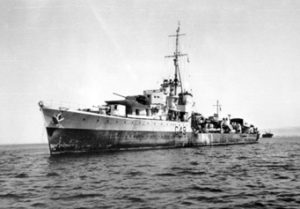
Dacre Smyth joined the RAN in September 1940 as a Special Entry Cadet Midshipman at the Royal Australian Naval College. He had a most varied wartime service. It included two postings to the heavy cruiser HMAS Australia, the first included the Battle of the Coral Sea and the latter some early bombardments in the SW Pacific campaign. In European waters he served in motor torpedo boats, and in the cruiser HMS Danae for the Normandy landings. In 1944 he returned to the war against Japan by joining the destroyer HMAS Norman (the destroyer in the above article) in the Indian Ocean. Norman, under the command of Captain Herbert James Buchanan, would serve with the British Pacific Fleet in operations off Japan.
In the post war Dacre Smyth commanded the corvette Latrobe, the frigate HMAS Hawkesbury, RANC, the oiler HMAS Supply and finally HMAS Cerberus (and was also NOC VIC)
Notably, Dacre Smyth was both a published poet and an accomplished marine artist. Some of works still grace the walls of RAN wardrooms ashore