
By Tom Sharpe*
Submariners are a bit odd. They won’t mind me saying this because they know it too. To even contemplate working and living underwater packed into a pressure hull with 100+ sailors, huge amounts of high explosives and a nuclear reactor, you have to be an outlier. You need to be able to overcome boredom, fear and separation from all normal society to abnormal levels.
Not being bothered about fresh air, or fresh clothes, helps. As does not being upset if you’re unable to see out. Intense, complex and “unusual” company ashore, submariners are a bit like Royal Marines in many respects – you don’t need to understand how they work, but you are always glad they’re on our side.
And so, now at Christmas-New Year, it seems fitting to acknowledge the ship’s company of our nuclear ballistic missile submarine at sea right now – allowing us to sleep peacefully and enjoy the festive season without fear because these rough and ready individuals stand ready to unleash Armageddon on our behalf.
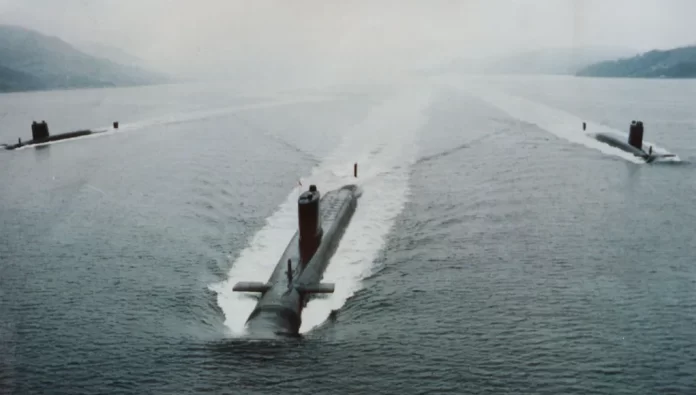
One such British submarine – they are colloquially known as “bombers” in the Royal Navy, “boomers” in the USN – has been continuously at sea ever since 1969, silently providing the first and last line of defence for our country. First it was the four Resolution-class boats, paving the way. The current four Vanguards took over the watch in the 1990s, and now the Dreadnought class are in build to replace them, albeit very late.
These boats creep around (I think they prefer the term “patrol”) at very slow speed doing everything in their considerable power to avoid detection. The fact that our enemies cannot know where they are provides our nation’s assured nuclear second strike option and will continue to do so until a better option comes along, a technology emerges that makes them detectable or we all hold hands and disarm. None of these things are likely anytime soon. Not to go into deterrence theory but the bombers are arguably the most used and effective weapon system of the modern era, despite never having fired their weapons in anger. Which is the point. You might not like them, but you cannot argue that the effect they have is powerful. It doesn’t even cost much – not when you compare it to something actually expensive like the NHS or the welfare state.
Over the course of the year, I have spoken to a lot of submariners about various subjects – it has been an interesting year for them. Some I spoke to had service in bombers and some have been involved in the recent almost incredibly long deterrent patrols forced upon the system by the decaying support and maintenance infrastructure of the nuclear enterprise.
To give you an idea, R-boat patrols were typically 60-90 days long. You’re still saying goodbye to your friends and family for three months at a time – tuck that away – but it was manageable. Towards the end of that time, because the Vanguard class replacements were late, these patrols were extended. HMS Resolution set a record in 1991 with a patrol lasting 108 days.
I remember early in my career the angst over the psychological effect this would have on those sailors and senior officers muttering, “never again”. Yet here we are, 34 years on, and the Dreadnoughts are (very) late, so the V boats are being asked to do over 200 days on patrol: double the amount previously determined to be unacceptable. That is 200 days submerged in a nuclear propelled steel tube, surrounded by the ocean at such a depth and pressure as to be fatal if the tube should fail, with less connectivity to the outside world – much less – than an astronaut. The predictability and sloppiness that led us here – all over again – makes me bloody angry if I let it.
Deploying is part of Navy life, of course. In the surface fleet, I spent nearly 70 per cent of my 18 years in ships away from base port. In the early 90s, I could at least write home and queue for the pay phone on the jetty. The only challenge was getting those things done before ending up in the local pub. Then mobile phones became ubiquitous as did internet connectivity. Now, of course, ships have the internet at sea – the expectation of connectivity is such a feature of modern life that removing it, which you sometimes have to for operational reasons, is a problem.
Submariners, however, almost never have it. In fact, they have protocols for their mobile phones which I won’t go into, but suffice to say they don’t work onboard and involve a factory reset on return from patrol. You can see why there isn’t a huge queue to join the Silent Service and why a few that do decide to join wind up leaving pretty quickly.
Messages to the boat from loved ones are limited to 120 words a week once or two times 60 a week. That’s the length of this paragraph. Those are your choices. The boat relies entirely on low-frequency communications to receive them and the bandwidth is such that literally every character counts. Needless to say, the submariners can’t reply to the messages they get
Here are examples of past familygrams I’ve been supplied with:
BROKE HAND WHILE DRIVING, NOT MY FAULT. FAINTED, SOMEHOW DIDN’T CRASH. CHILDREN FINE. DON’T WORRY, CAST OFF IN 6 WEEKS. I’LL MANAGE. BOUGHT A DOG.
THANK YOU WE LOVE YOU SO MUCH GOT LOTS OF PLANS FOR WHEN YOURE BACK SO PROUD OF YOU KEEP GOING XXXXX
The messages are all vetted. It now becomes the Captain’s responsibility to determine what gets seen by the recipient. By and large, the messages fall into three main categories: loving ones between a young or new couple, more administrative ones from the established marriage or partnership, often with an update on the children, and finally those from others such as parents or siblings, updating on news or football scores.
There is a fourth category where the Captain’s judgment is required: births and deaths. There are no rules on this; it’s up to the CO to decide if that person knowing that information is in the interests of the mission and – in second place – the interests of the individuals concerned.
A deterrent sub can’t even come up to periscope depth, much less surface to get someone off as both give your position away – the one thing you must avoid. Everyone on board understands this, but that doesn’t make it any easier to manage. I understand that births are routinely passed on, but deaths are not. It’s as bleak as this: “there’s nothing we can do about it, so why know?”
Imagine having to a) make that decision and then b) sit on it for months. You’d better be good at compartmentalising stuff. And the person concerned may need to reach deep for forgiveness when the time comes.
Now flip it and look at all this from the partner’s perspective. You’ve just waved goodbye to your loved one for six months, knowing that to all intents and purposes, you are now on your own, even if something dreadful (or amazing) happens. Submariners spend time preparing themselves for this; partners do not, and yet are expected to manage. Officers’ wives feel this acutely as they are instinctively expected to help other wives, which as a notion is as dated as it is unreasonable. But it happens nonetheless. It gets particularly difficult over Christmas as you are bombarded by happy family adverts and messaging. There isn’t anyone in the Navy who doesn’t watch celebrities howling in the jungle over a message from their family – having been away for about four days – without smiling wryly to themselves.
There is one ironic positive here. At least partners can be sure that those in a submarine are having a miserable time. The Christmases I spent away from home were, all bar one, alongside in harbour, often somewhere quite nice. Saying you have to cut your loving family call short because the beach barbecue has started (when they can hear the music) isn’t helpful. Submariners’ partners at least don’t have to put up with that! Swings and roundabouts…
Here are a few thoughts that deterrent submariners’ wives have sent me:
“I don’t make it easy for my husband. His extensive to do list before he deploys covers me for every conceivable eventuality.”
“I honestly don’t know how those of us who stay behind get through it. Not knowing where your loved one is, what they’re doing, how they are or when they’re even likely to be back is, for most people, incomprehensible.”
“About a month before deployment I prove to myself and to my husband that I am independent and invincible. The barriers come up and very rarely do I allow myself to think about the days, weeks and months that lie ahead. The goodbyes are painful. Too painful for words. We would love more than anything else to hold our loved ones close and stop the clock, but all too often we say a quick ‘see you soon’ and that has to do. And then it’s all about time. Seasons change and people say things like ‘time’s flying’ and ‘he’ll be home before you know it’… these comments are never received well but I just politely agree. It’s easier.”
Back on patrol, the captain has two choices on Christmas day itself. Blast through it like it’s just another day or at least try and make it into something different. Most defer to the latter. This might just be the naval tradition of the officers serving lunch to the ratings. It might involve some sort of fancy dress, which, as with Royal Marines, it’s best not to think about too closely. One boat had video messages from home, pre-recorded in secret, and revealed on the day. Again, this is a mixed blessing. Lovely, but you also risk popping the bubble you’ve built to help you get through the abnormality of it all. There will often be escape committees, pantomimes and carols. The chefs invariably play a blinder, producing quantities of food which no one is quite sure where it’s come from.
Operationally at Christmas, you get a sense on board that everything ashore is quiet. The periodicity of operational messages decreases as headquarters and support teams reduce to the minimum staff. You have to remain focused despite this – the enemy doesn’t care that it’s Christmas, and might even seek to exploit it, so whatever it is you do to relax on the day, this has to be kept in mind. Like everything else, it’s a balancing act.
You do get a message from the Prime Minister which the captain then reads out on the main broadcast. This is a nice touch, but probably one of those things where the author might not want to hear what’s being said in response. Of course, the captain already has a letter from the PM sealed in his safe to be opened in the event of the unimaginable. Drafting the so-called “letter of last resort” is the first duty on assuming the office of PM, and anecdotally, the gravitas of what they have just been asked to articulate has made some go pale. It does make you wonder why politicians haven’t then resourced the deterrent properly over the years – in particular Prime Minister Cameron’s decision to postpone the Dreadnought class by five years directly contributed to the hardship patrols of today – but that’s for another time.
The boat that is on patrol today will be managing all this, and so will the partners ashore, whilst counting down to “day zero”, the name given to the return date. The partners don’t manage this bit because for reasons of operational security, they don’t know when it is.
Recent “day zeros” have been notable for a couple of things. First, the VIP attention they have garnered. This is a mixed blessing for those onboard who do appreciate the recognition, but don’t necessarily want to have to clean the boat from top to bottom. Second, one boat had been at sea for so long, presumably in shallow/warm water, she had changed colour from black to an off greenish brown with marine growth. I had hoped that having the PM and Defence Secretary greeting a submarine that had been on patrol so long it had changed colour would prompt a shift in attitude to Defence spending. In fact some work is going into improving the nuclear enterprise but as ever, it’s too little too late. More generally, the lack of seriousness Defence receives from No 10 leads me to have some quite un-Christmassy thoughts, so I’ll leave it there.
For now, on a more positive note, I say we should all raise a glass, say a prayer, lift our hats or just quietly recognise the men and women who sustain this remarkable effort. In the tradition of military banter, I called them weird at the top, but what I really meant was special. They are special, and we should be grateful for those who sacrifice so much to guard us while we sleep. Let’s give thanks for another year of service from our unseen, ever watchful guardians.
The commitment happens all year round, but Christmas has a way of bringing these things into sharp focus. It certainly does for the partners and families left behind, living with a peculiar mix of pride, resilience and uncertainty and all the while, unable to communicate any more than a paragraph once a week – and that with nothing ever heard back until journeys’ end, as you might expect, from the men and women of the Silent Service.
*Tom Sharpe served as a Royal Navy officer for 27 years, commanding four different warships. His primary specialism was anti-air warfare.
This article fist appeared in the Telegraph and is republished with the author’s permission.