By Ed Offley*
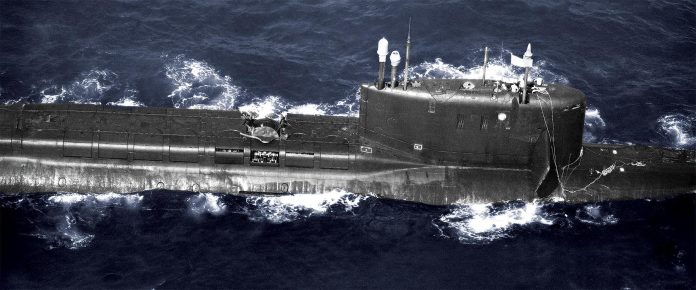
It was a submariner’s ultimate nightmare come to life. A massive explosion ripped through the Yankee I–class submarine K-219, tearing open one of her 16 missile tubes. The force of the explosion—which occurred when liquid nitrogen tetroxide propellant came into contact with seawater—blew off the tube’s hatch and ejected a shattered SS-N-6 “Serb” missile and its two nuclear warheads into the sea. A toxic torrent of seawater, nitric acid, and plutonium fragments thundered into the belly of the missile compartment. (From: The US Naval Institute.)
Within minutes, the 425-foot-long submarine was falling out of control toward her “crush depth,” where the hydrostatic pressure of the sea would overcome the submarine’s steel pressure hull. Only by blowing all the ballast tanks did Captain Second Rank Igor A. Britanov halt the unplanned dive at 1,250 feet. The submarine shot to the surface of the Atlantic.
K-219’s 90-day deployment to her assigned “patrol box” around 600 miles northeast of Bermuda had come to a sudden halt at 0538 hours Moscow Time on Friday, 3 October 1986. But the crisis was only beginning.1
Cold War at Sea
The decades-long Cold War between the United States and Soviet Union was still going strong in the fall of 1986. NATO and Warsaw Pact armies confronted one another across a divided Europe. Missile launch teams from the American plains to Ukraine and Russia manned their underground launch control centers around the clock in anticipation of orders no one wanted to receive. And at sea, both sides deployed ballistic-missile submarines armed with thermonuclear warheads and dispatched nuclear-powered fast-attack submarines to hunt and shadow their adversary’s “boomers.”
That dangerous stand-off had come under renewed strain beginning in the mid-1970s—not at sea, but on land—when the Soviets deployed multiple-warhead SS-20 ballistic missiles that could reach targets throughout Western Europe in a matter of minutes. In response, the United States in the early 1980s began deploying Pershing II missiles and ground-launched Tomahawk cruise missiles to Western Europe that could do the same to the Soviet Union and its allies.2
Each side now had the capability of firing missiles that could decapitate its adversary’s government and key military targets. This exacerbated the existing threat to the United States posed by the Soviet Union’s Yankee- and Delta-class ballistic-missile submarines that for nearly two decades had patrolled the Atlantic east of Bermuda. Each submarine’s 16 missiles, when fired in a depressed trajectory, could strike military targets from Groton, Connecticut, to Kings Bay, Georgia—including Washington, D.C.—in just 12 minutes.3
But in one regard, the Soviet submarine force was at a grave disadvantage. The U.S. Navy had employed solid-fuel submarine-launched missiles since the advent of the Polaris submarine force in 1960. A quarter-century later, the Soviets were still using liquid-fueled SS-N-6 Serb and SS-N-8 Sawfly missiles on their Yankee and Delta boats, respectively. The single-stage Serb contained separate fuel tanks loaded with nitrogen tetroxide and hydrazine. When brought into contact, the two elements exploded, creating the fiery thrust that could propel the 15-ton missile and its two nuclear warheads more than 1,300 miles. The nitrogen tetroxide also exploded on contact with seawater, forming dangerously poisonous nitric acid fumes. It was an exceptionally volatile and deadly cargo.4
A Strained Submarine Force
When K-219 backed away from the pier at the Gadzhiyevo submarine base northwest of Murmansk on 3 September 1986, she was in her 15th year of operational service but was still considered a frontline strategic missile submarine. There were newer submarines—34 Delta class and four Typhoon class—also conducting strategic patrols, but the Yankee class was still patrolling at sea. Her 118 officers and crewmen were considered among the elite of the Soviet Navy. But there were serious problems confronting the force.
As Captain First Rank Igor Kurdin, a former executive officer of K-219, described it, “The limitations of Soviet military finances, and the continual, demanding requirements of increasingly frequent submarine patrols and deployments during the Cold War, literally stretched the submarine force to the breaking point.”
In their 2005 article in Undersea Warfare, Kurdin and U.S. Navy Lieutenant Commander Wayne Grasdock asserted that K-219’s ill-fated 1986 patrol was symbolic of the strains and pressures faced by Soviet submariners at that juncture of the Cold War—specifically, the Soviet Navy’s response to the deployment of the Pershing II and cruise missiles to Europe.
Although Britanov was an experienced submarine commander, he was not taking his usual submarine out to sea. Moreover, his crew included several dozen newcomers hastily transferred to fill the complement of 31 officers, 38 warrant officers, and 49 seamen. Predeployment training, Kurdin added, had been “chaotic.”
The number of military patrols for [Yankee-class submarines] rose to two [to] three times per year. Technical resources reached the limit of their capabilities, and the repair base was far from adequate for the fleet’s new tasks. . . . Under the pressure of these conditions, senior commanders had to close their eyes to the fact that non-proficient crews were going out to sea on alien boats.5
Throughout the Cold War, the Soviet submarine force had experienced numerous accidents. The loss of the Golf II–class diesel-electric missile submarine K-129 and her 98-man crew on 8 March 1968 occurred after a mysterious explosion while on patrol in the North Pacific. The November-class attack submarine K-8 and 52 of her 125-man crew were lost on 12 April 1970 in the Bay of Biscay when the boat foundered while under tow after a major fire. On 24 May 1968, nine sailors suffered fatal levels of radiation exposure on board K-27, which was scuttled in 1982 in the Kara Sea.

Deadly Fumes
The explosion in Missile Silo 6—the third silo on the port side—was not a solitary event. Several minutes before the blast, a loud alarm went off warning the crew that deadly nitric acid fumes were accumulating inside the missile tube. “Allow water and oxidizer to mix in sufficient quantity and you had a powerful, poisonous acid that could cut through nearly anything. Wires, seals, even the aluminum body of the missile itself,” Kurdin and his two coauthors wrote in Hostile Waters, a history of the incident. “That’s when a problem could turn into a catastrophe.”
Even as Britanov and the maneuvering watch were struggling to save K-219 from plunging below crush depth, the threat that would ultimately doom the submarine was emerging from the toxic water accumulating on the lower level of the missile compartment—Compartment 4. Choking nitric acid fumes began filling the massive compartment. Two sailors and the submarine’s weapons officer quickly succumbed as the toxic gas seared their lungs, which filled with thick mucus that suffocated them.
Britanov ordered the compartment evacuated. Crewmen hurried aft into Compartments 5 (aft missile compartment), 6 (auxiliary machinery), and 7 (reactors), slamming the hatches shut.6
The Word Gets Out
News of the unfolding crisis rocketed up the chain of command on both sides. The Los Angeles–class attack submarine USS Augusta (SSN-710) had been shadowing K-219 since she passed over the hydrophone arrays of the Atlantic sound surveillance system several weeks earlier. An hour after the explosion that nearly deafened the Augusta’s sonar operators, Commander James D. von Suskil sent a “FLASH/CRITIC” message to Atlantic Submarine Force headquarters in Norfolk:
CONTACT SUFFERED MAJOR UNEXPLAINED EXPLOSION. CONTACT ON SURFACE FIGHTING FIRES AND FLOODING. AM STANDING CLEAR OF CRITICAL ZONE PENDING FURTHER ORDERS UNODIR [unless otherwise directed] WILL MAINTAIN COVERT SURVEILLANCE—CAESAR7
Commander, Submarine Force Atlantic, did not share this bulletin with the rest of the Navy. The Atlantic Fleet and Pentagon would not learn of K-219’s accident until nine hours later, when an officer at the Fleet Ocean Surveillance Information Center in Norfolk saw that three Soviet-flag merchant ships from as far away as the Gulf of Mexico and Halifax, Nova Scotia, had just made radical course changes and were headed toward K-219’s plotted location.
Soviet leaders also had heard the grim news. Once safely on the surface, Britanov quickly ordered a flash message sent in the clear to headquarters, and within an hour it was in the hands of Admiral of the Fleet Vladimir Chernavin, commander-in-chief of the Soviet Navy. In a stark departure from previous Soviet responses to major accidents, General Secretary of the Communist Party Mikhail Gorbachev directed that the U.S. government, Warsaw Pact capitals, and the news media be informed of the incident. This remarkable turnaround from long-standing Soviet silence stemmed in great part from the massive nuclear emergency that had struck the Chernobyl Nuclear Power Station five months earlier on 26 April. In that earlier incident—which scientists later said released 400 times more radioactive material than at Hiroshima—Moscow had waited two days until acknowledging the explosion and release of radioactivity and even then downplayed its effects.8

Alerted by the Navy, President Ronald Reagan canceled a weekend at Camp David and flew back to monitor the crisis from the White House. The Navy dispatched several P-3 Orion patrol planes to complement the Augusta’s covert surveillance.
A Chernobyl at Sea
While naval staffs in Norfolk and Moscow struggled to comprehend what was happening out in the Atlantic, Britanov and his crew were being relentlessly attacked by the nitric acid permeating K-219. Attempts to isolate the poison were proving futile because the gas rapidly destroyed the rubber hatch seals. Within an hour of the mishap, crewmen were reporting brown nitric acid fumes as far aft as Compartment 7, containing two 90-megawatt OK-700 pressurized water reactors. In addition, a survey inspection of the missile compartment by sailors wearing oxygen breathing gear discovered a fire burning out of control in the lower level.
Engineer Seaman Sergei Preminin, 20, was sitting at the aft reactor control station in Compartment 6 alongside Senior Lieutenant Nikolai Belikov when word came that the nitric fumes had just reached the compartment immediately forward of them. The pair unhooked their masks from the oxygen line in Compartment 6, attached them to their portable oxygen breathing apparatus (OBA) canisters, and retreated to Compartment 8 (the main turbines), where 60 crewmen—including 14 unconscious and 3 dead—were already sheltering.

Then the reactor overheat alarm went off in a deafening shriek. Minutes later, Britanov’s chief engineer informed him the reactor controls and instruments in Compartment 2 forward of the control room had all failed, probably because of the fire amidships. Returning to the aft control station, Belikov reported the gauges for both OK-700 reactors showed failing coolant flow through the VM-4 cores; the internal fission temperatures in both were rising to dangerous levels.
K-219 now faced a threat even deadlier than a missile explosion. As former Executive Officer Kurdin and his coauthors described it, a “China syndrome” meltdown of the uranium cores “could eat right through the reactor vessel, burn through the bottom of the submarine, and then, when the mass of glowing hot slag hit cold water, explode in a fireball of radioactive steam.” In addition to destroying the submarine, this would unleash a major plume of radioactive contamination into the Gulf Stream.
The Last-Gasp Effort
Captain Britanov ordered Belikov and Preminin to carry out a dangerous, last-gasp effort to prevent such a fireball: Enter the locked, closed lower compartment housing the two reactors and shut them down by releasing four “quench baffles” into each core that would suppress the runaway fission reaction. Belikov told Preminin he would make the first attempt, adding, “If I can’t get all the baffles down, you’ll have to finish it.”
Donning a lead-lined radiation suit and OBA mask, the lieutenant entered Compartment 7. Belikov climbed down the ladder to the lower level and wrenched open a tiny hatch to the reactor space. The temperature inside was already 180 degrees Fahrenheit and climbing. Belikov stepped up to the starboard reactor and threw the release handle. Nothing happened.
He shouted over the intercom to the chief engineer in Compartment 2 that the release mechanism was jammed and they would have to lower the baffles manually. He inserted a large wrench handle into the first of four hexagonal sockets on the top of the starboard reactor vessel. Using all his strength, Belikov managed to partially seat the first baffle, then noticed his OBA canister was empty. Staggering like a drunk, he climbed through the access hatch, mounted the ladder, and staggered aft to Compartment 8. When the hatch opened, he fell unconscious at Preminin’s feet.
Preminin donned his silver antiradiation suit and mask and retrieved the wrench as Belikov, recovering, got to his feet. The two men entered Compartment 7 and descended the ladder. While Belikov waited in the outer compartment, Preminin climbed through into the reactor space, where he completed lowering the first baffle. He then slowly worked his way through the second and third. He began turning the fourth but collapsed on the deck. Sweat seeping out from his face mask instantly flashed into steam. Belikov climbed through the hatch and managed to complete lowering the fourth baffle, then realized his OBA again was out of air. Somehow, Belikov managed to help Preminin out of the hellish heat, up the ladder, and back to Compartment 8. Both collapsed.
Britanov urgently implored the men in Compartment 8 to shut down the second reactor, but he was told there were only two full oxygen canisters remaining. To everyone’s surprise, Preminin got to his feet, gazing at the still-unconscious Belikov, and said, “I’ll go.”
When he opened the hatch to Compartment 7, the heat was not the only thing assaulting his senses. He could smell the bitter scent of fuming nitric acid. He also felt the squeeze of air pressure coming from the heat and a broken steam line. He stepped up to the reactor control gauges and swept them with his emergency lantern. The gauges showed zero coolant flow in either VM-4 core, although the temperature in the first reactor was beginning to drop.
Grabbing the kashtan microphone, he reported, “Captain? This is Seaman Preminin. I’m in the local reactor control area in seven. I’m going in.”
“You can do it, Sergei,” Britanov replied.
Reaching the access hatch, Preminin unbolted it. The pressure inside the reactor space was by now so high the hatch blew open and slammed against the bulkhead. He climbed into the inferno. Somehow, he found the strength to attach the wrench and turn the handle around and around as each baffle slowly descended into the uranium core. Suddenly gasping, he noticed the first OBA cannister was out of air. He carefully removed it and attached the last one to his air tube. Attacking the fourth and last baffle, he ignored the stabbing pain in his throat and leaned into the wrench.
In the control room, Britanov waited for what seemed an eternity before a faint voice came over the loudspeaker. “Comrade Commander . . . Captain, the reactors are secured.”
A Hero’s Death
Britanov ordered a flash message sent to naval headquarters in the clear that the two VM-4 reactor cores were secure. General Secretary Gorbachev was notified in minutes. So, too, was President Reagan in the White House, thanks to an EP-3E Aries II reconnaissance aircraft overhead K-219 that intercepted, translated, and forwarded Britanov’s text.9
Sergei Preminin’s bravery and valor spared the world from a Chernobyl-like nuclear disaster in the North Atlantic. However, K-219’s ordeal was not over. With the arrival of the three Soviet-flagged vessels, Britanov transferred most of the 114 surviving crewmen to the freighter Yaroslavl and attempted to rig a towline for the improbable job of a several-thousand-mile journey back to Gadzhiyevo. The task became impossible when the crew still on board the submarine ran out of OBA canisters and flooding slowly overcame the boat’s remaining buoyancy. On 6 October 1986, K-219 fell 18,000 feet to the Hatteras Abyssal Plain.
The K-219 incident began and ended with submarine collisions—one fictional and the other acknowledged. The Kremlin initially accused the nearby Augusta of colliding with K-219 and causing the fatal explosion, but Captain Britanov later forcefully denied it. Shortly after K-219 sank, the Augusta did collide with a Delta-class missile boat nearby, causing $2.7 million in damage to her sonar dome.10
K-219’s crew had a brief interlude after surviving the crisis. Traveling on board the Soviet ship to Cuba, they enjoyed several weeks of recovery before being flown back to Moscow. An unsympathetic Soviet Defense Minister Sergei Sokolov warned Captain Britanov and his chief engineer that they faced possible charges of negligence and a prison sentence of up to 20 years. Reprieve came when Sokolov was fired after West German teenager Mathias Rust on 28 May 1987 was able to fly his Cessna 172 from Finland to Russia, landing near Red Square. Sokolov’s successor, Dmitri Yazov, overturned the criminal investigation and even praised the actions of Britanov and his crew as “blameless and positive in nature.”11
Five days after the sinking, Reagan and Gorbachev met in Reykjavik, Iceland, for a planned summit to discuss nuclear disarmament. While the two-day talks collapsed without an agreement, the summit set the stage for the successful 1987 Intermediate-Range Nuclear Forces Treaty that removed the SS-20, Pershing, and GLCM missiles from deployment.
Four crewmen from K-219 never came home. When she sank, the submarine bore with her the bodies of the three sailors killed in the aftermath of the silo explosion and the body of Engineer Seaman Sergei Preminin.
Having secured the two VM-4 reactor cores, Preminin had returned to the Compartment 8 hatch, only to find the air pressure spike in the reactor space had sealed it beyond the ability of anyone to overcome. Compartment 7, the scene of his heroism, also became his tomb.
1. CAPT Peter Huchthausen, USN (Ret.), Capt 1st Rank Igor Kurdin, VMF (Ret.), and R. Alan White, Hostile Waters (New York: St. Martin’s Press, 1997).
2. John T. Correll, “The Euromissile Showdown,” Air & Space Forces Magazine, 1 February 2020.
3. Siegfried Breyer and Norman Polmar, Guide to the Soviet Navy (Annapolis, MD: Naval Institute Press, 1977), 124–27; and Huchthausen, Kurdin, and White, Hostile Waters, 68, 144.
4. “The Missile Defense Project,” Center for Strategic and International Studies, csis.org/programs/missile-defense-project.
5. Capt 1st Rank Igor Kurdin, VMF, and LCDR Wayne Grasdock, USN, “Loss of a Yankee SSBN,” Undersea Warfare 7, no. 6 (Fall 2005).
6. Huchthausen, Kurdin, and White, Hostile Waters, 79–82.
7. Huchthausen, Kurdin, and White, 98.
8. Huchthausen, Kurdin, and White, 111–14; and National Security Archive, “Session of the Politburo of the CC CPSU,” trans. and declassified by the CIA, 6 October 1986.
9. Huchthausen, Kurdin, and White, Hostile Waters, 125–38, 149–57.
10. William Arkin and Joshua Handler, Neptune Paper No. 3: Naval Accidents 1945–1988(Washington DC: Greenpeace, 1989).
11. Huchthausen, Kurdin, and White, 280–81.